
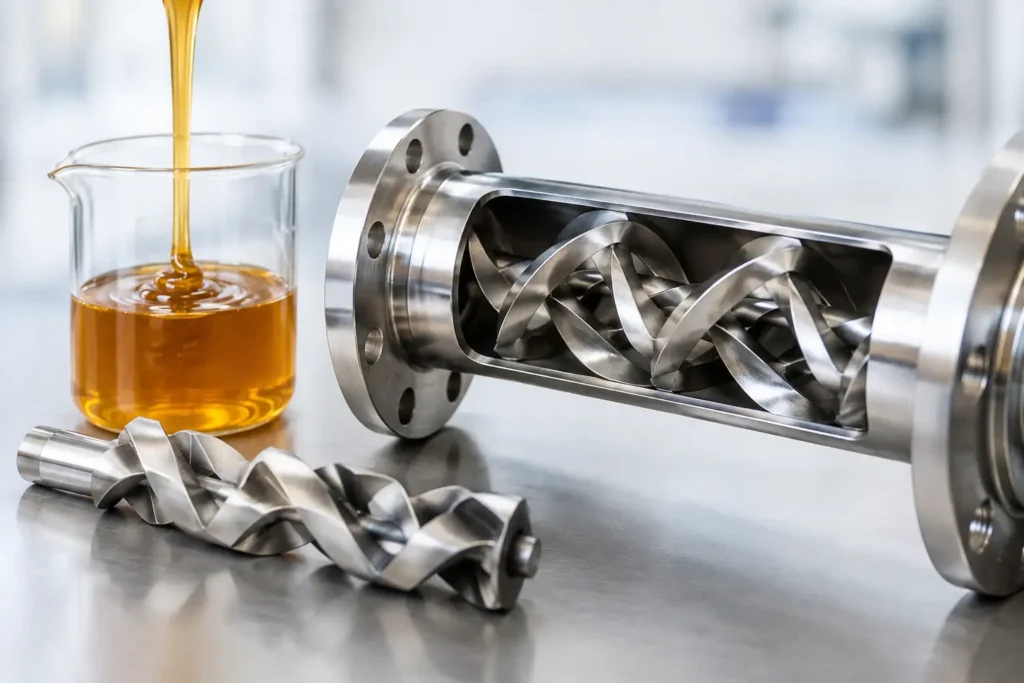
A thick resin, polymer solution, slurry, syrup, or high-solids chemical can move through a pipe with a deceptively calm profile. That calm profile is exactly why a static mixer for viscous liquids must be selected with more care than a general-purpose inline mixer. At low Reynolds numbers, the fluid does not naturally churn across the pipe. It travels in organized layers, and an additive introduced near the wall can remain near the wall long after the injection point.
A properly engineered static mixer divides those layers, redirects them, and recombines them repeatedly without motors, shafts, seals, or a separate power supply. The objective is not simply to create turbulence. In many viscous applications, turbulence is unavailable or undesirable. The objective is controlled distributive mixing, with enough element geometry and pressure energy to produce a repeatable blend at the required flow rate.
Why Viscous Liquids Need a Different Mixing Approach
Viscosity changes the physics inside the line. Water-like fluids can often develop turbulent eddies that help distribute a chemical, colorant, catalyst, or second liquid. Highly viscous fluids commonly operate in laminar flow, where radial movement is limited and molecular diffusion may be too slow to finish the job within the available pipe length.
Static mixing elements solve this problem by continuously splitting the flowing material into smaller streams and changing their position within the pipe. Each element increases interfacial area between the incoming components. Successive elements reduce the scale of unmixed layers until the process reaches the required uniformity.
That mechanism makes static mixing especially useful where a plant needs consistent additive distribution but cannot justify the footprint, maintenance, or residence time of a tank mixer. It is commonly applied to adhesive formulations, lubricants, coatings, polymer processing, food products, personal-care materials, wastewater chemicals, and high-viscosity chemical injection services.
The limitation is equally important: the mixer uses pressure drop as its energy source. Higher viscosity, greater flow, more restrictive geometry, and additional elements all increase the pressure required to move product through the assembly. The best design is therefore not the mixer with the most elements. It is the design that reaches the required mixing quality within the available pressure-drop budget.
Selecting a Static Mixer for Viscous Liquids
Start with real process data
A useful selection begins with operating data, not just pipe size. The process team should define the viscosity of every stream at actual operating temperature, including expected minimum and maximum values. A product that is manageable at 140°F may become dramatically more resistant to flow during startup at 70°F.
Flow rate matters in the same way. Static mixers are designed around a flow window, and a unit that performs well at normal production rate may provide less mixing when the line is throttled back. For batch-to-continuous transitions, seasonal viscosity changes, or variable-speed pumping, the turndown range should be evaluated early.
The most relevant application inputs generally include:
- Main-stream and injected-stream flow rates
- Viscosity, density, and temperature of each component
- Pipe inside diameter and available straight-run length
- Allowable pressure drop across the mixer
- Required blend uniformity or concentration tolerance
- Solids content, particle size, and risk of fouling
- Chemical compatibility, cleaning method, and connection requirements
This information allows an engineering team to estimate Reynolds number, pressure loss, required element count, and whether the application needs distributive mixing alone or a higher-shear solution.
Match element geometry to the mixing duty
Not all static mixer elements behave the same way. Helical and alternating-direction elements are widely used for laminar-flow blending because they divide and reorient the stream with each successive element. Their predictable geometry makes them effective for viscous liquid-liquid blending, dilution, and additive incorporation.
Other element styles may be better suited to turbulent blending, gas-liquid contact, dispersion, or applications where low pressure loss is the primary requirement. The selection depends on what must be mixed and what the process can tolerate. A high-viscosity polymer and a low-viscosity color concentrate may require a different design than two similarly viscous streams entering at comparable rates.
Shear sensitivity also deserves attention. Some products benefit from increased shear, while others can be damaged by it. Fragile emulsions, shear-sensitive food products, or materials with a narrow particle-size requirement may need a geometry that emphasizes controlled folding and redistribution rather than aggressive mechanical action.
Treat pressure drop as a design variable
Pressure drop is often the deciding factor in viscous service. Every mixing element imposes resistance, and the effect can become substantial as viscosity rises. A mixer that delivers excellent uniformity but causes pump overload, unstable flow, excessive heat generation, or limited throughput is not a practical solution.
Pump capability should be reviewed against the complete system, including piping, valves, filters, heat exchangers, injection equipment, and the static mixer. Positive-displacement pumps are common in viscous service, but their pressure capability does not eliminate the need for a disciplined pressure-drop calculation. Relief protection, pulsation, and downstream pressure limits may also affect the final design.
In some cases, increasing mixer diameter lowers velocity and pressure loss but may reduce the intensity needed for efficient mixing. In other cases, a smaller diameter produces the desired mixing action but requires a larger pressure margin. There is no universal diameter-to-element-length rule that replaces application analysis.
Injection Location Can Determine the Result
A static mixer cannot correct every poor injection arrangement. Introducing a small additive through a centered injection quill or properly positioned port gives the elements a much better starting condition than feeding it along the pipe wall. This is particularly relevant when the injected material has a much lower flow rate or different viscosity than the carrier stream.
For corrosive, hazardous, or reactive chemicals, the injection point must also support safe containment and prevent local chemical attack. A fixed or retractable injection quill may be appropriate when precise placement, serviceability, or isolation is required. The quill, mixer, and downstream pipe should be considered as one chemical-injection system rather than separate purchases.
Adequate straight run upstream can help stabilize incoming flow, especially downstream of pumps, elbows, control valves, or reducers. The exact requirement depends on the piping layout and mixer design, but ignoring inlet conditions can make field performance less predictable than test results suggest.
Materials, Connections, and Cleanability Matter
Viscous-liquid mixing often involves difficult fluids: solvents, acids, caustics, high-temperature oils, sticky polymers, sanitary products, or abrasive slurries. Material selection must address the process chemistry, temperature, pressure, and cleaning procedure. Stainless steel is common, but PVC, CPVC, PVDF, PFA-lined construction, specialty alloys, and sanitary finishes may be necessary for specific duties.
Connection style is not an afterthought. Flanged, threaded, sanitary clamp, socket-weld, and custom end connections affect installation, maintenance, and clean-in-place strategy. For products that cure, settle, or build up on surfaces, a removable-element design can simplify inspection and cleaning. A permanently welded assembly may be preferred where containment, pressure rating, or minimal dead volume takes priority.
For sanitary and hygienic processes, finish quality, drainability, gasket compatibility, and validated cleaning access should be addressed before fabrication. For abrasive products, element wear and wall thickness may be more important than surface finish. The right construction follows the service condition, not a catalog default.
Validate Performance Before Committing to Production
The highest-risk viscous mixing projects are usually those with incomplete data, extreme viscosity variation, tight blend tolerances, or a chemical reaction that begins immediately after contact. In these cases, mixer simulation, process calculations, pilot testing, or sample evaluation can prevent costly field modifications.
A complete static mixing system may include the mixer body, injection quill, flow-conditioning components, pressure instrumentation, isolation valves, and a skid-mounted arrangement. This approach is useful when repeatability and installation speed matter as much as the mixer itself. ProMixUSA supports these engineered systems with ready-to-ship equipment and application-specific static mixer configurations for demanding industrial service.
Performance should be verified against measurable acceptance criteria. That may mean concentration sampling at a defined downstream location, conductivity testing, color consistency, pH stability, viscosity uniformity, or reaction yield. A statement that the streams are mixed is not enough when product quality, safety, or compliance depends on a defined tolerance.
When a Static Mixer Is Not the Best Answer
Static mixers are highly effective for continuous inline blending, but they are not a substitute for every mixing technology. If the process requires bulk tank turnover, suspension of settled solids, gas dispersion, high-intensity emulsification, or large changes in batch composition, a mechanical tank mixer or high-shear mixer may be the better primary device.
Likewise, a static mixer may struggle where flow is intermittent, viscosity varies beyond the pump's practical pressure range, or solids can bridge and foul the elements. Some applications need upstream heating, recirculation, larger passages, or a combination of mechanical and inline mixing. The equipment should follow the process objective rather than force the process into a preferred product category.
A well-specified static mixer earns its place by making a difficult continuous process predictable. When viscosity, pressure drop, injection geometry, materials, and cleaning requirements are evaluated together, the result is more than an inline component: it is a controlled mixing point that protects throughput, product consistency, and operating confidence.