
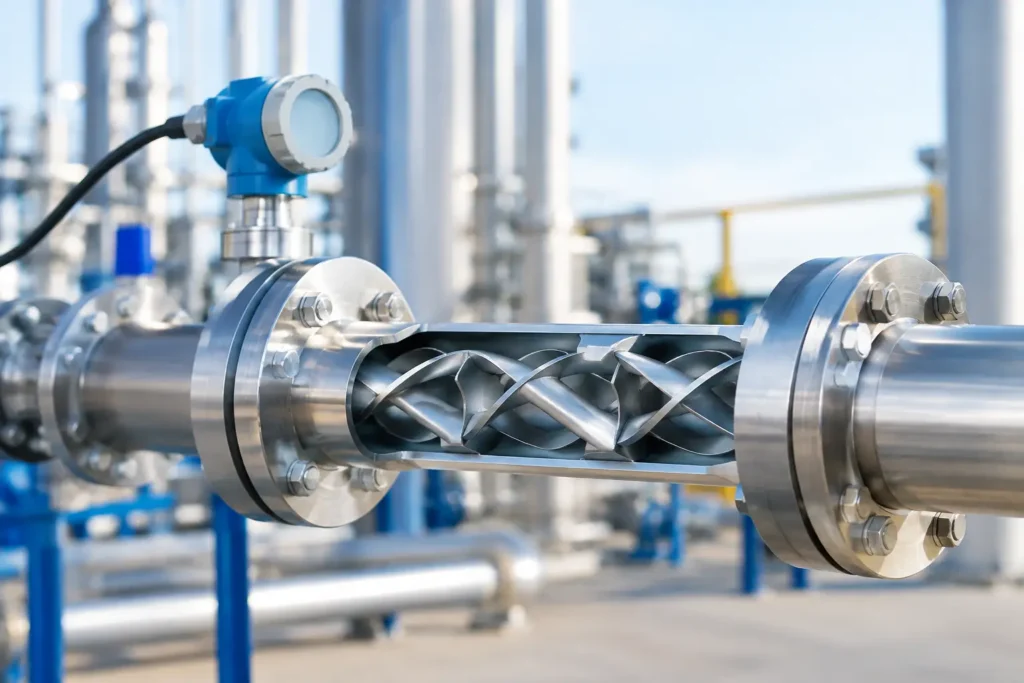
A gas liquid static mixer has to do more than place bubbles into a flowing liquid. It must create controlled interfacial contact at the required flow range without imposing a pressure drop that compromises pumping capacity, gas delivery, downstream separation, or process stability. For chemical injection, oxidation, pH adjustment, gas scrubbing, flotation, and reaction service, that balance determines whether the installation performs consistently or becomes a recurring operating problem.
Unlike a motor-driven mixer, an inline static mixer uses the energy already available in the process stream. Fixed elements divide, rotate, and recombine the flowing phases through the pipe. The result can be a highly uniform gas dispersion, but only when the mixer geometry, injection method, pipe diameter, operating pressure, and fluid properties are selected as one system.
How a Gas Liquid Static Mixer Works
The mixing elements inside a static mixer repeatedly change the direction and position of material moving through the pipe. In liquid-only service, those divisions and recombinations reduce concentration gradients. In gas-liquid service, they also stretch and redistribute gas structures, producing a more even bubble population and increasing contact area between phases.
That added interfacial area is often the point of the installation. A reaction that depends on oxygen, ozone, chlorine, carbon dioxide, hydrogen, nitrogen, or another gas cannot be judged only by how much gas enters the line. It must be judged by how effectively that gas contacts the liquid and how long the resulting dispersion remains useful downstream.
Gas adds complications that do not appear in ordinary liquid blending. It is compressible, its volume changes with pressure and temperature, and it may travel through the line in patterns ranging from small dispersed bubbles to elongated plugs or stratified layers. The flow regime can shift as rates change. A mixer that disperses gas effectively at one operating point may produce substantially different results during turndown, start-up, or a low-flow batch transfer.
Static mixing elements increase turbulence or controlled laminar folding, depending on the process conditions and element design. In turbulent flow, the mixer can break apart larger gas pockets and distribute bubbles through the liquid stream. In viscous or lower-Reynolds-number applications, a carefully designed element train can still create repeated phase division without relying solely on turbulence.
The purpose is not always the smallest possible bubble. Very fine bubbles can improve mass transfer, but they may also increase foaming, alter downstream degassing behavior, or create challenges in separators and vessels. The right dispersion is the one that serves the complete process, not just the pipe section containing the mixer.
Start With the Injection Point
A static mixer cannot correct every poor injection arrangement. Gas introduced through an undersized, poorly located, or improperly oriented connection can enter as intermittent slugs, hug one pipe wall, or create localized vibration before it reaches the mixing elements.
The injection point should be designed around the gas and liquid flow conditions. Injection quills, spargers, and engineered ports can place the gas where the liquid velocity will carry it into the element section. In many applications, injection immediately upstream of the static mixer provides the most direct path to dispersion. The spacing still matters. Too much open pipe between injection and the first element can allow the gas to separate, coalesce, or collect at a high point.
Process pressure deserves early attention. Higher line pressure reduces gas volume for a given mass flow and often makes controlled introduction easier. If pressure falls sharply downstream, the gas may expand after the mixer, changing bubble size, velocity profile, and phase distribution. This is common where a mixed stream enters a low-pressure vessel, flash zone, or open channel.
For hazardous, corrosive, or reactive gases, the injection assembly is also a containment and maintenance decision. Connection type, valve placement, materials, isolation capability, and access for inspection should be addressed before finalizing the mixer body.
Selecting a Gas Liquid Static Mixer
The first selection question is not simply, "What diameter is the line?" Pipe size establishes the mixer diameter, but it does not define the required element geometry or length. A sound specification begins with actual minimum, normal, and maximum liquid flow rates; gas flow expressed at stated pressure and temperature; operating pressure; liquid viscosity; density; surface tension where relevant; and allowable pressure drop.
A process engineer should also define what success looks like downstream. Is the goal gas dissolution, oxidation, neutralization, stripping, flotation, controlled aeration, or a stable feed to a reactor? Does the stream flow directly into a retention tank, or must it remain uniform through valves, meters, heat exchangers, and long piping runs? These details influence both the required mixing intensity and the placement of the equipment.
Element length is a major trade-off. More elements generally provide more phase redistribution and a more uniform outlet profile. They also add pressure loss and can increase plugging risk if the liquid contains solids, fibers, crystals, or deposits. Shorter mixers reduce resistance but may not provide sufficient gas breakup or distribution. The correct design is based on process performance at the needed operating range, not on using the longest available element train.
Mixer style matters as well. Some geometries are suited to aggressive radial mixing and turbulent service. Others are selected for lower-Reynolds-number applications, controlled laminar blending, or conditions where pressure drop must remain tightly managed. A gas-liquid installation may require a custom element arrangement when the process has a large turndown ratio, a viscous carrier liquid, or a narrow allowable differential pressure.
Material selection is equally practical. Stainless steel is common for many water, chemical, and sanitary applications, while specialty alloys may be necessary for chlorides, strong oxidizers, elevated temperatures, or aggressive chemical streams. PVC, CPVC, PVDF, PFA, and lined designs can be appropriate where corrosion resistance outweighs mechanical or temperature requirements. The gasket, flange, injection fitting, and any instrumentation connection must be compatible with the same service conditions.
Pressure Drop Is a Process Cost
Every static mixer gets its mixing energy from pressure loss. That is its operating principle, not a defect. The engineering task is to use enough differential pressure to create the required dispersion while preserving adequate margin for pumps, control valves, and downstream equipment.
A design based only on normal flow can be misleading. At maximum flow, pressure drop may become excessive. At minimum flow, velocity may be too low to maintain the same level of gas distribution. If the liquid flow is controlled but gas flow varies, or vice versa, the ratio between phases can move substantially across the operating envelope.
This is why gas-liquid mixer selection benefits from application data rather than a nominal line-size request. Process conditions determine whether a standard inline mixer will meet the duty or whether the application calls for a custom static mixer, revised injection quill, larger housing, alternate elements, or a complete skid arrangement with controls and measurement points.
Installation Details That Protect Performance
Orientation affects gas-liquid behavior. In horizontal piping, gas naturally migrates toward the top of the pipe, especially at lower liquid velocities. A poorly positioned injection port or insufficiently mixed section can leave a nonuniform phase profile. Vertical upflow may help maintain distribution in some services, while vertical downflow can be appropriate in others. The right choice depends on gas fraction, velocity, pressure, and downstream process requirements.
Avoid treating the mixer as an isolated spool piece. Elbows, reducers, valves, flow meters, and tees close to the inlet or outlet can alter the flow profile. In some systems, downstream pipe length is required to support reaction or gas dissolution after dispersion. In others, the mixer should be close to the point of use to prevent phase separation before the stream reaches the vessel or reaction zone.
Maintenance planning should be realistic. Static mixers have no shafts, seals, motors, or rotating impellers, but they are not maintenance-free in fouling service. Polymerizing chemicals, scale-forming water, slurries, and crystallizing solutions can build on elements over time. Removable element designs, clean-in-place capability, drainability, access spool arrangements, and appropriate upstream filtration can reduce downtime.
When a Static Mixer Is the Right Tool
A gas-liquid static mixer is a strong fit when continuous inline contact is needed, available pressure drop can support the required mixing, and the process benefits from a compact system with no moving internal parts. It is often effective for chemical dosing and neutralization, aeration, oxidation, ozone contact, carbon dioxide addition, gas scrubbing, and reactor feed conditioning.
It may not be the best standalone solution where the process requires long gas residence time, very high gas holdup, independent control of gas and liquid mixing energy, or heavy solids handling. Those duties may require a contact tank, mechanical agitation, recirculation loop, venturi equipment, or a combined system. Good process design does not force every application into one device category.
For demanding gas injection duties, ProMixUSA can evaluate the mixer body, element configuration, materials, end connections, and injection arrangement as a complete process package. The objective is clear: controlled dispersion that holds up under real operating conditions, not just a component that fits between two flanges.
The most useful next step is to compare the gas and liquid operating ranges with the downstream process requirement. When those conditions are defined before equipment is released, the static mixer becomes a predictable production tool rather than a pressure-drop experiment.