
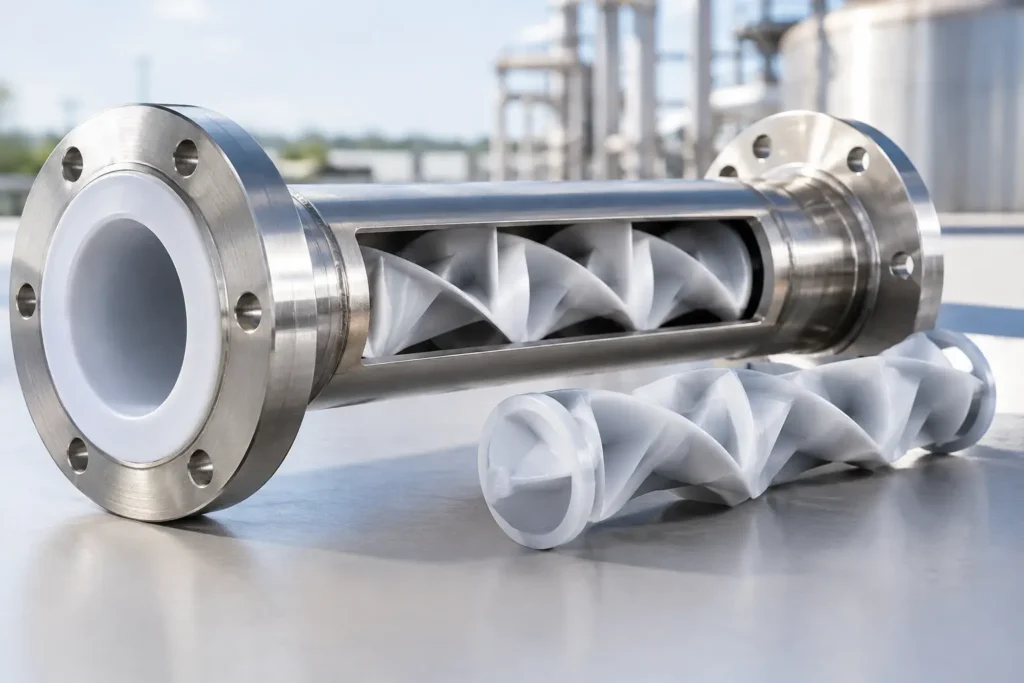
A PFA lined static mixer is often specified when the process needs repeatable inline blending but the fluid would quickly attack stainless steel, carbon steel, or standard polymer equipment. In these applications, mixing performance and materials compatibility cannot be separated. A mixer that produces the right blend but compromises the wetted surface is not a dependable process solution.
PFA, or perfluoroalkoxy, provides broad chemical resistance, a smooth nonstick surface, and useful temperature capability for aggressive liquid services. Combined with a properly selected static mixer element geometry, a lined design can handle corrosive chemical injection, pH adjustment, oxidizer addition, solvent blending, and other duties where contamination, leaks, and unplanned replacement are unacceptable.
What a PFA Lined Static Mixer Does
A static mixer creates mixing energy from fluid velocity rather than a motor, shaft, or impeller. As process fluid moves through a series of fixed mixing elements, the elements divide the stream, redirect it radially, and recombine it repeatedly. The result is controlled distributive mixing in a compact section of pipe.
In a PFA lined construction, the process-contacting bore and mixing elements are protected by PFA. The structural housing carries the mechanical load, while the fluoropolymer lining isolates the wetted surfaces from the chemical. This arrangement gives plants a practical route to inline mixing where metal exposure could cause corrosion, product discoloration, metallic contamination, or premature equipment failure.
The basic operating principle is simple, but selection is not. The required number of elements, element diameter, mixer length, pressure drop, and injection arrangement all depend on the fluids and the required result. A chemical dilution duty may need only uniform concentration downstream. An immiscible liquid blend may require more intense dispersion and more careful review of droplet size, viscosity ratio, and interfacial tension.
Where PFA Lined Static Mixers Earn Their Place
PFA-lined equipment is commonly considered for acids, caustics, halogenated compounds, high-purity chemicals, specialty solvents, and corrosive intermediates. Typical process duties include blending concentrated acid with water, injecting sodium hypochlorite, neutralizing wastewater streams, mixing chemical reagents before a reactor, and combining additives with a corrosive carrier fluid.
The liner can also be valuable where product purity matters. Even when a metal alloy survives the chemistry, a plant may prefer a fluoropolymer-wetted flow path to reduce extractables, surface reaction risk, or cleanup concerns. That does not automatically make PFA the right material for every regulated or high-purity process. Temperature, cleaning chemistry, particle content, and connection design still require review.
A static mixer is particularly effective when the process already has sufficient pumping energy. There are no rotating seals, bearings, motors, or gearboxes to maintain. For continuous chemical addition lines, that simplicity can reduce mechanical maintenance and eliminate a common leak path. The trade-off is permanent pressure loss through the elements. If available differential pressure is limited, the mixer must be sized carefully rather than treated as a short piece of pipe.
Start With the Chemistry, Then Review the Mechanical Limits
PFA has excellent resistance across a wide range of aggressive chemicals, but “fluoropolymer compatible” is not a complete specification. Process teams should define the full operating envelope: chemical concentration, temperature, pressure, flow rate, normal and upset conditions, solids content, and cleaning or flushing media.
Temperature and pressure must be considered together. A lined mixer may perform well at a given temperature under modest pressure, yet have a lower allowable pressure as temperature increases. Vacuum service also deserves separate attention because liner support, construction details, and differential pressure can affect suitability. The housing material may be strong enough for the line rating while the lined assembly has a different operating limit.
Permeation is another application-specific concern. Certain chemicals can migrate through fluoropolymer materials over time under elevated temperature or pressure. This does not necessarily rule out PFA, but it may affect housing selection, inspection planning, and the appropriate safety controls around the mixer. For highly hazardous service, specify the full containment requirement rather than relying only on a broad chemical-resistance chart.
Gaskets, injection quills, valves, instruments, and downstream piping also need compatible wetted materials. A PFA-lined mixer cannot protect a system that includes an incompatible bare-metal quill or elastomer seal immediately upstream. The most reliable installations treat materials selection as a complete flow path decision.
Geometry Determines the Mixing Result
Static mixer elements are available in different geometries because not every fluid behaves the same way. Low-viscosity liquids in turbulent flow can often reach uniform concentration with relatively short mixers. Viscous streams may operate in laminar flow, where the elements must repeatedly divide and rearrange the fluid to overcome the absence of natural turbulence.
For liquid-liquid blending, the design target may be concentration uniformity, initial dispersion, or both. For gas-liquid and gas-gas service, density differences, gas fraction, and flow regime become central to the design. A mixer that works well for a low-viscosity acid dilution may not be appropriate for a viscous polymer additive or a two-phase stream with intermittent slug flow.
The injection point has equal importance. Introducing a reagent at the pipe centerline, near the wall, or through multiple ports changes the starting distribution entering the mixer. An injection quill can place the chemical into the highest-velocity region and reduce wall wetting before the mixer. For reactive chemicals, the distance between injection and the first mixing element should be controlled so the process does not create localized concentration spikes or deposits.
Pressure drop is the governing trade-off. More elements generally improve mixing, but they also increase energy demand. A larger diameter can reduce velocity and pressure loss, though it may also change the mixing behavior. The right design balances blend quality against pump capacity, allowable line pressure, and operating cost. It is not always the longest mixer or the most aggressive element design.
Connection and Installation Details Matter
PFA-lined static mixers must fit the actual piping system, not a generic line diagram. Flanged connections are common in corrosive service because they allow inspection and replacement, but the facing style, bolt loading, liner flange design, and gasket arrangement must be matched to the line. Custom end connections may be required for existing equipment, nonstandard ratings, or skid integration.
Install the mixer where the line remains full and flow is stable. Avoid placing an inline mixer immediately after a sharp elbow, control valve, or pump discharge disturbance unless the application has been evaluated for that condition. Unstable upstream flow can change pressure drop and mixing consistency. If the process cycles across a wide flow range, size the mixer for the minimum, normal, and maximum operating cases rather than only the nameplate flow.
Orientation depends on the service. Horizontal mounting is common, but vertical flow may help in some systems or create challenges in others. With two-phase fluids, settling solids, or gas release potential, the installation must support the actual flow regime. A mixer should also be accessible for inspection, flushing, and isolation without making routine maintenance a piping project.
When Standard Sizing Is Not Enough
A standard PFA lined static mixer is a strong starting point for many corrosive blending duties. However, custom engineering becomes necessary when the process has high viscosity, tight concentration tolerances, limited pressure drop, unusual nozzle sizes, elevated temperature, hazardous reagents, or a complex chemical injection sequence.
This is where process data has real value. Flow rates, viscosity curves, density, temperature, fluid miscibility, line size, injection rate, and required downstream uniformity allow the mixer to be selected on performance rather than assumption. For difficult services, mixer simulation can evaluate element count, velocity profile, pressure loss, and expected mixing behavior before fabrication.
ProMixUSA supports corrosive-service mixing requirements with application-specific static mixer configurations, materials selection, connection options, and complete skid-level solutions when the duty extends beyond the mixer body. The goal is a system that arrives ready to integrate, not a component that creates a new design problem in the field.
A properly specified PFA lined static mixer gives a corrosive process a controlled place to blend, react, or dilute without adding rotating equipment to the line. Start with the chemistry and operating envelope, then match the mixer geometry and injection method to the result the process actually requires. That approach protects both the equipment and the consistency of every batch or continuous run that follows.