
A chemical feed that looks fully dispersed at the discharge point can still separate in a storage tank. A batch that blends perfectly at 200 gallons may fail at 10,000 gallons. That is why the static mixer vs agitator decision cannot be reduced to a preference for inline or tank-mounted equipment. It starts with where mixing must occur, what the fluids require, and how the process operates from startup through shutdown.
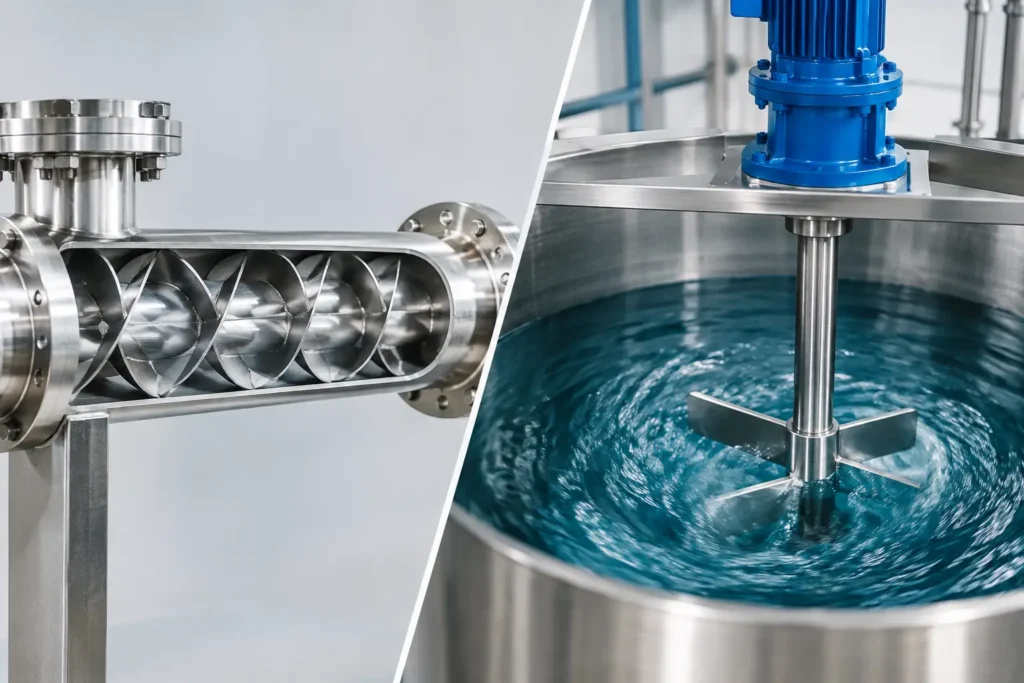
A static mixer uses fixed internal elements inside a pipe. Flow energy moves the fluids through those elements, repeatedly dividing and redirecting the stream. An agitator uses a motor-driven shaft and impeller to create circulation inside a vessel. Both technologies can deliver repeatable industrial mixing, but they solve different process problems.
Static Mixer vs Agitator: The Fundamental Difference
A static mixer is a continuous-flow device. It has no moving parts, no motor, and no seal assembly. As liquid or gas passes through the mixer, engineered elements create radial mixing, flow division, and recombination. The result is controlled blending within a defined pipe length, provided the process maintains sufficient flow and pressure drop.
An agitator is a vessel-mixing device. Its impeller creates bulk circulation patterns that move material from the top, bottom, and walls of a tank. Depending on impeller geometry and speed, an agitator can suspend solids, prevent settling, disperse gas, maintain temperature uniformity, or blend a batch before transfer.
The practical distinction is straightforward: a static mixer blends material as it travels, while an agitator mixes material where it is held. A process may need one or the other, or both. For example, a plant may use an agitator to keep a polymer solution uniform in a day tank, then use an inline static mixer to blend that solution with dilution water and a second chemical immediately before injection.
When a Static Mixer Is the Better Choice
Static mixers are especially effective where ingredients enter a flowing process line and the required result is a uniform discharge concentration. Typical duties include chemical dilution, neutralization, pH adjustment, coagulant and flocculant blending, additive injection, liquid-liquid blending, gas-liquid contacting, and continuous heat-transfer applications.
The major advantage is mechanical simplicity. With no bearings, gearbox, motor, or rotating seal, a static mixer has limited maintenance requirements. This is valuable in corrosive chemical service, remote installations, hazardous areas, and applications where unplanned maintenance creates costly downtime.
Static mixers also provide a highly repeatable result at a known operating condition. If flow rate, viscosity, density, injection point, and pressure remain within the design range, the same element geometry produces the same mixing action continuously. For chemical injection, this can reduce concentration gradients that lead to overdosing, underdosing, or inconsistent reaction performance.
Pressure Drop Is the Design Trade-Off
A static mixer does not consume electrical power through a drive motor, but it is not energy-free. It creates pressure drop. The pumping system must supply enough pressure to move fluid through the mixer at the required flow rate. More elements generally improve mixing quality, but they also increase pressure loss.
This makes hydraulic design central to static mixer selection. A short mixer may be sufficient for low-viscosity liquids that are readily miscible. A viscous liquid, large density difference, difficult emulsion, or low Reynolds number service may require a longer element train, a different element geometry, or a larger diameter to control pressure drop.
Poor injection arrangement can also defeat a properly sized mixer. Introducing a chemical near the pipe wall, immediately before a restrictive fitting, or through an improperly oriented quill may create uneven distribution before the stream reaches the elements. The injection quill, static mixer, pipe size, and available straight run should be treated as one engineered system.
Where Static Mixers Have Limits
A static mixer cannot mix material that is standing still. If a storage tank has long residence times, solids settle between transfers, or a product must remain homogeneous for hours or days, inline mixing alone is usually not enough.
It is also not the first choice for duties that require a wide turndown ratio. At very low flow, the available mixing energy decreases and some designs may not achieve the desired blend quality. A static mixer can be engineered for laminar flow, transitional flow, or turbulent flow, but the operating range must be defined honestly during selection.
When an Agitator Is the Better Choice
Agitators are built for tanks, totes, reactors, blend vessels, and other applications where material needs active circulation over time. They are the better fit when the process requires batch blending, solids suspension, viscosity reduction through movement, thermal uniformity, or continuous maintenance of a homogeneous tank inventory.
Impeller selection determines the type of mixing action. Axial-flow impellers drive top-to-bottom circulation and are often used for blending and solids suspension. Radial-flow impellers deliver higher localized shear and can support dispersion duties. High-shear and ultra-high-shear mixers use specialized rotor-stator systems where droplet size reduction, emulsification, or particle deagglomeration is the primary objective.
A properly specified tank agitator considers more than horsepower. Vessel diameter, liquid height, baffle arrangement, viscosity, specific gravity, solids loading, batch volume, operating temperature, and desired blend time all affect the final design. The wrong impeller can create vortexing near the surface while leaving dead zones at the tank bottom or perimeter.
Mechanical Complexity Comes With Maintenance
Unlike a static mixer, an agitator includes rotating equipment. Motors, gear reducers, shafts, bearings, couplings, impellers, and mechanical seals require inspection and maintenance. Top-entry mixers may be practical for large vessels and demanding batch processes, while side-entry designs can support specific tank geometries and storage applications. Portable mixers offer flexibility for smaller batches, pilot work, and intermittent production.
Seal selection deserves particular attention in chemical service. A standard seal may not tolerate aggressive solvents, elevated temperatures, abrasive solids, or vacuum conditions. For containment-sensitive applications, magnetic-drive designs can eliminate a dynamic shaft seal and reduce leak paths. The correct configuration depends on the process risk, not simply the initial equipment cost.
Comparing Energy, Space, and Operating Cost
Static mixers typically require less installed equipment around the process line. They do not need a motor control center, support platform, shaft access, or tank roof reinforcement. Their footprint is compact, and a ready-to-ship unit can often be integrated into existing piping with the correct connection type and face-to-face dimension.
Agitators require electrical power continuously or during each mixing cycle. They also occupy vessel space and may demand access for maintenance. Yet an agitator can be the more economical option when the alternative is trying to force a difficult batch process through a long inline mixer at excessive pressure drop.
The real cost comparison should include pump capacity, electrical load, maintenance labor, spare parts, lost production risk, cleaning requirements, and product waste. A low-price mixer that produces inconsistent concentration or repeated rework is not a low-cost solution.
Material and Connection Selection Matter
The process fluid often determines whether the mixer body and wetted components should be stainless steel, sanitary stainless construction, PVC, CPVC, PVDF, PFA, specialty alloy, or a lined design. Chemical compatibility includes more than the primary fluid. Consider cleaning chemicals, temperature excursions, concentration changes, and upset conditions.
For static mixers, connection selection affects both installation and serviceability. Flanged, threaded, sanitary clamp, socket weld, butt weld, and custom connections each serve different piping standards. For tank agitators, mounting configuration, shaft length, seal type, and impeller material must match the vessel and operating environment.
Sanitary processes add another layer of requirements. Surface finish, drainability, clean-in-place compatibility, elastomer selection, and contamination control may govern the design as much as mixing performance. Industrial mixing equipment should fit the process specification rather than require the process to adapt around a catalog item.
Use Process Data to Make the Decision
The fastest way to select the wrong mixer is to specify from pipe diameter or tank volume alone. Useful design data includes minimum, normal, and maximum flow rate; viscosity across temperature; specific gravity; solids content and particle size; pressure and allowable pressure drop; desired blend uniformity; available straight pipe; batch time; and chemical compatibility.
For tank mixing, define whether the objective is simple blending, solids suspension, gas dispersion, emulsification, heat transfer, or reaction control. For inline service, identify the injection rate, injection location, pipe orientation, flow regime, and downstream distance available before the fluid reaches its point of use.
Where the duty is uncertain or performance is critical, mixer simulation and application review can prevent costly field changes. A static mixer may need revised element geometry or length. An agitator may need a different impeller, baffles, a higher torque drive, or a retractable configuration. These changes are far easier to make before fabrication and installation.
The Right Answer May Be a Combined System
Many demanding processes benefit from both technologies. An agitator maintains consistent tank inventory, while a static mixer provides final inline blending after a second ingredient is injected. This arrangement is common when chemical concentration, reaction timing, or dosing accuracy must remain stable at the process point.
ProMixUSA engineers static mixing, injection, and mechanical agitation equipment as connected process components, with material, connection, and operating conditions matched to the application. The objective is not to sell more equipment. It is to achieve repeatable mixing without unnecessary pressure loss, excessive maintenance, or preventable product waste.
Start with the process behavior, not the equipment category. When flow must be blended continuously, a static mixer can provide compact, maintenance-light performance. When material must remain uniform inside a vessel, an agitator provides the circulation that piping alone cannot deliver. Defining that boundary clearly leads to a system that performs when production is on the line.