
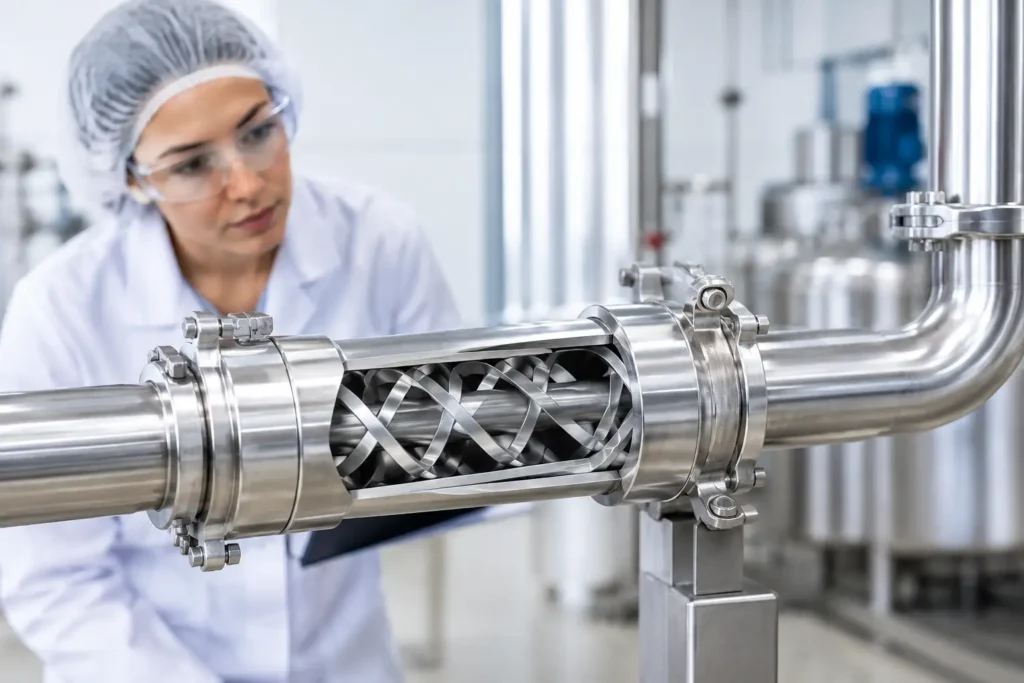
A poor mixing decision in a hygienic process line rarely announces itself at startup. It appears later as an off-spec batch, inconsistent concentration, excess CIP time, trapped product, or a pressure-drop problem that limits throughput. Inline sanitary static mixers address these risks without motors, seals, shafts, or moving internal parts – but only when the mixer geometry, installation point, and sanitary construction match the process.
For food and beverage, dairy, pharmaceutical, biotechnology, personal care, and specialty chemical operations, the objective is not simply to combine two streams. It is to achieve a defined blend quality repeatedly, protect cleanability, minimize product loss, and preserve the process conditions downstream. That requires a specification built around the actual fluid behavior, not a generic pipe size and flow rate.
What Makes a Static Mixer Sanitary?
A static mixer blends process streams by dividing, rotating, and recombining flow as it passes through fixed internal elements. Each element changes the position of fluid within the pipe, reducing concentration gradients over a specified number of elements. The energy for mixing comes from the process flow itself.
A sanitary design applies hygienic principles to that mixing function. Wetted surfaces must be suitable for the product and cleaning chemistry. Internal geometry must avoid areas that retain product or cleaning solution. Connections, welds, surface finish, drainability, and gasket selection all influence whether the assembly can be cleaned and validated as part of the line.
For many hygienic services, 316L stainless steel is the standard starting point because it offers corrosion resistance and a proven fit with sanitary fabrication practices. It is not automatically the correct choice. Chloride exposure, aggressive cleaning agents, high temperature, and product chemistry can require a closer review of alloy selection, elastomers, or specialty materials. A mixer that delivers excellent blend uniformity but suffers corrosion or gasket degradation is not a successful installation.
The term sanitary should also not be treated as a finish requirement alone. Surface finish matters, particularly where product adhesion or microbial control is critical, but it works alongside crevice-free fabrication, full-drain design, compatible sanitary clamp connections, and properly executed welds. The entire installed assembly matters, including reducers, injection fittings, valves, and dead-leg-prone spool pieces around the mixer.
Start With the Mixing Duty, Not the Mixer Length
The most useful input for specifying a static mixer is a clear description of what must happen inside the line. Is the duty dilution, pH adjustment, flavor addition, polymer activation, blending of two miscible liquids, dispersion of a minor ingredient, or temperature equalization? Each duty creates different mixing requirements.
For simple blending of compatible, low-viscosity liquids under turbulent flow, a relatively compact element arrangement may produce the required uniformity. For viscous materials, laminar flow, or significant viscosity differences between the streams, mixing becomes more demanding. The flow profile is less naturally chaotic, so the elements must repeatedly redistribute material across the pipe cross section. More elements and a longer mixer may be required.
The injection method has equal importance. Introducing a small chemical stream at the pipe wall can create a concentrated ribbon that takes longer to distribute than a well-designed injection point positioned to use the main flow effectively. In demanding chemical addition applications, an injection quill can place the additive at the intended location before it enters the static mixing section. This improves repeatability and can prevent localized overconcentration at the pipe wall.
A complete specification should identify flow range, normal and maximum viscosity, density, temperature, pressure, line size, available straight run, and allowable pressure drop. It should also state the desired outlet uniformity. “Good mixing” is not a measurable requirement. A target concentration variation, blend tolerance, or downstream analyzer requirement gives the engineering team a design basis.
Pressure Drop Is the Operating Trade-Off
Static mixers are valued because they have no rotating equipment to maintain. The trade-off is pressure drop. Every element creates resistance, and that resistance rises as flow increases or as the fluid becomes more viscous.
The right approach is not to minimize pressure drop at all costs. An undersized or overly short mixer can save pumping energy while failing to produce a consistent blend. On the other hand, specifying more elements than the process needs can consume unnecessary head, reduce available capacity, and increase operating cost.
Pressure-drop analysis should use the actual operating envelope, not only a single nominal flow rate. A production line may run at several rates during startup, normal production, changeover, or CIP. A mixer that performs well at peak production may provide insufficient mixing at the lowest rate, especially if the flow regime changes. Conversely, a design that is acceptable for product may place an avoidable burden on the CIP pump.
This is where application-specific sizing has more value than selecting a mixer from a diameter chart. Element style, diameter, length, and the relationship between mixer bore and adjacent piping can be adjusted to balance blend performance against hydraulic limits.
Cleanability Depends on the Installed Geometry
Sanitary static mixers are often selected for their low hold-up volume compared with a tank-based blend step. That advantage can disappear if the mixer is installed with poor transitions or without regard for drainage and cleaning flow.
A mixer should be evaluated as part of the complete hygienic circuit. Abrupt bore changes, poorly aligned connections, non-drainable orientation, and fittings that create stagnant pockets can compromise a well-built mixer. Vertical versus horizontal mounting may affect drainage. If the process requires full drainability, the orientation and placement of the elements should be reviewed before fabrication.
CIP performance also deserves a separate conversation from product mixing performance. Cleaning solution needs sufficient velocity and coverage to remove residues from the element surfaces. Sticky, protein-rich, high-sugar, or shear-sensitive products may demand more stringent cleaning validation than low-residue liquids. For aseptic or high-purity applications, the design may also need to account for SIP exposure, thermal expansion, and documentation requirements.
Sanitary clamp connections are common because they support rapid removal and inspection when needed. However, permanent welded installations may be preferred where minimizing potential leak paths and preserving a fully integrated cleanable line are higher priorities. Neither choice is universally better. The correct connection depends on maintenance access, validation expectations, operating pressure, and the plant's established hygienic standards.
Where Inline Sanitary Static Mixers Fit Best
These mixers are particularly effective when blending must occur continuously and predictably in a closed process line. Typical duties include dilution of concentrates, addition of flavors or colors, acid or caustic dosing, blending of liquid ingredients, controlled neutralization, and homogenization of compatible process streams before filtration, filling, heat exchange, or downstream reaction.
They can also support thermal consistency. When streams at different temperatures combine, a static mixer improves temperature uniformity before a heat exchanger or temperature-sensitive operation. The same principle applies to concentration measurement. An analyzer installed downstream of an adequately sized mixer receives a more representative sample of the process, improving control-loop performance.
There are limits. A static mixer is not the best answer for every dispersion, emulsification, or powder-wetting duty. Highly immiscible fluids, difficult emulsions, gas-liquid dispersion, solids suspension, and applications requiring particle-size reduction may need high-shear equipment, a mechanical mixer, a recirculation loop, or a staged system. The goal is to match the mixing mechanism to the result required, not force every application through an inline element mixer.
Questions That Prevent Costly Rework
Before releasing a purchase order, process and maintenance teams should resolve several practical points: What blend uniformity is required at minimum, normal, and maximum flow? What is the allowable pressure drop for both production and CIP? Which product, cleaning, and sterilization chemicals contact the wetted surfaces? Does the installation need full drainability, removable access, or permanent weld-in construction?
It is also worth confirming the real piping constraints. Available straight run, valve locations, instrument ports, support points, and the need to remove the mixer for inspection can change the best configuration. A short mixer body may be attractive in a crowded skid, but the surrounding injection and transition piping still needs room to function correctly.
ProMixUSA engineers sanitary static mixing equipment around these operating details, including application-specific element configurations, sanitary connections, material options, and complete inline mixing systems when the duty requires more than a single spool section.
The strongest specification is the one that gives the mixer supplier a usable process window rather than a single design point. Provide the fluids, flow range, temperature, viscosity, cleaning method, line constraints, and required outlet consistency. That information turns a sanitary mixer from a catalog component into a controlled part of the process.