
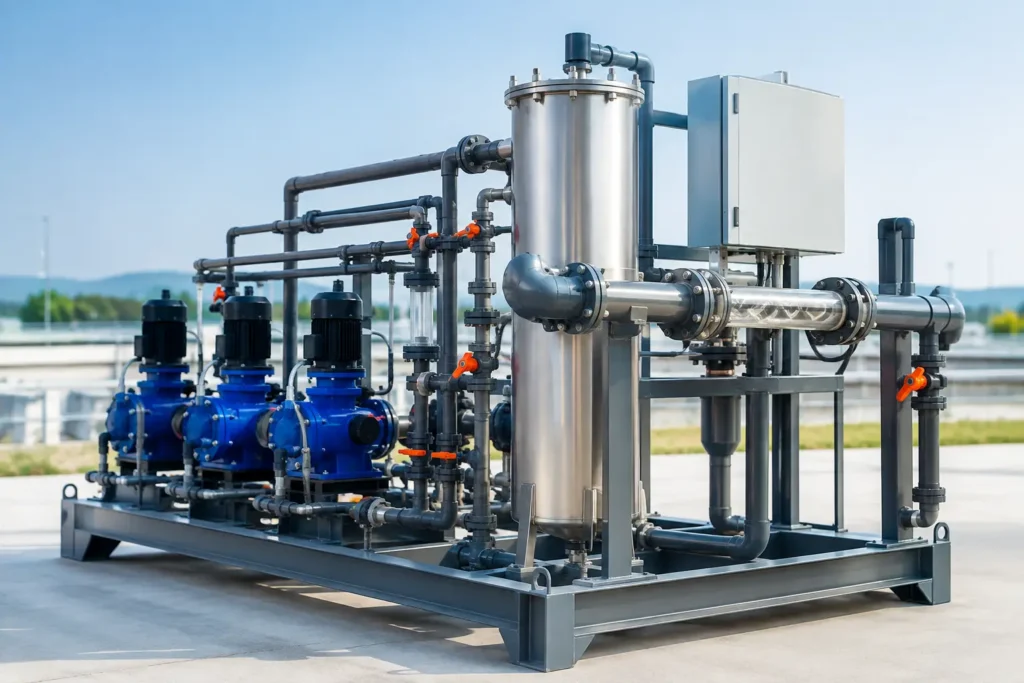
A static mixer skid system is not simply an inline mixer mounted on a frame. It is a complete, engineered process package that controls how chemicals are stored, metered, injected, blended, monitored, and delivered to the main process line. For plants handling pH adjustment, coagulant addition, disinfection, polymer activation, corrosion inhibition, or other critical dosing duties, that integration directly affects product quality, operator safety, and uptime.
A skid can replace an improvised collection of pumps, pipe spools, valves, instruments, and field supports with one defined system. The benefit is not only cleaner installation. It is repeatable performance from startup through long-term operation, with equipment selected around the actual fluid, flow range, pressure, and control requirement.
When a Static Mixer Skid System Is the Right Fit
Static mixing is especially effective when the process already has sufficient line velocity to move fluids through a stationary mixing element. The mixer uses the energy of the flowing stream to split, redirect, and recombine fluids. There are no rotating shafts, motors, gearboxes, or mechanical seals inside the mixer body.
That makes a skid-mounted static mixing system a practical choice for continuous processes where a liquid additive must disperse quickly and consistently into a carrier stream. Municipal and industrial water treatment, chemical manufacturing, pulp and paper, food and beverage processing, energy operations, and OEM process packages are common applications.
The fit depends on the application. A static mixer does not create flow, and it cannot correct poor injection conditions on its own. If the process line has very low velocity, highly variable flow, large solids, or a batch operation requiring independent agitation, a mechanical tank mixer, recirculation loop, or high-shear mixer may be the better solution. The strongest skid designs address those limits early rather than treating the mixer as a standalone answer.
What Belongs on the Skid
The exact equipment package changes by service, but the central job remains the same: introduce a controlled chemical stream and produce a uniform downstream mixture. A complete system commonly combines a chemical feed connection, metering pump or pumps, calibration equipment, injection assembly, static mixer, process piping, isolation valves, pressure protection, and instrumentation on a fabricated base.
A chemical injection quill is often as important as the mixer itself. It positions the injected fluid at the right location in the pipe, often toward the higher-velocity region of the stream, instead of allowing the chemical to run along the pipe wall. This is particularly relevant for corrosive chemicals, concentrated additives, or applications where localized reaction can damage piping.
The static mixer follows at a calculated distance and provides controlled mixing intensity. Element geometry, element count, mixer diameter, and available pressure drop determine how effectively the streams are distributed. More elements can improve homogeneity, but they also increase pressure loss. That trade-off should be evaluated against pump capacity and the allowable pressure budget for the full system.
Instrumentation makes the skid operational rather than merely assembled. Depending on the process, it may include flow indication, pressure gauges or transmitters, backpressure control, pulsation dampening, leak detection, conductivity measurement, pH measurement, sample points, or control-panel interfaces. Operators need a way to confirm that the chemical is being delivered and that the process is responding as intended.
Design Starts With Process Conditions, Not a Catalog Size
Selecting a mixer body diameter that matches the process pipe is only one part of the work. A useful skid specification begins with the conditions that drive hydraulic and chemical performance:
- Main-stream flow rate, including minimum, normal, and maximum operating cases
- Chemical flow rate, concentration, viscosity, specific gravity, and temperature
- Line pressure, available differential pressure, and allowable pressure drop
- Pipe size, schedule, connection type, and available straight-run space
- Material compatibility for wetted components, seals, valves, tubing, and instruments
- Required mixing quality and the downstream distance available before the next process step
Flow turndown deserves close attention. A static mixer can perform very differently at minimum flow than at design flow because mixing energy comes from fluid velocity. If a plant experiences wide production swings, the skid may require a different element design, a smaller mixer section, parallel mixer paths, recirculation, or control logic that maintains workable conditions.
Chemical properties can also change the equipment decision. A low-viscosity acid injection may need a different quill material and check-valve arrangement than a viscous polymer feed. Oxidizers, caustics, solvents, chlorides, and abrasive slurries each introduce separate compatibility concerns. Stainless steel is suitable for many services, but it is not a universal answer. PVC, CPVC, PVDF, PFA-lined components, sanitary materials, and specialty alloys may be necessary based on the fluid and operating temperature.
Injection Location Determines Mixing Results
A well-sized static mixer cannot compensate for injection at the wrong point. The chemical should enter where it can be captured by the moving process stream and directed immediately into the mixing elements. Injection upstream of a pump may be appropriate in some systems, but it can also expose pump materials to concentrated chemical or create undesirable reactions. Injection downstream is often preferred when controlled dispersion and equipment protection are priorities.
The skid layout should account for required straight pipe, valve access, drainability, venting, and maintenance clearance. A compact footprint is valuable, but squeezing components together without service access creates future operating problems. Metering pumps need room for diaphragm inspection, tubing replacement, calibration, and safe chemical handling. Instruments need locations that provide meaningful readings rather than turbulent, misleading measurements.
For hazardous services, containment and isolation are part of the process design. Drain connections, relief routing, double containment where appropriate, drip pans, splash shielding, and clearly located emergency shutoff points support safer chemical injection. These features should be engineered into the package rather than added in the field after commissioning.
Controls Should Match the Consequence of a Bad Dose
Simple applications may only need a local pump control and manual calibration. Critical applications often require flow-paced dosing, ratio control, remote start-stop, alarm contacts, variable-speed pump control, and interlocks that prevent chemical feed when the carrier stream stops.
The right control strategy depends on what happens when the dose is too high, too low, or absent. A noncritical additive may tolerate periodic manual verification. A treatment chemical affecting discharge compliance, product chemistry, or personnel safety may require continuous feedback and documented operating data.
Control architecture should also consider maintenance reality. Operators need clear status indication, manual override procedures, accessible isolation, and startup sequences that do not depend on tribal knowledge. A skid that is technically sophisticated but difficult to operate will eventually be bypassed or misused.
Factory Assembly Reduces Field Risk
Field-built systems can work, but they often accumulate design changes during installation. Connection elevations shift, support locations are improvised, instrument wiring is separated from piping work, and different vendors may assign responsibility to one another when performance falls short.
A factory-assembled skid reduces those handoffs. Piping alignment, component placement, structural support, and access can be reviewed as one package before shipment. Where the application requires it, pressure testing, functional checks, instrument verification, and documentation can be completed before the equipment reaches the site.
This approach also improves project scheduling. A plant receives a defined package with known battery limits instead of sourcing individual items and coordinating fabrication in parallel with a shutdown. For replacement projects with limited outage windows, that difference can be substantial.
Specifying a Skid for Long-Term Service
The lowest initial price is not always the lowest operating cost. A skid with unsuitable wetted materials, undersized valves, inaccessible strainers, or inadequate pressure protection can create recurring downtime that quickly exceeds its purchase savings. Conversely, overbuilding every component in exotic materials can add cost without improving the actual service life.
A better approach is to identify the true failure risks: corrosion, plugging, pump pulsation, low-flow mixing, temperature exposure, operator handling, or changing chemical concentration. Then specify the material, geometry, instrumentation, and controls that directly address those risks.
ProMixUSA engineers complete static mixing systems around those operating details, from ready-to-ship components to custom skid configurations for demanding chemical injection and flow-conditioning service. The objective is a package that arrives ready for installation and continues producing repeatable mixing results after the project team has left the site.
The most useful next step is to treat the skid as part of the process, not an accessory to it. When flow conditions, chemical behavior, injection geometry, pressure loss, controls, and maintenance access are considered together, the result is safer dosing and a system operators can trust on every shift.