
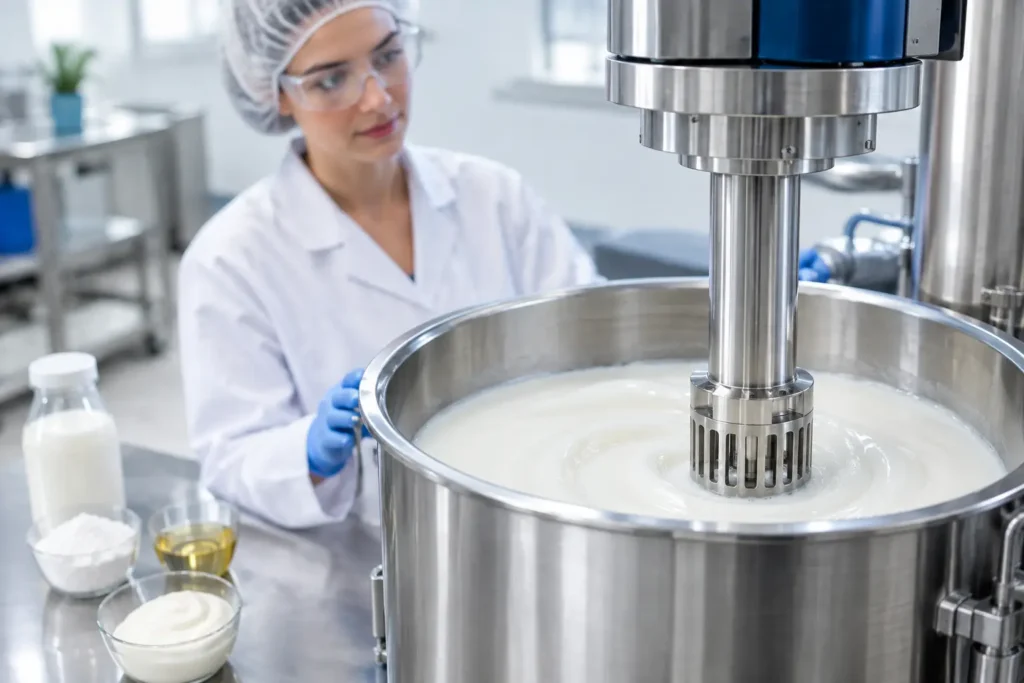
A formulation can look fully blended in a tank and still fail on the production line. Oil droplets may separate after filling, powders can leave fisheyes, pigments may show color variation, or a chemical reaction may run unevenly because the active ingredient was never dispersed at the required scale. Ultra high shear homogenizer applications address these failures by applying concentrated mechanical energy where ordinary agitation reaches its limit.
For process engineers and plant teams, the question is not simply whether a product needs more mixing. The real question is whether the process requires smaller droplets, finer particles, faster wet-out, a narrower particle-size distribution, or a stable emulsion through storage and downstream processing. Ultra high shear equipment is selected when those outcomes matter more than gentle bulk circulation alone.
What Ultra High Shear Changes in a Process
An ultra high shear homogenizer forces product through a closely controlled mixing zone at high velocity. Rotor-stator geometry, narrow clearances, and multiple stages create intense hydraulic and mechanical forces. Those forces reduce droplets, break agglomerates, disperse solids, and distribute one phase through another with far more energy than a conventional propeller or low-shear tank mixer can provide.
The distinction matters because a tank mixer and a homogenizer do different jobs. A tank mixer moves the batch. It maintains suspension, promotes turnover, and can blend materials efficiently across a vessel. An ultra high shear homogenizer acts on localized product structures. It reduces the size of droplets or agglomerates that determine emulsion stability, appearance, reaction consistency, texture, and filtration behavior.
Many successful systems use both. A top-entry or side-entry mixer provides macro-mixing in the vessel while an inline or batch high-shear unit processes the portion of product that needs intense treatment. This arrangement prevents dead zones and provides repeatable dispersion without oversizing either piece of equipment.
Core Ultra High Shear Homogenizer Applications
Emulsifying oil and water phases
Emulsions are among the most common applications. Food products, personal care formulations, coatings, lubricants, agricultural chemicals, and specialty chemical products often combine phases that naturally separate. The homogenizer reduces the dispersed-phase droplet size and distributes it throughout the continuous phase.
Smaller droplets generally improve stability, but there is no universal target size. The correct result depends on viscosity ratio, interfacial tension, emulsifier chemistry, solids loading, temperature, residence time, and the product's expected shelf life. Excessive shear can also be counterproductive in sensitive formulations by damaging a desired structure, incorporating excess air, or generating unnecessary heat.
Wetting and dispersing powders
Fine powders create a different challenge. Many powders resist wetting, float at the surface, or form dry agglomerates that persist even after long tank-mixing cycles. Ultra high shear systems rapidly draw liquid into those agglomerates and break them apart, improving the dispersion of gums, thickeners, pigments, carbomers, proteins, mineral fillers, and active powders.
For a powder-handling process, the feed method is as critical as the homogenizer itself. Adding a powder too quickly can overload the wetting zone and create lumps faster than equipment can disperse them. Controlled induction, recirculation, adequate liquid head, and a properly sized batch volume are often what turn high-shear capability into a reliable operating process.
Deagglomerating pigments and specialty solids
Coatings, inks, adhesives, sealants, mining chemicals, ceramic slurries, and composite formulations may require deagglomeration rather than true particle-size reduction. The primary particles may already be at the desired size, but clusters of particles remain bound together. A high-energy rotor-stator zone can separate those clusters and improve color development, viscosity consistency, gloss, adhesion, and downstream pumping performance.
Not every solid responds the same way. Hard crystalline particles or materials requiring significant particle fracture may call for milling rather than homogenization. A practical review should distinguish between breaking weak agglomerates and reducing the particle size of a hard solid. Treating those as the same requirement leads to poor equipment selection.
Preparing chemical reaction feeds
In chemical processing, poor dispersion can create local concentration spikes and inconsistent reaction conditions. Ultra high shear units are used to distribute reactants, catalysts, additives, and immiscible feed streams before or during reaction. The objective may be faster mass transfer, improved conversion, more uniform polymerization conditions, or controlled formation of a reaction intermediate.
This service requires careful attention to heat release and pressure. High shear adds energy to the product, and reactive systems can add much more. A skid may need recirculation controls, temperature monitoring, pressure-rated piping, appropriate seals, and a safe chemical injection point upstream of the homogenizer. Equipment selection must account for the full process, not only the mixing head.
Producing sanitary and personal care formulations
Sanitary applications often demand uniform texture as well as cleanability. Creams, lotions, gels, sauces, dressings, beverage concentrates, and nutritional products can benefit from controlled droplet size and rapid ingredient incorporation. For these services, the wetted material, surface finish, elastomer compatibility, drainability, and clean-in-place requirements may be as consequential as shear level.
A homogenizer built for industrial coatings is not automatically appropriate for a hygienic process. Sanitary connections, polished stainless wetted surfaces, documented elastomers, and a geometry that avoids product hold-up should be specified from the start. If the formulation is heat-sensitive, the system should also include a realistic plan for cooling during recirculation.
Selecting the Right Homogenizer Configuration
The operating mode should follow the process objective. Batch units are useful when a vessel already exists, formulations change frequently, or the production volume is moderate. Inline units fit continuous processing and recirculating systems where flow rate, pass count, and residence time can be controlled. Multi-stage configurations provide progressively finer treatment but also increase energy input and pressure drop.
Viscosity is another major decision point. A low-viscosity emulsion may move readily through an inline unit, while a viscous gel, paste, or high-solids slurry may require a different feed arrangement, a positive-displacement pump, or a batch-mounted homogenizer. Product behavior matters more than a single viscosity value because many materials are shear-thinning, temperature-dependent, or prone to settling.
Material compatibility cannot be treated as an accessory decision. Stainless steel is common, but corrosive chemical duty may require specialty alloys, PVDF, PFA-lined components, or other engineered wetted materials. Seal design must also match the service. Abrasive solids, solvent exposure, elevated temperature, vacuum conditions, and hazardous atmospheres all affect the right mechanical seal, flush plan, motor classification, and housing construction.
Process Details That Determine Results
The highest available tip speed does not guarantee the best product. Results depend on the rotor-stator design, the gap, throughput, recirculation rate, number of passes, feed location, and temperature profile. A system that delivers excellent dispersion at pilot scale may behave differently at production scale if the circulation pattern or feed rate changes.
Heat is a frequent constraint. Mechanical energy becomes heat in the product, especially during repeated passes. That can lower viscosity and improve processing in some formulations, but it can also damage heat-sensitive ingredients, alter solvent behavior, or change the final emulsion. Jacketed vessels, heat exchangers, controlled recirculation, and temperature interlocks should be evaluated early rather than added after quality issues appear.
Air management deserves the same discipline. Poorly designed feed conditions can entrain air, leading to foam, inaccurate density, oxidation, inconsistent fills, and longer downstream deaeration. Maintaining adequate inlet conditions and avoiding uncontrolled vortex formation upstream will protect both homogenizer performance and finished-product quality.
ProMixUSA helps industrial teams match high-shear equipment, tank agitation, injection hardware, and process materials to the conditions that actually govern production. The strongest specification starts with measurable targets: desired droplet or agglomerate range, batch or continuous throughput, viscosity profile, temperature limits, pressure, solids content, cleaning requirements, and chemical compatibility.
A well-chosen ultra high shear homogenizer does more than make a batch look uniform. It gives operators a repeatable way to control the product characteristics that determine whether the process runs cleanly, the package stays stable, and the finished material performs as designed.