
A batch that looks uniform at the mixer can still separate in the tote, plug a downstream filter, or miss its final viscosity target. High shear mixer emulsification is the controlled reduction and distribution of one immiscible liquid phase into another, but stable results depend on more than motor speed. The emulsion must be created with sufficient energy, held at the right temperature, and supported by a formulation that can stabilize the newly formed droplets.
For industrial processors, the goal is not simply maximum shear. It is repeatable droplet size, reliable throughput, manageable heat load, and equipment that fits the actual tank, recirculation loop, or inline process.
What High Shear Actually Does to an Emulsion
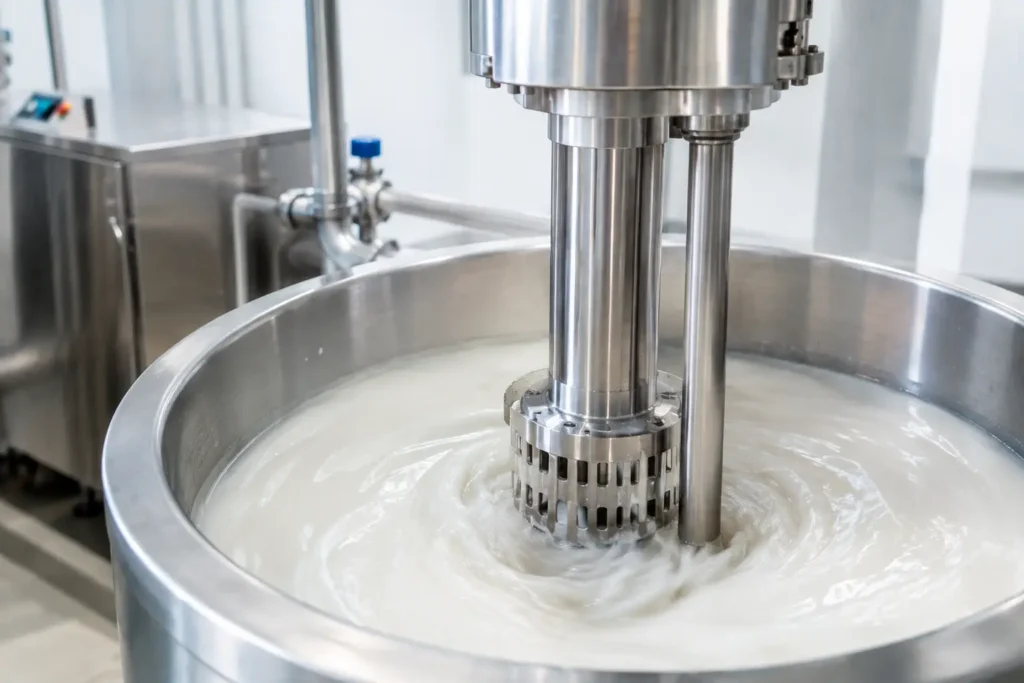
A high shear mixer typically uses a rotor-stator workhead. As the rotor turns at high speed, it draws material into the workhead and forces it through precisely sized stator openings. The resulting velocity gradients, turbulence, pressure changes, and impact forces break dispersed-phase droplets into smaller droplets and distribute them through the continuous phase.
Smaller droplets generally resist rapid separation better because they settle or cream more slowly. They also create a more consistent appearance, texture, and functional performance in products such as lotions, coatings, polymer emulsions, fuel additives, food systems, and chemical formulations. Yet droplet reduction is only one part of the job. Without adequate surfactant coverage, polymeric stabilization, or the correct phase ratio, small droplets can collide and coalesce after leaving the high-energy zone.
This is why an emulsion can be overprocessed as well as underprocessed. Excessive recirculation may add heat, damage shear-sensitive ingredients, entrain air, or produce a droplet distribution that does not improve finished-product stability. The required endpoint should be defined by product testing, not by a fixed mixing time copied from another formulation.
The Variables That Control High Shear Mixer Emulsification
Rotor-stator geometry and tip speed
Rotor tip speed is a useful starting point because it indicates the intensity of the workhead, but it is not a complete design criterion. Rotor diameter, stator hole or slot geometry, workhead clearance, and the number of passes through the shear zone all influence the final droplet-size distribution.
A fine-hole stator can deliver intensive size reduction, but it may restrict flow and become less practical with higher-viscosity products, solids, or waxy ingredients. A slotted stator may move more material and tolerate more demanding feeds, though it may not deliver the same final fineness in a single pass. Workhead selection should match the product rheology and the target, rather than rely on the highest available rpm.
Viscosity and phase ratio
As the continuous phase becomes more viscous, droplets can be more difficult to break because the fluid resists deformation. At the same time, a higher continuous-phase viscosity can help slow coalescence once droplets are formed. This trade-off is common in creams, gels, adhesives, and thick chemical slurries.
The dispersed-phase volume also matters. A low oil loading in water may emulsify readily, while a concentrated system can become highly viscous during addition and demand a different order of operations. In some cases, phase inversion is intentional. In others, it is a costly process upset. Pilot testing should establish the allowable addition rate and the phase ratio at which viscosity rises sharply.
Formulation and ingredient addition
The mixer creates interfacial area. The emulsifier system has to protect that area quickly enough to prevent coalescence. If oil is introduced faster than the surfactant can stabilize it, increasing mixer speed alone may not correct the problem.
Addition location is equally important. Feeding the dispersed phase directly into the high-energy inlet region can improve incorporation and shorten batch time. Introducing it at the surface of a large tank may create floating pools, vortexing, and long circulation paths before the material reaches the workhead. For continuous production, metering both phases into an inline high shear mixer provides tighter control over feed ratio and residence time.
Temperature and heat removal
High shear generates heat through mechanical energy. That heat may be helpful when melting waxes, dissolving certain ingredients, or lowering viscosity for processing. It can also create trouble by volatilizing solvents, degrading active ingredients, changing viscosity, or reducing emulsion stability after cooling.
Monitor actual process temperature at the vessel and, where practical, at the mixer discharge. Jacket capacity, batch size, recirculation rate, and ambient conditions all affect how quickly heat accumulates. A high-shear workhead should be specified with the thermal limits of the formula and the vessel cooling system in mind.
Batch, Inline, or Recirculating Configuration
The correct configuration follows the production objective. A portable or top-entry high shear mixer is often effective for batch processing, product development, and vessels that need flexibility across multiple formulas. Its success depends on positioning the workhead where it receives fresh material rather than repeatedly processing the same local volume.
An inline high shear mixer is better suited to controlled continuous processing or a recirculation loop. It applies defined shear as material passes through the workhead, making it useful when a process requires consistent treatment before filling, filtration, reaction, or downstream blending. A recirculating system combines tank capacity with multiple controlled passes and can be a practical route for larger batches that need fine emulsification.
Tank turnover still matters. A high shear device excels at local droplet breakup, but it may not provide the bulk circulation needed in a large vessel. Pairing a high shear mixer with a properly sized low-speed agitator can prevent stratification, sweep material toward the shear zone, and reduce total processing time. This combination is frequently more effective than oversizing a single mixer.
How to Specify the Mixer for the Process
A useful specification starts with the product and process data, not a horsepower request. Provide the batch volume or continuous flow rate, normal and maximum viscosity, density, temperature range, phase ratio, particle or droplet-size target, and expected production time. Include whether the process is sanitary, corrosive, hazardous, pressure-rated, or prone to solids buildup.
Material selection is part of emulsification reliability. Stainless steel is common for general chemical and sanitary service, but chloride exposure, aggressive acids, solvents, and high-purity applications may require upgraded alloys, polished sanitary finishes, specialty elastomers, or fluoropolymer-lined components. Seal selection should account for pressure, temperature, dry-run risk, and the consequences of leakage.
Connection details also affect installation quality. Tri-clamp fittings support sanitary changeover, while flanged or NPT connections may suit industrial piping. An inline unit needs adequate upstream feed conditions and downstream backpressure control. A tank-mounted unit needs sufficient clearance, correct immersion depth, and a mounting arrangement that can withstand vibration and torque.
ProMixUSA supports these decisions with high shear and ultra-high-shear equipment engineered around vessel geometry, flow conditions, material compatibility, and the required production duty.
Common Emulsification Failures and Their Likely Causes
Large droplets or visible oiling-off usually point to insufficient shear exposure, poor emulsifier selection, an excessive addition rate, or a phase temperature mismatch. Before changing equipment, verify that the formula was prepared in the intended sequence and that the emulsifier was fully activated or dissolved.
A batch that becomes foamy may be pulling air through a surface vortex or operating with inadequate liquid level above the workhead. Lowering the mixer, changing feed location, reducing unnecessary surface agitation, or using a closed recirculation loop can reduce air entrainment. Defoamer may help, but it should not be used to hide a mechanical or procedural issue.
If viscosity changes from batch to batch, investigate temperature history, raw-material variation, phase ratio, and total shear exposure. Some thickened systems continue to build viscosity after hydration or cooling, so measurements taken immediately at discharge may not reflect the final product. Establish a consistent sampling temperature and hold time before accepting or rejecting a batch.
Scale-Up Without Guesswork
Scaling from a one-gallon lab trial to a 1,000-gallon production vessel is not a matter of multiplying mixer horsepower by volume. The larger system has different circulation distances, heat transfer, residence times, and hydraulic losses. Matching tip speed alone can overstate the expected result, while matching power per volume can overlook the need for multiple passes through the workhead.
A disciplined scale-up plan tracks the lab formulation, phase-addition sequence, processing temperature, mixer geometry, pass count, and measured product response. Compare droplet size, viscosity, stability, appearance, and any functional performance that matters downstream. If the production system is inline or recirculating, calculate the turnover time and verify that the full batch receives sufficient exposure.
For difficult formulations, a pilot run is usually less expensive than a production-scale correction. It identifies whether the constraint is shear intensity, bulk circulation, cooling capacity, feed control, or the chemistry of the emulsion itself.
The best high shear mixer emulsification system is the one that produces the required stability without wasting energy, overheating the batch, or complicating cleaning and maintenance. Define the product endpoint first, then engineer the workhead, flow path, vessel agitation, and operating procedure around that result.