
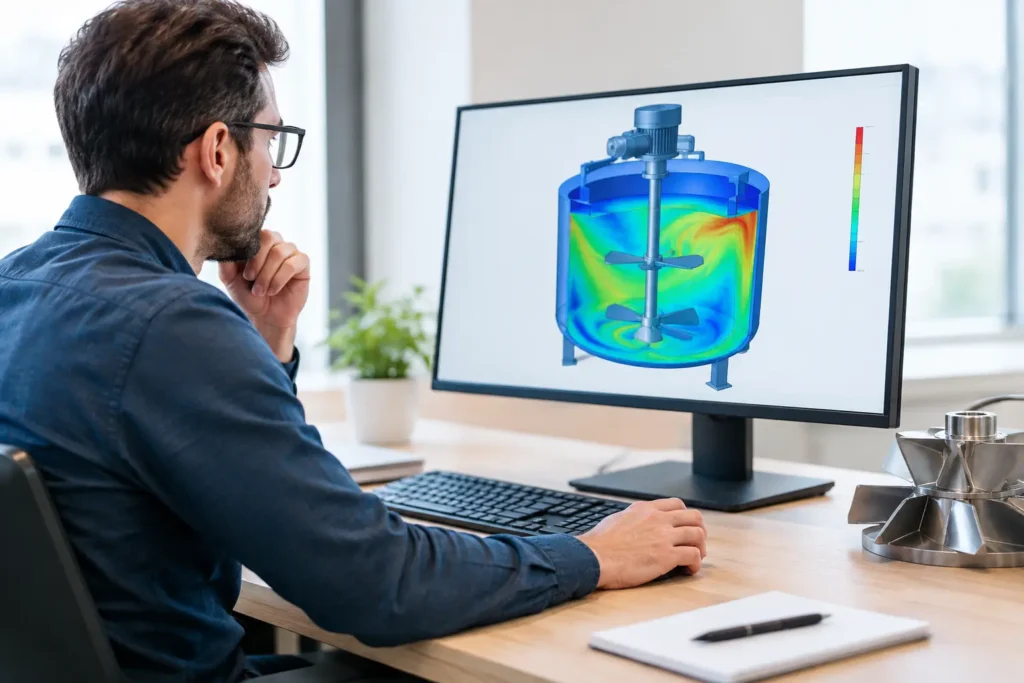
A mixing problem rarely announces itself as a mixing problem. It shows up as an off-spec batch, inconsistent additive concentration, excess pump load, air entrainment, a blocked injection point, or a tank that takes twice as long to turn over as expected. Mixer simulation services give process teams a way to evaluate those risks before committing to a mixer, static mixer, injection quill, piping layout, or complete skid.
For industrial buyers, the value is not a colorful flow image. The value is a defensible equipment decision based on expected velocity profiles, pressure drop, shear exposure, phase distribution, and residence time. That matters when process changes are expensive, shutdown windows are short, and production consistency is nonnegotiable.
What mixer simulation services are designed to answer
Most industrial mixing studies use computational fluid dynamics, commonly called CFD, to model how fluids move through piping, static mixer elements, injection points, and vessels. The model translates operating conditions and equipment geometry into predictions that engineering and operations teams can use during design or troubleshooting.
For an inline application, a simulation may determine whether a chemical injected into a carrier stream reaches the required concentration uniformity before the next control point, filter, reactor, or analyzer. It can compare element configurations, injection locations, pipe diameters, and flow rates while identifying the pressure-drop cost of each option.
For a tank, the question is usually broader. Will the impeller create complete turnover? Is there a low-velocity region near the wall, bottom, or liquid surface? Will a high-viscosity material circulate, or will it form a stagnant zone? A study can also assess vortexing, surface drawdown, gas dispersion, solids suspension, and the effect of baffles, off-center mounting, or multiple impellers.
Simulation is especially useful when the process does not fit a standard selection chart. Standard mixer sizing remains highly effective for many established services. But unusual rheology, variable flow rates, tight piping constraints, corrosive chemistry, multiphase flow, or strict uniformity requirements can make a physical model far more valuable.
The process data that determines a useful result
A simulation is only as credible as the process information behind it. Geometry matters, but operating reality matters more. A model built around nominal conditions may miss the actual issue if the system spends most of its operating life at turndown, startup, or peak flow.
The most useful inputs include:
- Fluid density, viscosity, and whether viscosity changes with shear, temperature, or concentration
- Flow-rate range, not only the design flow rate
- Pipe, vessel, nozzle, and injection-point dimensions
- Additive flow rate, concentration, density, and injection pressure
- Existing or proposed mixer geometry, including element count or impeller details
- Allowable pressure drop, mixing target, batch time, and relevant operating constraints
For non-Newtonian fluids, this work becomes more dependent on good data. A product that appears to have one viscosity on a specification sheet may behave very differently under pumping and mixing shear. Where the material model is uncertain, the right approach may be to evaluate a range of plausible rheological conditions rather than present one result as absolute.
The same principle applies to two-phase systems. Liquid-liquid emulsions, gas-liquid dispersion, and solids suspension can be modeled, but they require clear assumptions about droplet size, particle properties, coalescence, settling, and other process behavior. Simulation narrows the design range and identifies likely failure modes. It does not eliminate the need for application testing when the final product quality depends on highly sensitive multiphase behavior.
Static mixer simulation: balancing uniformity and pressure drop
Static mixers offer a straightforward trade-off: more mixing elements and more aggressive geometry generally improve distribution, but they also increase pressure drop. The correct design is not automatically the longest mixer body or the most intensive element style. It is the configuration that reaches the required blend quality within the available hydraulic budget.
A simulation can show whether the process reaches acceptable homogeneity in a short section of pipe or requires additional elements. It can also reveal whether the injection point is creating a concentrated stream that remains near the pipe wall despite an otherwise capable static mixer. In those cases, moving the injection quill, changing injection orientation, or selecting a different mixer diameter can be more effective than simply adding length.
This is particularly relevant for chemical dosing, pH adjustment, coagulant addition, disinfectant injection, polymer activation, and dilution systems. The downstream process may require a repeatable concentration profile, while the pump and piping system can only tolerate a limited pressure loss. Modeling helps put those requirements on the same engineering basis.
Material selection should be considered at the same time. A static mixer may require 316 stainless steel, specialty alloy, PVDF, PFA, PVC, CPVC, or a lined construction based on temperature, chemical compatibility, cleanliness requirements, and mechanical duty. A hydraulically correct mixer built from the wrong material is not a workable solution.
Tank mixer simulation: finding dead zones before startup
Tank agitation problems often originate in vessel geometry rather than motor horsepower. A poorly placed impeller can produce high turbulence near the shaft while leaving remote areas under-mixed. A larger motor does not automatically correct poor circulation paths.
Tank mixer simulation evaluates the relationship between impeller type, diameter, speed, liquid level, baffle arrangement, and vessel shape. Axial-flow impellers may be well suited for bulk circulation and blending. Radial-flow designs can provide intense local shear. High-shear and ultra-high-shear equipment may be required when dispersion or emulsification is the primary duty rather than simple blending.
The operating objective should drive the model. A blend-time target requires a different evaluation than solids suspension. Emulsification requires attention to local energy dissipation and recirculation through the high-shear zone. Heat-transfer duty may require confirmation that fluid reaches jacketed surfaces instead of bypassing them through a narrow circulation loop.
There are also mechanical constraints. Top-entry, side-entry, portable, and magnetic-drive mixers each have different mounting, sealing, maintenance, and access considerations. Simulation should support a complete selection, not treat the impeller as an isolated component.
When a study provides the highest return
Mixer simulation services are most valuable when the financial consequence of a wrong choice exceeds the cost and time of analysis. That threshold is reached quickly for large vessels, high-value products, hazardous chemicals, costly downtime, or systems that are difficult to modify after installation.
They are also effective in troubleshooting. If a current process has variable product quality, poor chemical distribution, unexplained pressure loss, or recurring fouling near an injection location, a model can identify likely hydraulic causes without repeated trial-and-error modifications. The findings may support a new static mixer, revised injection quill, changed impeller configuration, or a targeted piping adjustment.
Not every application needs a full CFD study. A standard water-like liquid blended at stable flow through a conventional inline mixer can often be selected from established design methods. The decision depends on process criticality, uncertainty, and the cost of being wrong. Engineering effort should match the risk.
Turning simulation results into buildable equipment
The most useful report is one that leads directly to a practical equipment package. Results should connect fluid behavior to specifications: mixer diameter and length, element style, allowable pressure drop, injection-quill position, impeller design, motor speed, shaft arrangement, materials, connections, and instrumentation needs.
That connection is where an equipment-focused engineering partner adds value. ProMixUSA can pair application analysis with custom static mixers, tank mixers, injection equipment, and complete static mixing skid systems built around the actual process constraints. The goal is not to model an idealized system. It is to deliver equipment that can be fabricated, installed, operated, and maintained in the plant.
A well-run simulation does more than confirm a selection. It exposes the assumptions that deserve attention before purchase order release. When flow conditions, chemical properties, and installation limits are addressed early, the final mixing system has a far better chance of producing repeatable results on its first day of operation.