
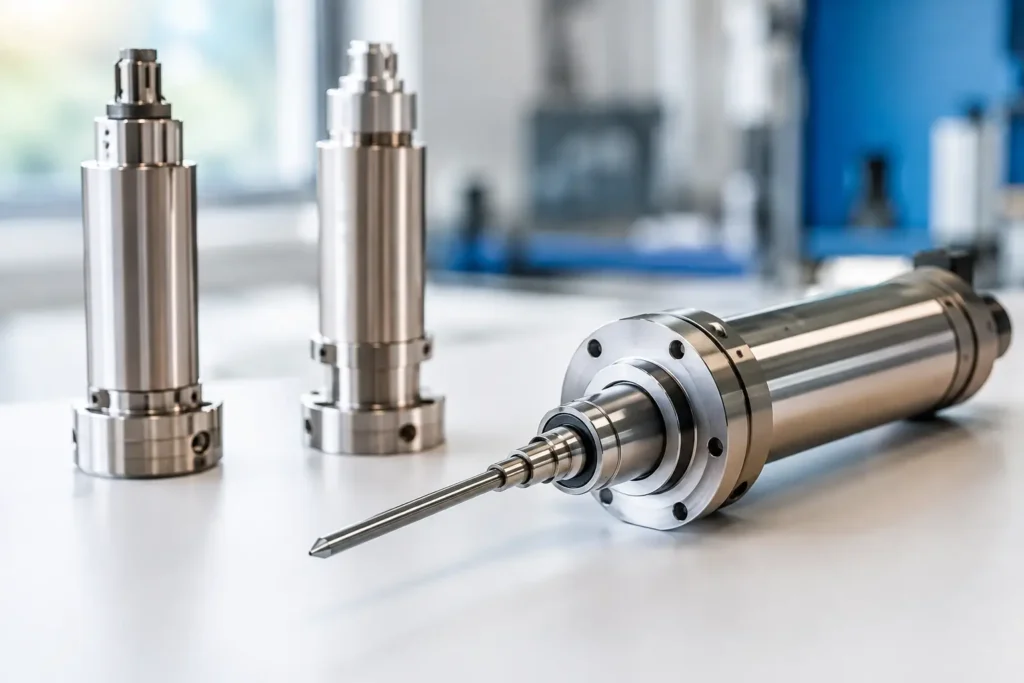
A chemical injection point can become the highest-risk fitting on a process line when it is difficult to isolate, impossible to inspect under pressure, or positioned where the chemical never reaches the flowing stream. Retractable injection quill applications address that operating reality by allowing a plant to insert, service, or remove an injection device without a full line shutdown when the assembly is correctly engineered for the service.
For process engineers and maintenance leaders, the value is not simply convenience. A retractable quill can protect personnel during chemical handling, reduce downtime, preserve injection accuracy, and provide access to a component exposed to corrosion, fouling, vibration, and pressure cycling. The design must still match line pressure, piping geometry, chemical properties, insertion depth, and required isolation method. A retractable quill is a controlled access system, not a universal replacement for every fixed injection point.
Where Retractable Injection Quill Applications Add Value
The most common use is continuous chemical injection into pressurized pipelines. Water and wastewater systems may dose disinfectants, coagulants, pH-control chemicals, corrosion inhibitors, or polymer solutions. Chemical processing lines may inject catalysts, neutralizers, antiscalants, inhibitors, dyes, oxidizers, or reactants. Oil and gas, power generation, pulp and paper, food processing, and industrial utilities also depend on repeatable low-volume dosing into moving process streams.
In these services, the quill extends the injection outlet beyond the pipe wall and into a selected point within the flowing fluid. That placement helps prevent a concentrated chemical stream from washing directly along the inner pipe wall, which can accelerate localized corrosion, deposits, or liner damage. It also gives the chemical a better starting position for dispersion before the stream reaches a downstream vessel, heat exchanger, analyzer, filter, or static mixer.
Retractable construction is especially useful when the injection tip is expected to wear or plug. A fixed quill may require depressurizing and isolating an entire section of piping before service. A properly specified retractable assembly uses an isolation valve and controlled withdrawal arrangement so the quill can be removed for inspection or replacement while the line remains in operation. This is often justified where shutdowns interrupt production, compromise treatment capacity, or create a difficult startup sequence.
Safe Chemical Injection Depends on More Than the Quill
A retractable quill should be selected as part of the injection system, not as an isolated pipe fitting. The chemical feed pump, tubing, backpressure conditions, check valve, isolation valve, pipe pressure, temperature, and downstream mixing requirement all affect performance.
The first engineering question is whether the chemical can be injected safely at the available differential pressure. If process pressure exceeds injection pressure, process fluid can backflow into the injection assembly. A suitable check valve and a properly designed injection arrangement are essential, but a check valve is not a substitute for reviewing the full pressure scenario. Consider normal pressure, pump deadhead pressure, upset conditions, valve closures, and the pressure present during maintenance.
Isolation is equally critical. Many retractable designs use a full-port ball valve, gate valve, or other isolation valve that permits passage of the quill assembly during insertion and withdrawal. The valve bore must accommodate the quill geometry, and the pressure rating of every wetted and pressure-retaining component must suit the process. Operators also need a defined procedure for insertion, locking, withdrawal, depressurization of the retrieval chamber when applicable, and confirmation that isolation is complete.
For hazardous, toxic, flammable, or highly corrosive chemicals, the design may require additional containment, purge capability, double isolation, special packing arrangements, or engineered retrieval hardware. The right approach depends on the plant's safety analysis and operating procedures. A simple retractable assembly may be appropriate for moderate-pressure utility dosing, while severe service can demand a more specialized engineered package.
Insertion Depth and Injection Orientation
Quill placement has a direct effect on chemical distribution and pipe-wall protection. In many applications, the discharge point is located near the pipe centerline or into the more turbulent region of flow. The best position depends on pipe diameter, velocity profile, orientation, chemical flow rate, nozzle design, and the distance available before the next critical process component.
Injecting too close to the wall can create a concentrated boundary layer. With aggressive chemicals, that can lead to corrosion under deposits, premature degradation of polymer piping, or damage to lined pipe systems. Extending the quill too far can introduce its own problems, including vibration, flow disturbance, mechanical damage from solids, or interference with pigging operations.
Orientation also matters. A downstream-facing tip may reduce direct impingement and drag in some liquid services. Other applications benefit from a lateral or upstream-directed discharge to improve momentum and dispersion. There is no single orientation that fits every system. The practical target is a placement that avoids wall attack and gives the injected chemical sufficient contact with the bulk flow.
Mixing Requirements After Injection
An injection quill delivers chemical into a pipeline. It does not automatically guarantee homogeneous concentration downstream. Turbulent flow may provide sufficient dispersion for some low-dose, low-viscosity chemical feeds when adequate straight-run distance is available. Laminar flow, high-viscosity fluids, short downstream runs, and reactions requiring fast uniformity may need more than pipe turbulence can provide.
This is where an inline static mixer is often paired with the quill. The quill establishes a controlled injection point, while static mixing elements divide and redirect the combined flow to create repeatable blending. The combination can improve chemical utilization, reduce overdosing, stabilize downstream measurements, and shorten the distance required to reach concentration uniformity.
The trade-off is pressure drop. A static mixer must be sized around flow range, fluid viscosity, density, allowable pressure loss, and required mixing quality. In applications with solids, fibers, or scale-forming chemistry, element geometry and cleanability deserve close attention. An injection system that mixes exceptionally well but plugs every few weeks is not a process improvement.
Applications That Commonly Benefit
Retractable quills are frequently specified where injection reliability and maintainability have a measurable production or compliance impact. Common examples include:
- Chlorine, sodium hypochlorite, chlorine dioxide, caustic, acid, and coagulant dosing in municipal and industrial water treatment.
- Corrosion inhibitor, biocide, demulsifier, drag reducer, and scale inhibitor injection in energy and pipeline systems.
- pH adjustment, catalyst addition, neutralization, oxidation, and reaction control in chemical manufacturing.
- Additive injection ahead of static mixers, reactors, separation equipment, or quality-control analyzers.
- Cleaning chemicals, processing aids, and controlled ingredient additions in sanitary systems when materials and surface finish meet the process requirement.
Each case should be evaluated for chemical compatibility and maintenance exposure. Sodium hypochlorite service, for example, may favor PVC, CPVC, PVDF, or other compatible nonmetallic wetted materials depending on concentration and temperature. Strong acids, chlorides, solvents, high temperatures, and abrasive slurries can shift the decision toward specialty alloys, PFA-lined components, or a different injection strategy entirely.
Specifying a Retractable Quill for Real Operating Conditions
A useful specification starts with the process line, not the catalog description. Provide the pipe size and schedule, line material, connection type, operating and design pressure, operating and design temperature, fluid properties, flow range, and pipe orientation. Then define the injected chemical, concentration, injection rate, viscosity, specific gravity, vapor pressure where relevant, and any solids or crystallization tendency.
Also identify how the quill will be maintained. Will maintenance personnel need to remove it during operation? Is there physical clearance for withdrawal? Does the location require a locking device, a support bracket, or a handling tool? Is the line insulated, elevated, or located in a classified area? These details determine whether a retractable design offers a genuine operating advantage or adds unnecessary complexity.
Connection selection deserves the same attention. Threaded, flanged, sanitary clamp, socket weld, and custom connections each have different service limits and maintenance implications. A quill for a compact skid may use a different arrangement than one installed on a large field pipeline. Materials, seals, packing, valve style, and wetted construction must be selected as a complete assembly.
ProMixUSA supports fixed and retractable injection quills alongside static mixers and complete injection and mixing systems, allowing the injection point and downstream blending equipment to be engineered around the same process objective. That coordination matters when chemical feed accuracy, mixing distance, material compatibility, and shutdown avoidance are all part of the purchase decision.
A retractable quill earns its place when it makes a difficult injection point safer to own and easier to maintain. Specify it around actual line conditions, give the injected chemical a deliberate path into the process stream, and verify what happens downstream. Those decisions turn a serviceable fitting into a dependable chemical injection system.