
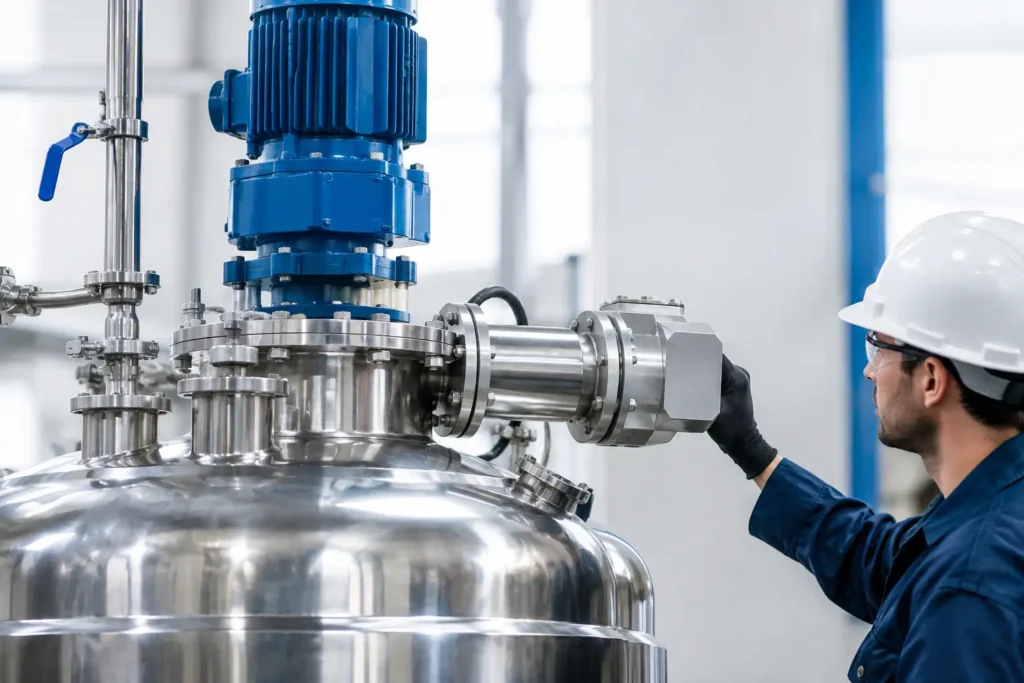
A 500,000-gallon storage tank can look calm at the surface while stratification, temperature gradients, settled solids, or water bottoms develop below it. Side entry mixer applications address that problem from the tank wall, generating controlled bulk circulation without requiring a long shaft and drive assembly from the roof. For large-volume storage and process tanks, that mounting arrangement can reduce installation complexity while delivering the turnover needed to protect product quality.
The correct side entry mixer is not selected by tank volume alone. Fluid viscosity, density differences, available mounting elevation, impeller diameter, tank geometry, solids characteristics, and the actual mixing objective all determine whether a side-mounted unit is the right answer. A mixer intended to blend two compatible hydrocarbon streams is fundamentally different from one expected to keep abrasive mineral solids off the floor.
Where Side Entry Mixer Applications Deliver Value
Side entry mixers are widely used where a tank needs continuous or periodic circulation, but top-entry access is constrained by roof structure, internal equipment, vapor-control hardware, or maintenance considerations. The drive mounts through a shell nozzle, with the shaft and impeller extending into the vessel. This arrangement is particularly effective in large, low-viscosity liquid inventories where axial-flow impellers can establish broad circulation patterns.
Petroleum, fuel, and terminal storage
Fuel terminals, refinery tank farms, and lubricant storage operations use side entry mixers to maintain homogeneity in products that can stratify during storage. Common duties include blending additive packages, reducing temperature variation, mixing different product receipts, and preventing water or sludge from remaining concentrated at the tank bottom.
For crude oil service, mixer placement and impeller direction matter as much as motor horsepower. The design must produce enough floor-sweeping velocity to mobilize settled material without creating unnecessary vortexing or disturbing water bottoms when separation is required. In many tanks, two or more mixers positioned around the shell are more effective than one oversized unit because they eliminate stagnant zones and provide a more balanced circulation pattern.
Chemical storage and batch preparation
Chemical manufacturers and bulk chemical distributors often store acids, caustics, polymers, solvents, glycols, brines, and formulated intermediates in tanks that require consistent concentration before transfer or downstream dosing. A side entry mixer can maintain uniformity between batches, circulate a solution after chemical addition, or support dissolution when the process does not demand high shear.
Materials selection is central in this service. Wetted components may require 316 stainless steel, duplex alloys, specialty nickel alloys, or engineered polymers and linings based on corrosion risk, chloride exposure, solvent compatibility, and operating temperature. Seal selection also deserves close review. A seal that performs reliably in clean hydrocarbon service may not be appropriate for a corrosive, crystallizing, or hazardous chemical.
Water, wastewater, and industrial treatment systems
Large equalization, storage, and treatment tanks can use side entry mixers to prevent settling, equalize chemical concentration, and maintain a uniform feed to subsequent treatment stages. Applications include lime or slurry management, coagulation aid blending, pH-adjustment chemical storage, process-water conditioning, and industrial wastewater holding.
These duties can be more difficult than they first appear. Suspended solids may settle rapidly during shutdown, while fibrous material, scale, or precipitates can accumulate around the impeller. A design that works in clean water may lack the torque reserve, impeller geometry, or mounting location needed for a solids-bearing stream. For abrasive service, engineers should evaluate shaft deflection, wear protection, seal flush needs, and the consequences of starting against a settled bed.
Food, beverage, and sanitary liquid storage
Edible oils, syrups, liquid sweeteners, beverage ingredients, and other sanitary products can require gentle tank circulation to maintain temperature and composition. Side entry mixers may be considered when vessel size makes a roof-mounted drive impractical or when access conditions favor shell mounting.
The trade-off is sanitary design. Product-contact materials, surface finish, clean-in-place coverage, drainability, and seal hygiene must match the facility's standards. Some sanitary duties are better served by a top-entry or bottom-entry design, especially where complete drainage or very high cleanability is non-negotiable. Side entry equipment remains viable when the vessel connection, internal geometry, and cleaning program are engineered as a complete system rather than treated as an afterthought.
Matching the Mixer to the Mixing Duty
“Mixing” is too broad to specify equipment. Side entry mixer applications generally fall into circulation, blending, solids suspension, heat transfer, or tank cleanup. Each calls for a different hydraulic result.
For circulation and temperature equalization, the goal is usually bulk turnover. An axial-flow impeller moves a high volume of liquid at relatively low shear, creating a loop through the tank. This is often the preferred approach for fuels, oils, brines, and low-viscosity chemical inventories.
For blending, the question is how quickly a newly introduced component must disperse throughout the tank. Injection point location, feed rate, density difference, and mixer-induced velocity all affect blend time. Introducing a heavy additive directly into a weak-flow area can extend mixing time dramatically, even when the installed motor has adequate power.
For solids suspension, the critical criterion may be just-suspended speed: the point at which particles no longer remain stationary on the tank floor. That duty typically requires more energy than simple liquid blending. Particle size, concentration, density, and settling rate must be defined before selecting a mixer. If the real requirement is dispersion of powders, emulsification, or particle-size reduction, a side entry mixer alone may not provide sufficient shear. A high-shear mixer, recirculation loop, or static mixing system may be the better process solution.
Heat transfer is another frequent driver. Tanks with heating coils, jackets, or recirculated thermal fluid benefit when the product moves consistently across heat-transfer surfaces. Good circulation reduces localized hot or cold zones and can shorten heating or cooling cycles. However, a high-viscosity product may demand a different mixer style entirely. Side entry systems are strongest in large tanks containing low- to medium-viscosity fluids, not every thermal process.
Engineering Details That Determine Field Performance
A reliable installation begins with tank and process data, not a catalog motor size. Engineers should establish the working and maximum liquid levels, tank diameter and height, bottom shape, nozzle size and elevation, internal obstructions, liquid properties across the operating temperature range, and required blend or suspension time. Existing tank drawings are valuable because heating coils, suction lines, columns, and level instruments can disrupt intended flow paths.
Impeller selection determines whether the mixer develops axial circulation, radial discharge, or a combination of both. For most large storage tanks, a properly sized axial-flow impeller provides efficient pumping action. The shaft angle and direction of rotation are then set to sweep the floor, promote vertical turnover, and avoid directing flow into a nearby outlet or obstruction.
Mechanical details deserve equal attention. The tank nozzle and reinforcement must support the mixer load. Shaft length affects critical speed and deflection. Seal arrangement should reflect pressure, vapor exposure, emissions requirements, and maintenance practices. In outdoor terminals, weather protection, motor classification, gearbox service factor, and access for lifting equipment are practical parts of the specification.
Multiple smaller mixers can offer operational advantages over a single large unit. They may permit staged operation, provide redundancy, and improve coverage in very large diameter tanks. The downside is added capital cost, more penetrations, and more maintenance points. There is no universal configuration: the best arrangement follows the mixing duty and tank layout.
Maintenance Access Is a Major Advantage
Because the motor, gearbox, and seal housing are located at the tank shell, side entry mixers can simplify routine inspection compared with roof-mounted equipment. Maintenance teams can service external drive components from a platform or grade-level access area without working above the tank roof. This can reduce downtime and improve job planning, particularly where roof access is limited.
That advantage does not eliminate maintenance requirements. Alignment, seal condition, gearbox lubrication, vibration trends, motor load, and fastener integrity still need scheduled attention. Facilities operating sticky, abrasive, or solids-laden products should also plan for cleaning and inspection intervals based on actual service history rather than a generic calendar schedule.
Specify the System, Not Just the Mixer
The strongest side entry mixer specification connects process performance with mechanical reality. It defines the liquid, the duty, the target result, the tank geometry, material compatibility, electrical classification, seal requirements, and maintenance constraints. It also recognizes when side entry mixing is not the best fit.
ProMixUSA engineers side entry tank mixers around the application, from ready-to-ship equipment for straightforward storage duties to custom configurations for difficult chemical, solids, and large-tank service. When the process data is clear, the resulting system can deliver repeatable circulation where the tank needs it most – at the product, not just at the surface.