
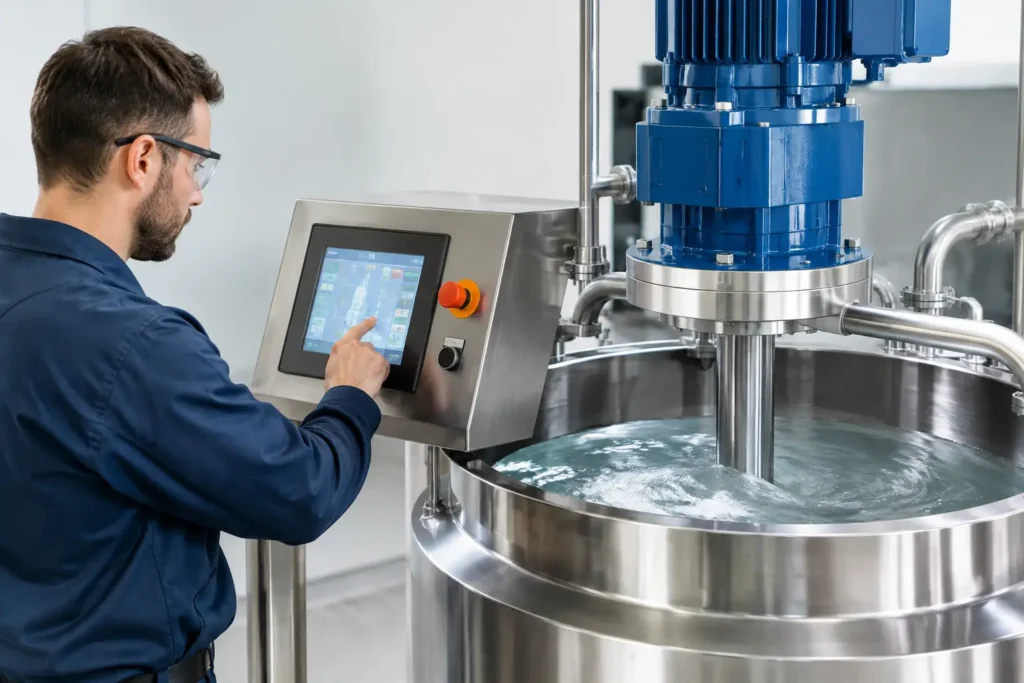
A static mixer can produce highly repeatable results without a motor. A tank mixer can generate the circulation and shear a batch requires. But mixer automation is what keeps either process performing as operating conditions shift – when flow rate changes, a feed concentration drifts, a vessel level falls, or a new product recipe enters production.
For process engineers and plant teams, automation is not simply adding a variable-frequency drive or placing a mixer on a timer. It is the coordinated use of instruments, control logic, mechanical equipment, and operating data to maintain a defined mixing outcome. That outcome may be dilution uniformity, emulsion quality, pH control, polymer activation, chemical dosing accuracy, reaction consistency, or safe treatment of a difficult stream.
The right approach depends on the process. Some applications need a basic start-stop sequence and a permissive tied to vessel level. Others need closed-loop dosing, flow-proportional injection, recipe management, feedback from analytical instruments, and documented batch records. The common requirement is clear: the automation strategy must match the mixing physics.
What Mixer Automation Controls
Mechanical mixing performance is determined by more than motor speed. Impeller diameter, blade design, liquid level, viscosity, density, baffle arrangement, vessel geometry, and process temperature all influence circulation patterns and power demand. Automation gives operators a practical way to manage the variables that can change during production.
On an agitated tank, the most common control point is mixer speed. A variable-frequency drive allows the motor to ramp smoothly, operate at a selected RPM, and adjust speed based on a recipe, level, viscosity proxy, or process measurement. A speed command alone, however, does not confirm that material is mixed. A mixer can run at its target RPM while the tank contains an unmixed high-viscosity zone, an air vortex, or a poorly distributed additive.
That is why better systems combine speed control with process feedback. A level transmitter can prevent operation at an unsafe low liquid level. Motor current can signal rising viscosity, impeller fouling, or a mechanical problem. Temperature can indicate whether mixing and heat transfer are proceeding as expected. Conductivity, pH, density, turbidity, or concentration analyzers can provide direct evidence that the target blend or treatment condition has been reached.
For inline applications, automation often centers on flow and injection ratio. A static mixer has no moving parts to control, but its performance depends on maintaining flow conditions within the design envelope. Flowmeters, pressure transmitters, control valves, metering pumps, and injection quills work together to place a chemical at the correct location and dosage before the mixed stream reaches downstream equipment.
Start With the Mixing Objective, Not the Controls Package
The most expensive automation mistake is specifying controls before defining what “mixed” means. A requirement such as “automatically blend chemical” is too broad for equipment selection or control design. The process team should establish the required uniformity, batch time, throughput, allowable dosing error, operating range, and response required when feed conditions change.
Consider a water-treatment chemical injection system. If the carrier-water flow varies widely, running a chemical metering pump at one fixed rate will change the dose as flow changes. Flow-paced control can maintain a programmed ratio by adjusting the pump output to the measured carrier flow. If residual chemistry must remain within a narrow band, an analyzer may provide trim control. That second layer can improve results, but only if the analyzer response time, sample conditioning, and control-loop tuning support it.
The same logic applies to tank batches. A recipe may command a fill volume, establish an agitator speed, add ingredients in sequence, hold for a defined mix time, and release the batch only after required conditions are met. This can prevent skipped steps and reduce reliance on manual timing. Yet a timed hold is not always a substitute for validation. Products with changing viscosity, solids content, or temperature may require confirmation through torque, density, sampling, or another quality indicator.
Choose Instruments That Survive the Service
A control strategy is only as dependable as its measurements. Instrument selection should account for chemical compatibility, temperature, pressure, solids, coating tendency, sanitary requirements, hazardous-area classification, and the accessibility needed for calibration and maintenance.
Flow measurement deserves particular attention in inline mixing and chemical injection. Magnetic flowmeters are often suitable for conductive liquids, while Coriolis meters can provide mass flow and density information for demanding dosing services. Ultrasonic, turbine, positive-displacement, and differential-pressure technologies each have useful applications, but no meter type is universally correct. Entrained gas, low conductivity, pulsating pump discharge, non-Newtonian fluids, and limited straight-run piping can all affect accuracy.
Pressure monitoring can be equally valuable. A rising pressure drop across a static mixer may indicate fouling, a viscosity change, or a flow condition outside the original design basis. On an injection assembly, pressure information helps verify that the injected chemical can enter the process line against system backpressure. The controls should alarm on meaningful deviation, not every normal fluctuation. Alarm fatigue teaches operators to ignore the warnings that matter.
Materials selection is part of automation reliability. A sensor wetted surface, injection quill, static mixer, valve, or pump that is not compatible with the chemical will eventually create false readings, leaks, contamination, or downtime. Stainless steel, specialty alloys, PVC, CPVC, PVDF, PFA, and lined constructions each serve specific process conditions. The correct choice must consider both the normal fluid and cleaning, flushing, or upset chemicals.
Build Safety Into Sequences and Interlocks
Automation should make the process safer to operate, not merely easier to start. The control narrative should define what happens before a mixer starts, while it runs, during an alarm, and after a power interruption or emergency shutdown.
A typical tank mixer may require confirmation of adequate liquid level, closed access covers, available utilities, and a healthy drive status before starting. High-level protection can prevent overfill during automated ingredient addition. A low-level interlock can protect equipment and reduce splashing or vortex-related air entrainment. For hazardous chemicals, an injection skid may need permissives tied to ventilation, containment status, carrier flow, and pump discharge pressure.
There are trade-offs. Interlocks that are too broad can stop production for minor disturbances and encourage unauthorized bypassing. Interlocks that are too permissive can leave operators exposed to avoidable hazards. The right design separates process alarms, equipment protection, and personnel safety functions, then gives each the appropriate response and reset requirements.
Use Data to Improve the Process, Not Just Record It
A programmable logic controller and human-machine interface can provide recipes, trends, alarm history, and batch reporting. Those functions are useful only when the selected data explains process behavior. Trending agitator speed, motor load, temperature, flow, dosing rate, pressure drop, and quality measurements can reveal patterns that a single operator screen cannot.
For example, a gradual increase in mixer motor load at the same RPM may point to a raw-material change or thickening process. Repeated pressure-drop excursions through an inline mixer can signal inconsistent upstream filtration. A chemical dose that rises every time carrier flow accelerates may expose a metering-pump sizing or control-valve problem. These are actionable findings, not just stored numbers.
The data architecture should remain proportionate to the operation. A small standalone blending station may only need local control, a few critical alarms, and simple data logging. A multi-product production line may justify plant-network integration, batch management, historian storage, user permissions, and electronic records. More automation adds capability, but it also adds commissioning effort, cybersecurity responsibilities, training needs, and maintenance requirements.
Design the Equipment and Controls as One System
Controls cannot correct an improperly sized mixer, a poor injection point, or a static mixer selected without regard to flow range and pressure drop. Conversely, well-designed hardware can underperform when its instruments are installed in the wrong location or its operating sequence ignores residence time and mixing response.
An effective project starts with process conditions: minimum and maximum flow, fluid properties, viscosity profile, temperature, pressure, target blend quality, chemical compatibility, available utilities, and required connection standards. From there, the equipment supplier, controls integrator, and plant team can establish the mixer geometry, motor and drive arrangement, injection-quill placement, instrumentation, control philosophy, and startup test plan.
Factory testing and commissioning should verify more than rotation direction and signal response. Confirm actual flow ranges, pump turndown, alarm setpoints, mixer ramp rates, interlock performance, calibration procedures, and product-quality acceptance criteria. If the process relies on an analyzer for closed-loop control, test its lag time and failure response before relying on it in production.
ProMixUSA supports these decisions with application-specific mixing equipment, injection components, and complete static mixing systems engineered around the realities of industrial service. The strongest automation projects treat the mixer, piping, instruments, and controls as one operating system – because the process will only be as repeatable as the weakest connection in that system.