
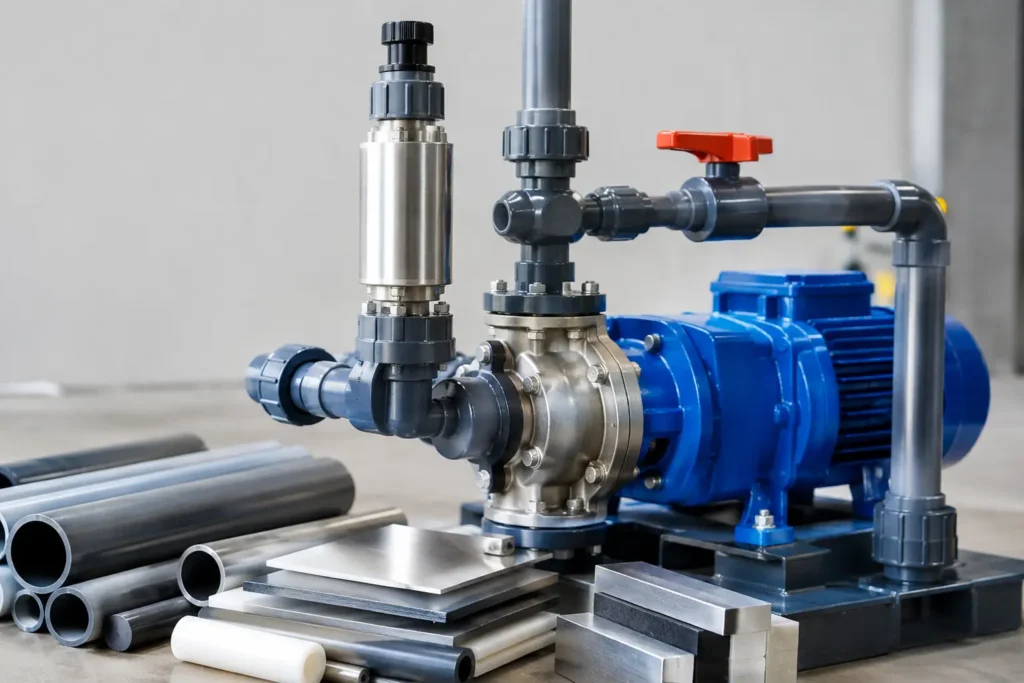
Acid injection failures usually start at the wetted surface
An acid injection system can have the correct dosing rate, a well-designed injection point, and a dependable metering pump, yet still fail prematurely because one wetted component was specified for the wrong chemical condition. Selecting the best materials for acid injection means evaluating more than the acid name on the container. Concentration, operating temperature, pressure, flow velocity, contaminants, cleaning procedures, and upset conditions all change the compatibility decision.
For an injection quill, the material choice extends beyond the quill tube. The process connection, flange face, gasket, isolation valve, check valve, O-rings, fasteners, and any static mixer downstream may see the same corrosive service. A system is only as resistant as its least compatible wetted component.
Start with the actual acid service
Material charts are useful screening tools, but they cannot replace application-level review. An entry labeled “excellent” may apply only at ambient temperature, at a limited concentration range, or under low-pressure conditions. Acid dilution can also produce localized heat at the injection point, creating a much harsher environment than the bulk process stream.
Define the service before selecting a metal or polymer. At a minimum, the specification should state the acid chemistry, concentration by weight, normal and maximum temperature, system pressure, injection rate, carrier-fluid composition, and expected operating cycle. Include cleaning chemicals, flush media, trace chlorides, oxidizers, abrasives, and possible backflow conditions. These details often determine whether a standard material is appropriate or a custom assembly is required.
The injection point deserves special attention. A quill tip may experience high local velocity, turbulence, pressure fluctuations, and direct contact with concentrated chemical before dilution occurs. A material that survives in a storage tank may not survive at the point of injection.
Best materials for acid injection by material family
PVDF for broad chemical resistance
PVDF is frequently a strong choice for acid injection quills, chemical-feed piping, fittings, and valve components. It provides very good resistance to many mineral acids and maintains useful mechanical performance at elevated temperatures compared with PVC or CPVC. Its smooth surface and corrosion resistance make it particularly suitable for clean chemical-dosing applications where metallic contamination is a concern.
PVDF does have limits. Pressure capability depends on wall thickness, temperature, connection design, and mechanical support. Long unsupported quills, high-vibration piping, abrasive service, and high-temperature duty may require a different construction or external reinforcement. Thermal expansion also needs to be considered during installation.
PTFE and PFA for difficult acid chemistry
PTFE and PFA offer some of the broadest chemical resistance available for wetted acid-service components. These fluoropolymers are commonly used for gaskets, seals, valve seats, lined piping, and lined injection assemblies where concentrated acids or aggressive oxidizing conditions rule out common metals and standard thermoplastics.
PFA is often preferred where a melt-processable fluoropolymer or smoother fabricated geometry is needed. PTFE remains a proven option for sealing surfaces and chemical-contact linings. Both materials bring trade-offs: they have lower structural strength than metal, can creep under load, and require careful gasket compression and mechanical design. A fluoropolymer lining protects the process surface, but the underlying shell, flange design, and liner termination must also be engineered for the pressure and temperature cycle.
PVC and CPVC for economical moderate service
PVC and CPVC are practical materials for many lower-temperature acid dosing applications. They are cost-effective, widely available, and easy to configure with common pipe connections. CPVC generally provides a higher temperature capability than PVC, making it the better candidate when operating temperature approaches the limits of standard PVC equipment.
Neither should be treated as a universal acid material. High temperature, concentrated oxidizing acids, external mechanical loads, UV exposure, and pressure transients can narrow the safe operating range. For injection quills installed into large process lines, verify the cantilever load and support arrangement rather than selecting a polymer quill based on chemistry alone.
316L stainless steel for selected services
316L stainless steel provides good mechanical strength, sanitary finish options, and practical fabrication flexibility. It can be effective in selected phosphoric acid, nitric acid, and other compatible services, depending on concentration and temperature. It is often specified when a metallic quill is needed for pressure, structural rigidity, or sanitary process requirements.
However, stainless steel should never be selected simply because it is the plant standard. Hydrochloric acid and chloride-bearing service can attack 316L rapidly, especially at elevated temperature or at crevices beneath deposits and gaskets. Acid injection systems often create exactly the localized conditions where stainless steel is most vulnerable.
Alloy 20 and nickel alloys for severe duty
For demanding acid duty, alloy selection may move beyond stainless steel to Alloy 20 or nickel-based alloys such as C-276. Alloy 20 is widely recognized for sulfuric acid resistance across many conditions, while nickel alloys can provide valuable resistance in aggressive mixed-acid, chloride-containing, and elevated-temperature service.
These materials command a higher initial cost, so they should be specified for a defined corrosion mechanism rather than as a blanket upgrade. The cost can be justified when unplanned shutdowns, contamination risk, safety exposure, or repeated replacement makes a lower-cost material the more expensive option over the equipment life.
Acid chemistry changes the answer
Hydrochloric acid is a common example of why broad labels are not enough. 316L stainless steel may be suitable for other process chemicals, but it is generally a poor choice for direct hydrochloric acid injection. PVDF, PTFE, PFA, lined constructions, or selected nickel alloys may be more appropriate, depending on temperature, concentration, pressure, and mechanical requirements.
Sulfuric acid requires equally careful review. Some materials perform well in concentrated sulfuric acid at one temperature range but deteriorate when the acid is diluted, heated, or contaminated. The heat generated when sulfuric acid mixes with water can be severe at the injection zone. Quill placement, injection velocity, and downstream mixing are part of the corrosion-control strategy.
Nitric acid is strongly oxidizing and may allow use of certain stainless steels under defined conditions, but concentration and temperature remain decisive. Phosphoric acid is often less aggressive, although fluoride content, solids, and high temperature can materially change compatibility. Hydrofluoric acid requires a specialized review because it attacks glass and silica-containing materials and presents exceptional personnel hazards. Do not apply a general acid-injection material rule to HF service.
Match the material to the injection assembly
A reliable specification identifies every wetted item, not just the quill body. For example, a PVDF quill paired with an incompatible elastomer O-ring can leak before the quill itself shows any degradation. A high-alloy pipe spool can still fail at a low-grade stainless threaded fitting. The same principle applies to check valves, calibration columns, valve seats, gaskets, and static mixer elements.
Connection style matters as well. Flanged assemblies provide serviceability and controlled gasket loading. Threaded connections can be practical in smaller chemical-feed lines but introduce crevice concerns and depend heavily on compatible sealants. For sanitary or contamination-sensitive processes, polished stainless construction, sanitary clamps, and fully drainable geometry may be required, provided the chemistry supports the selected alloy.
Injection geometry also affects material life. A retractable injection quill allows maintenance without taking a process line out of service, while a fixed quill may be the right choice for stable, lower-maintenance duty. In either case, the tip should be positioned to avoid dead zones, wall impingement, and concentrated acid contact with vulnerable pipe materials.
Specify for operating reality, not normal conditions
The best material selection accounts for startup, shutdown, flushing, and loss-of-flow scenarios. Ask what happens if the carrier stream stops while the metering pump continues to run, if a check valve leaks backward, or if an operator flushes the line with a hotter or chemically different solution. These are often the conditions that cause a short service life.
For complex applications, ProMixUSA can engineer acid injection equipment around the complete duty: quill length and insertion point, material construction, connection configuration, isolation approach, and downstream mixing requirement. A properly designed static mixer or flow-conditioning section can reduce localized concentration gradients and help protect downstream equipment while improving chemical distribution.
Material compatibility is not a catalog checkbox. It is a process decision that protects operators, equipment availability, product quality, and maintenance budgets. Provide the full chemical and operating profile before finalizing the construction, and the acid injection system will be built for the service it actually has to withstand.