
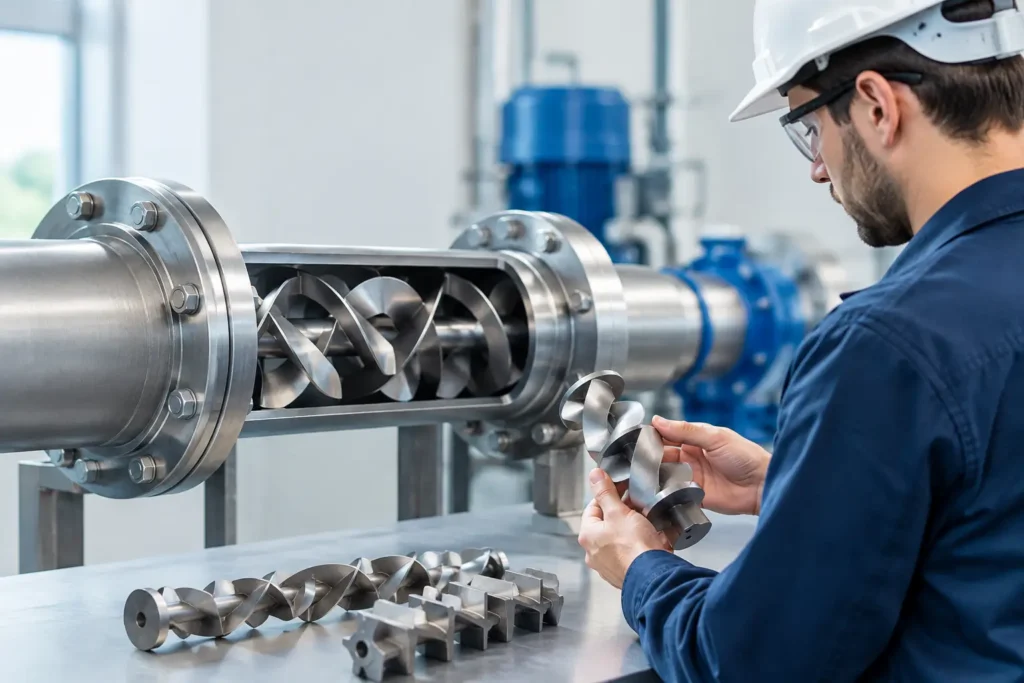
A static mixer can be a compact solution to a costly process problem, but only when the injection point, mixer geometry, flow regime, and pressure budget work together. Installing mixing elements in a pipe will not compensate for an underperforming chemical feed pump, poor feed distribution, incompatible materials, or insufficient available pressure. For industrial applications, static mixers must be specified as part of the process, not treated as a generic spool piece.
What Static Mixers Actually Do
Static mixers use fixed internal elements to repeatedly divide, rotate, redirect, and recombine flowing process streams. The energy required for mixing comes from the pressure already available in the pipeline. There are no motors, shafts, seals, or rotating impellers in the inline mixer itself.
As fluid moves through the element train, the interface between the main stream and the injected stream increases dramatically. That repeated redistribution can produce highly consistent blending, dilution, pH adjustment, neutralization, gas dispersion, polymer activation, and chemical dosing. It can also improve heat transfer where two streams enter at different temperatures.
The operating principle is straightforward, but the result depends heavily on flow conditions. In turbulent service, mixing is driven by controlled flow division and turbulence generated through the elements. In laminar service, the elements stretch and fold the fluid layers to shorten diffusion distances. A mixer that performs well at one viscosity, flow rate, or blend ratio may not provide the same result when those conditions change.
Static mixers are especially valuable where repeatability matters more than operator intervention. They are commonly installed upstream of analyzers, filters, heat exchangers, reaction zones, membrane systems, filling operations, and discharge points. For plants seeking low-maintenance inline blending, the absence of moving parts is a practical advantage. The trade-off is pressure drop, which must be engineered rather than assumed.
Start With Process Duty, Not Pipe Size
Pipe diameter is necessary information, but it is not the starting point for a successful static mixer selection. The correct design begins with the required outcome: complete blending, a target concentration profile, a controlled reaction, a stable emulsion, gas-liquid contact, or improved thermal uniformity.
Define the Fluids and the Flow Window
A credible specification includes normal, minimum, and maximum flow rates. Designing only around a nominal flow condition can leave a system undermixed during turndown or create excessive pressure loss at peak production.
Fluid viscosity is equally significant. Water-like liquids generally mix readily, while viscous oils, syrups, resins, slurries, and non-Newtonian materials require closer analysis. Viscosity should be provided at actual operating temperature, not only from a room-temperature data sheet. Specific gravity, solids content, particle size, vapor pressure, and corrosiveness can also influence the internal geometry and construction material.
Blend ratio matters as well. A low-rate chemical injection into a large carrier stream has different distribution requirements than combining two similar-volume streams. The injected stream may need to be introduced near the centerline, at multiple points, or through an injection quill designed to reach a more active flow region.
Treat Injection as Part of the Mixing System
Many apparent mixer problems start upstream of the first element. If a reagent enters as a wall-hugging stream, it may not reach the mixer in a form that supports rapid dispersion. A properly designed injection quill can place the chemical in the preferred location and direction before it enters the static mixer.
Injection velocity also deserves attention. A very low injection velocity can allow the additive to trail along the pipe wall. Excessive velocity may create localized wear, vibration, or an undesirable pressure interaction. In services involving corrosive chemicals, oxidizers, coagulants, acids, caustics, or disinfectants, safe chemical injection requires coordinated selection of the quill, check valve arrangement, materials, and mixer body.
Establish an Acceptable Pressure Drop
Pressure drop is not an incidental consequence of static mixing. It is the process energy that makes the elements work. More elements and more aggressive geometry generally improve mixing performance, but they also consume more pressure.
The available pressure budget must account for the entire system: piping, valves, injection hardware, filters, downstream equipment, and the static mixer. If a pump operates close to its limit, specifying a long element train can reduce throughput or destabilize control. Conversely, reducing element count solely to minimize pressure loss may leave concentration variation downstream.
The right design balances mixing quality and hydraulic cost. That balance is application-specific, particularly when flow varies widely or when a process stream has a high viscosity.
Select Geometry for the Required Mixing Mechanism
Not every static mixer uses the same element profile. Helical elements, corrugated elements, plate-style designs, and custom mixing configurations each create different flow patterns. The best choice depends on the fluids, Reynolds number, solids loading, cleanability requirements, and allowable pressure drop.
For clean liquid blending and chemical dosing, compact elements may provide efficient radial mixing in a relatively short length. For viscous or laminar-flow service, a longer element train may be needed to achieve the required number of fluid divisions. Gas-liquid contact, liquid-liquid emulsification, and difficult multiphase services can demand a more specialized design.
Element diameter, element length, and the total number of elements should be selected as a system. A larger mixer body may reduce velocity and pressure drop, but it can also alter mixing intensity. In some cases, reducing the pipe size around the mixer is appropriate. In others, maintaining line size is the better operational choice. This is why application data, rather than a one-size-fits-all rule, should drive the selection.
Match Materials and Connections to Real Service Conditions
A static mixer is exposed to the same chemical, temperature, pressure, and cleaning conditions as the surrounding line. Material selection must address more than basic corrosion resistance.
Stainless steel is widely used for industrial and sanitary liquid service, but chloride exposure, strong acids, elevated temperatures, and aggressive cleaning cycles may require higher-alloy materials. PVC, CPVC, PVDF, PFA, and lined constructions can be appropriate for chemical applications where metallic materials are not the preferred option. The selected material must also maintain its mechanical performance at operating temperature and pressure.
Connection details affect installation speed, maintenance access, and containment reliability. Flanged, threaded, sanitary clamp, socket, weld-end, and custom connection configurations all serve different plant requirements. Sanitary processes may require polished surfaces, drainability, and clean-in-place compatibility. Slurry or solids-bearing service may require inspection access and geometry that reduces the risk of buildup.
For OEMs and skid fabricators, a complete static mixing system may include the mixer body, elements, injection quill, isolation valves, calibration equipment, instrumentation connections, supports, and control interfaces. Defining those interfaces early prevents field modifications that compromise flow distribution or serviceability.
Know When a Static Mixer Is Not the Right Tool
Static mixers are highly effective for continuous inline operations, but they are not a replacement for every mechanical mixing duty. A tank mixer is usually the better choice when a vessel requires bulk circulation, solids suspension, batch blending, or ongoing agitation during hold time. High-shear equipment may be necessary when the process requires a specific droplet size, powder wet-out, or intense emulsification beyond what an inline static element train can provide.
They also require a flowing process stream. A static mixer cannot create circulation in a stagnant vessel, and it cannot provide mixing when the line is not operating. Fouling, crystallizing, curing, or high-solids materials may require removable elements, larger passages, flushing provisions, or a different mixing approach altogether.
The strongest designs use the right equipment at the right point in the process. A tank mixer can prepare a batch, a feed pump can control delivery, an injection quill can introduce the reagent safely, and a static mixer can provide repeatable final blending immediately before use.
Data That Produces a Defensible Specification
A static mixer supplier can move faster and provide a more dependable recommendation when the process information is complete. For complex service, provide the following details:
- Minimum, normal, and maximum flow rates for every stream
- Fluid composition, viscosity, density, temperature, and solids information
- Line size, connection type, design pressure, and available pressure drop
- Injection location, dosing rate, and required downstream mixing quality
- Material compatibility requirements, cleaning method, and site constraints
Where the duty is demanding, mixer simulation and application review can verify expected pressure drop, flow distribution, and element performance before equipment is fabricated. This is particularly valuable for wide turndown ranges, high-viscosity materials, reactive chemical injection, and systems where off-spec product or chemical waste carries a high cost.
Build for Repeatable Operation
The best static mixer installation is rarely the shortest mixer that fits between two flanges. It is the design that maintains blending quality through normal operating variation, protects the injection point, stays within the pump's pressure capability, and gives maintenance teams a practical path to inspect or clean the equipment.
ProMixUSA supports that process with ready-to-ship inline mixing equipment and custom-engineered static mixer assemblies for difficult liquid and gas applications. When process data is treated as design input rather than paperwork, an inline mixer becomes a dependable control point for product quality, chemical efficiency, and safe operation.