
A batch can look mixed while still carrying the defects that matter most: oversized agglomerates, unstable emulsion droplets, undispersed powders, inconsistent viscosity, or concentrated chemical pockets. High shear mixers are built for the point where ordinary tank agitation no longer delivers the energy needed to make a uniform, repeatable product.
The correct unit is not simply the mixer with the largest motor. It is the mixer that applies shear at the right location, at the right residence time, and with a hydraulic design that supports the entire process. For chemical processing, food and beverage, personal care, coatings, pharmaceuticals, water treatment, and specialty manufacturing, that distinction affects quality, throughput, cleanup, and operating cost.
What High Shear Mixers Actually Do
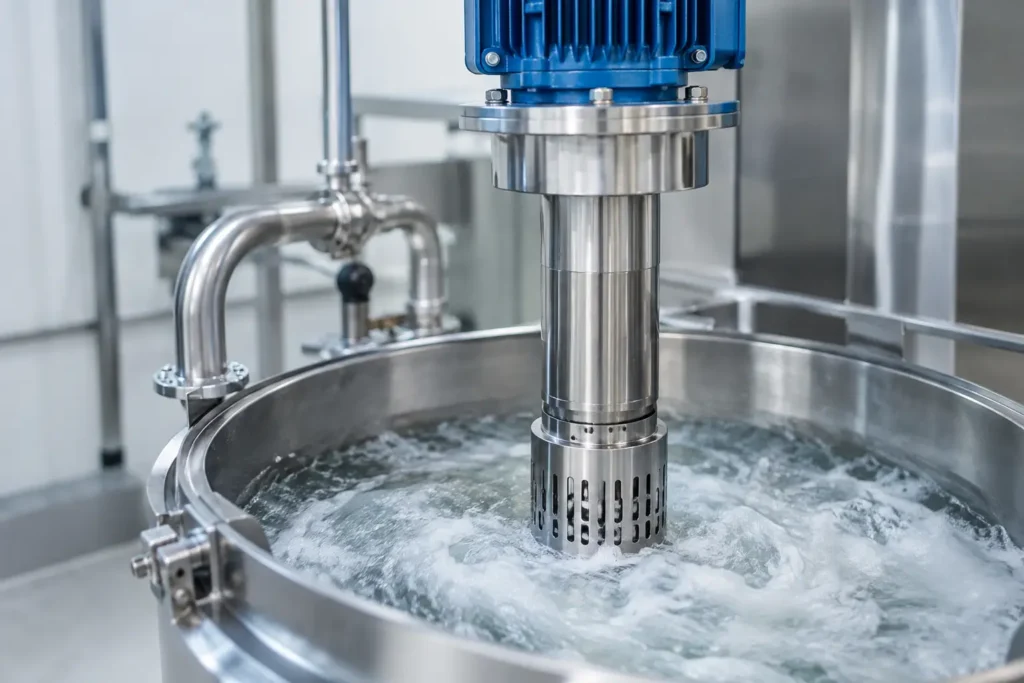
A high shear mixer typically uses a high-speed rotor turning within a close-tolerance stator. Product enters the mixing head, accelerates through the rotor-stator gap, and exits through stator openings at high velocity. That action creates intense mechanical and hydraulic forces that break down droplets, wet powders, disperse solids, and reduce agglomerates.
The result is different from the bulk circulation produced by a conventional propeller, turbine, or pitched-blade impeller. A tank agitator moves volume through the vessel and is often essential for turnover, suspension, heat transfer, or maintaining homogeneity. A rotor-stator head creates a concentrated high-energy zone. It is especially effective when the process requires emulsification or dispersion rather than simple blending.
Shear performance depends on more than rotational speed. Rotor diameter, tip speed, stator hole or slot geometry, rotor-stator clearance, product viscosity, density, temperature, and recirculation rate all affect the outcome. A high-speed mixer can still underperform when product bypasses the head, when the batch does not circulate through the shear zone, or when the material becomes too viscous for effective flow.
Batch, Inline, and Ultra-High-Shear Designs
The most suitable configuration starts with how and where the process needs energy.
Batch High-Shear Mixers
Batch units are commonly mounted from the top of a vessel, through the sidewall, or on a portable lift or cart. They process material inside the tank and can work alongside a separate low-speed agitator. This arrangement is practical for variable batch sizes, formulations that change frequently, and applications where operators need direct access to the vessel.
Batch operation is not automatically the best answer for every emulsion. In a large vessel, a single high-shear head may treat only a portion of the batch at any moment. The vessel geometry, liquid level, baffles, and companion agitator must return material to the head consistently. Without that circulation, processing time increases and batch-to-batch repeatability can suffer.
Inline High-Shear Mixers
An inline mixer processes liquid as it moves through a pipe loop or a continuous production line. The product enters the housing, passes through the rotor-stator assembly, and exits for downstream processing, recirculation, or direct transfer. This design gives engineers a defined process point and can provide highly repeatable treatment at a specified flow rate.
Inline equipment is often a strong fit for continuous emulsification, polymer activation, chemical dilution, pigment dispersion, and injection systems. It can also reduce the need to run an entire batch at high speed. The trade-off is that the pump, piping, pressure drop, and required residence time must be designed as one system. An inline unit cannot compensate for a poorly matched feed rate or inadequate recirculation loop.
Ultra-High-Shear Mixers
Ultra-high-shear equipment is intended for processes that demand tighter droplet or particle-size control, rapid incorporation, or more aggressive emulsification. These systems may use specialized rotor-stator geometries, multiple stages, or high-energy recirculation arrangements to produce much greater processing intensity.
More shear is not always better. Excessive energy can entrain air, raise product temperature, damage shear-sensitive materials, or change the texture of a finished product. The specification should be based on the required result, such as emulsion stability, viscosity target, dissolution time, or particle-size distribution, rather than an assumption that maximum tip speed is the answer.
Start With the Process Target, Not the Mixer Catalog
A sound mixer specification begins with a clear definition of what must change in the material. “Mix the batch” is not enough. Engineering teams should identify whether the target is a stable oil-water emulsion, complete powder wet-out, deagglomeration, controlled particle reduction, chemical activation, or uniform distribution of a low-volume additive.
Product data then drives the mechanical design. Useful inputs include minimum and maximum viscosity, specific gravity, solids loading, particle size, temperature, batch volume or continuous flow rate, pH, pressure, vapor concerns, cleaning method, and required production time. For multiphase service, the ratio of dispersed to continuous phase matters as well.
A formulation that works at laboratory scale may need a different approach at production scale. Small batches naturally pass through a lab head many times. Larger batches may require a recirculation loop, multiple heads, staged processing, or a combination of high shear and conventional agitation. Scale-up should account for actual energy input and flow through the shear zone, not only a proportional increase in motor horsepower.
Selecting the Mixing Head and Materials
Rotor and stator geometry controls how the mixer interacts with the product. Fine-hole stators can support high-intensity dispersion and emulsion work, while larger openings may be better for higher-viscosity materials, fibrous products, or systems with larger solids. Slotted stators can provide strong throughput and directional discharge. Multi-stage heads can progressively refine a material as it travels through the assembly.
The wetted materials must be selected for chemical compatibility and cleaning requirements. Stainless steel is common across industrial and sanitary processing, but corrosive acids, chlorides, solvents, oxidizers, and high-purity applications may require specialty alloys, fluoropolymer-lined construction, or other materials. Seal selection deserves equal attention. A failed seal can contaminate product, expose personnel, and stop production long before the rotor or stator reaches the end of its service life.
For sanitary service, surface finish, cleanability, drainability, elastomer compatibility, and connection style should be reviewed early. For industrial chemical service, flange ratings, mechanical seal support, hazardous-area motor requirements, and containment may be more critical. The mixer must fit the process environment as well as the fluid.
Installation Details That Affect Results
Even a correctly sized mixer can lose performance through installation errors. An inline unit needs sufficient net positive suction conditions where applicable, a properly selected feed pump, and piping that does not create unnecessary restriction or air pockets. Recirculation loops should pull from and return to locations that promote full-tank turnover rather than short-circuiting flow near the vessel wall.
For batch installations, head position and liquid level matter. A head placed too high can draw air or lose effective immersion. A head placed too low may create poor top-to-bottom circulation. Vessel shape, baffles, and the presence of a sweep or anchor agitator all influence how quickly material returns to the high-shear zone.
Heat is another design variable. Shear energy becomes heat in the product, especially during long recirculation cycles or high-viscosity processing. If the formulation has a narrow temperature range, the vessel jacket, heat exchanger, temperature instrumentation, and control strategy should be sized for the expected energy load.
When to Pair High Shear With Other Mixing Equipment
Many of the most effective systems use more than one mixing mechanism. A low-speed tank mixer can provide bulk turnover and wall sweeping, while a high-shear mixer handles emulsification or powder dispersion. A static mixer downstream can maintain uniformity after chemical injection or combine streams in continuous service without adding rotating equipment.
This is often a better engineering answer than forcing one mixer to solve every problem. The high-shear unit can be sized for the localized work it performs best, while the tank agitator, static mixer, pump, and injection equipment each handle their intended duty. That approach can improve repeatability and reduce unnecessary energy use.
Build Repeatability Into the Specification
A mixer purchase should produce more than a piece of rotating equipment. It should establish a process window operators can run with confidence. Define acceptable batch time, speed range, temperature limit, recirculation rate, viscosity range, and quality checks before finalizing the system. If the product is sensitive, consider trials using representative materials and document the conditions that achieve the target result.
ProMixUSA engineers high-shear and ultra-high-shear systems around the actual fluid, vessel, piping, and production requirement, with material and connection options suited to demanding industrial service. The best next step is to bring forward the process data that is already available, including the failure mode the current operation cannot tolerate. That is where a mixer specification becomes a dependable production solution.