
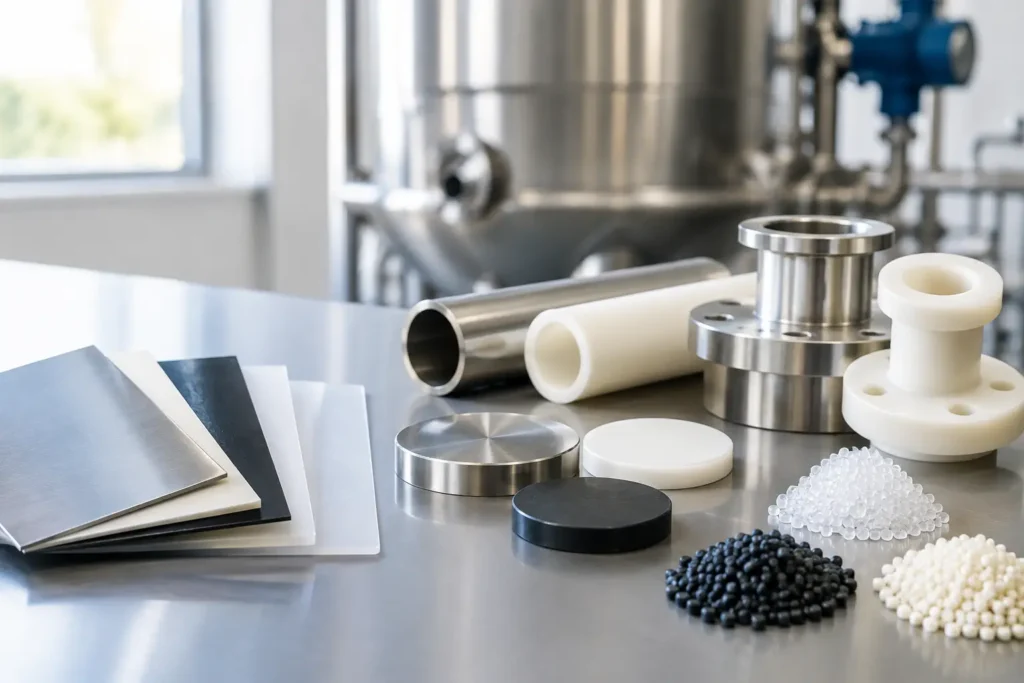
A static mixer can produce the required blend, an injection quill can place chemical exactly where it belongs, and a tank mixer can deliver repeatable agitation – yet all three can fail early if the wetted materials do not match the process. Knowing how to select wetted materials means evaluating the full service condition, not simply choosing the alloy or polymer that worked on the last project.
For industrial mixing and chemical-injection equipment, wetted materials include every surface exposed to the process fluid: mixer elements, housings, impellers, shafts, quill tubes, nozzle tips, seals, gaskets, O-rings, lining systems, and sometimes fasteners. A sound selection protects personnel, product quality, uptime, and capital investment. A poor one may show up as pitting, swelling, permeation, contamination, cracking, or an unplanned shutdown months after startup.
Start With the Actual Process Chemistry
The material decision begins with a complete chemical profile. Identify the primary fluid, but do not stop there. Concentration, impurities, additives, cleaning chemicals, neutralization steps, and off-spec batches can change the compatibility picture significantly.
For example, stainless steel is widely used because it provides strength, cleanability, and broad compatibility in many water-based and sanitary applications. But chloride-bearing fluids can create localized corrosion risk, particularly as temperature rises. A system that handles a mild chloride concentration at ambient temperature may need a more resistant alloy when operating hot, under stagnant conditions, or where deposits concentrate salts against the metal surface.
Acids and caustics demand the same discipline. A material that resists one acid concentration can be unsuitable at another. Hydrochloric acid, sulfuric acid, nitric acid, sodium hypochlorite, solvents, oxidizers, and high-purity chemicals each create distinct material-selection concerns. Ask for the chemical name, maximum and normal concentration, pH, impurity profile, and whether the stream is continuous, intermittent, or batch-operated.
Do not overlook mixed streams. Chemical injection often produces a short zone of very high local concentration before full dispersion. The injection quill tip, static mixer inlet, first mixing element, and nearby pipe wall may experience a more aggressive condition than downstream equipment. This is one reason material selection and mixing performance should be evaluated together.
Define Temperature, Pressure, and Flow Conditions
Chemical compatibility charts are useful starting points, not final engineering decisions. They often assume a stated temperature and may not address pressure, cyclic service, abrasion, or actual process geometry. Temperature is especially influential because it can accelerate corrosion, soften thermoplastics, increase chemical permeation, and reduce mechanical strength.
Pressure matters most when using plastic, lined, or fluoropolymer components. PVC, CPVC, PVDF, and PFA each offer valuable chemical-resistance advantages, but their pressure-temperature ratings, joint design, support requirements, and thermal-expansion behavior must match the installation. A material can be chemically compatible and still be mechanically inappropriate for the line pressure or cycling duty.
Velocity also changes the decision. High liquid velocity, slurry service, entrained solids, gas-liquid flow, and recirculating systems can introduce erosion or erosion-corrosion. In a static mixer, the element geometry intentionally creates division and radial mixing. That performance benefit must be balanced against pressure drop and the potential for solids to strike high-energy areas. For abrasive service, a corrosion-resistant material alone may not provide adequate life.
Account for Stagnant Zones and Crevices
Many corrosion problems originate where the process does not flow freely. Dead legs, crevices beneath gaskets, threaded areas, poorly drained quill assemblies, and deposits around mixer components can create a chemistry very different from the bulk fluid. Oxygen concentration, chloride concentration, temperature, and pH may all shift in these locations.
Specify designs that minimize hold-up where cleanliness or corrosion control is critical. For sanitary and high-purity applications, smooth finishes, drainability, appropriate elastomers, and connection details deserve the same attention as the primary housing material. For chemical service, select seal and gasket materials that can tolerate the chemical, temperature, and cleaning regime without swelling or losing compression.
Match Material Families to the Service Window
There is no universal “best” wetted material. The right answer depends on the process window and the consequences of failure.
Stainless steel is often the practical first choice for general industrial, food, beverage, pharmaceutical, water-treatment, and moderate chemical services. Type 316 stainless steel improves resistance in many chloride-containing environments compared with 304, but it is not a blanket solution for all chlorides or acids. Higher-alloy stainless and nickel-based alloys may be justified when corrosion risk, temperature, or reliability requirements exceed what standard stainless can support.
PVC and CPVC provide economical corrosion resistance for many water-treatment and chemical-dosing applications. PVC is commonly applied in lower-temperature service, while CPVC extends the usable temperature range. Both require careful attention to pressure rating, mechanical protection, and solvent-cemented or flanged joint practices.
PVDF offers stronger performance in many aggressive chemical applications and at elevated temperatures compared with commodity thermoplastics. PFA provides exceptionally broad chemical resistance and is frequently considered for highly corrosive, high-purity, or solvent services. The trade-off is cost, mechanical design limits, and the need to account for permeation or lining integrity in certain services.
Lined steel construction can be the right path when a project requires the structural strength of metal with the process-side resistance of fluoropolymer. It is particularly valuable for larger equipment, higher-pressure duties, or systems where an all-polymer structure is not practical. However, lined equipment requires disciplined fabrication, inspection, handling, and installation. Damage at a flange face, nozzle, or liner transition can compromise the entire corrosion barrier.
Select Seals, Gaskets, and Small Components With Equal Care
A corrosion-resistant mixer housing does not protect a system if its O-rings fail. Elastomers and minor wetted components are frequent weak points because they are easy to treat as standard hardware.
Confirm compatibility for mechanical-seal faces, elastomers, gasket material, bearing isolators, dip tubes, sample ports, and instrument connections. EPDM, FKM, PTFE, perfluoroelastomer, Buna-N, and other materials have very different responses to acids, caustics, hydrocarbons, solvents, oxidizers, and temperature. Compression set, swelling, hardening, and extraction can all affect service life.
For a tank mixer, seal selection also depends on vessel pressure, vacuum potential, shaft speed, shaft movement, and whether dry running is possible. For injection equipment, consider whether crystallization, solids deposition, or intermittent flushing can interfere with the sealing arrangement. The small parts are often where maintenance cost is decided.
Consider Cleaning, Product Purity, and Regulatory Requirements
The process fluid is not the only fluid that contacts equipment. Clean-in-place solutions, steam, sanitizers, flush water, and maintenance chemicals may be more aggressive than the production stream. A mixer that sees mild product during operation but concentrated caustic and oxidizing sanitizer during cleaning must be specified for the whole cycle.
Product purity can also rule out otherwise compatible materials. Extractables, particle shedding, surface finish, weld quality, and cleanability are central concerns in food, beverage, pharmaceutical, semiconductor, and specialty chemical applications. When cross-contamination is unacceptable, use material and finish requirements that support validated cleaning and inspection practices.
Evaluate Lifecycle Cost Instead of Purchase Price Alone
The lowest-cost material at purchase can become the highest-cost choice in service. Consider expected maintenance intervals, replacement labor, downtime exposure, spare-part availability, product loss, safety risk, and disposal requirements. A higher-grade alloy, PVDF component, or PFA-lined assembly may cost more upfront while eliminating repeated failures and production interruptions.
At the same time, over-specification has a cost. Exotic alloys and fluoropolymer-lined equipment are not automatically better for every duty. If the chemistry, temperature, and operating profile support stainless steel or CPVC, those materials may offer the best commercial outcome with shorter lead times and simpler maintenance.
How to Select Wetted Materials With Better Project Data
A material recommendation is only as good as the information behind it. Provide equipment suppliers with the operating and upset-case chemistry, concentration range, temperatures, pressures, flow rates, solids content, cleaning procedure, connection requirements, and required design life. Include whether the service is batch or continuous, indoor or outdoor, and whether equipment will see vacuum, thermal cycling, or intermittent dry conditions.
For complex duties, use a structured review before fabrication. ProMixUSA can align mixer, static-mixer, injection-quill, and skid material options with the actual application rather than forcing a standard construction into an unsuitable process. That approach is particularly valuable where aggressive chemical injection, extreme emulsification, sanitary processing, or custom connection geometry creates multiple material interfaces.
The best material choice is the one that remains stable through normal operation, startup, cleaning, upset conditions, and maintenance – while still fitting the mechanical and commercial realities of the project. Start with complete process data, challenge assumptions at the high-risk points, and specify every wetted component as part of one engineered system.