
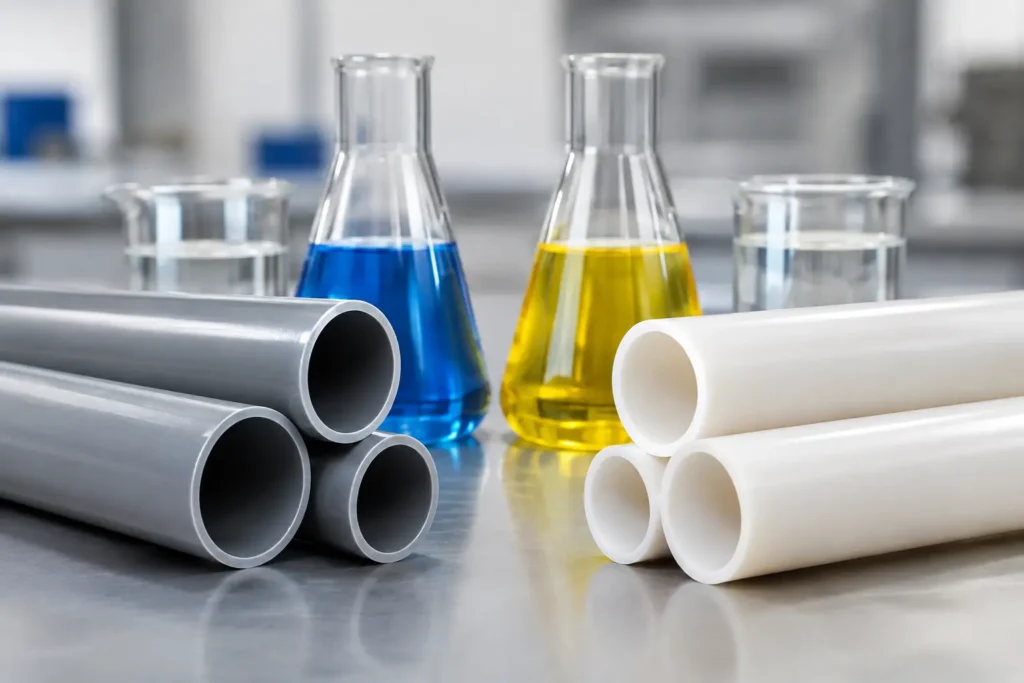
For chemical injection quills, static mixers, calibration columns, venturi devices, and piping components, the right choice starts with the actual process – not a generic statement that a fluid is “corrosive.” Chemical identity, concentration, temperature, pressure, flow velocity, cleaning method, and upset conditions all affect material performance.
PVC Versus PVDF Chemical Resistance in Process Service
PVC and PVDF are thermoplastics, yet their fluorine content and molecular structure lead to very different operating boundaries. In addition, PVC is widely specified because it offers useful resistance to many aqueous acids, bases, salts, and water-treatment chemicals at an attractive installed cost. PVDF is a fluoropolymer with broader resistance to aggressive chemicals and substantially better performance at elevated temperatures.
The practical distinction is straightforward: PVC is often the efficient choice for ambient-temperature aqueous chemical service. PVDF is commonly selected when the process includes hotter fluids, strong oxidizers, high-purity chemicals, solvent exposure, or conditions where a larger compatibility margin is required.
Neither conclusion should be treated as universal. A material can be chemically compatible in a static immersion chart and still be unsuitable for an injection point, mixer housing, valve seat, gasketed connection, or pressurized line. Real equipment sees stress, thermal cycling, pressure pulses, and localized concentration changes that a simple chemical-resistance rating does not capture.
Where PVC Performs Well
PVC has earned its place in industrial systems. It is lightweight, readily fabricated, and commonly available in fittings, flanges, pipe, static mixer bodies, injection assemblies, and custom components. For many municipal, industrial water, wastewater, and general chemical-dosing systems, it provides a practical balance of corrosion resistance and cost.
PVC is often a strong candidate for ambient-temperature service involving dilute mineral acids, caustic solutions, brines, hypochlorite at appropriate concentration and temperature, and other water-based chemicals. It is especially useful where process temperatures remain controlled and the fluid does not contain a solvent that can soften, swell, or extract plasticizer-free PVC compounds.
Its limitations become more pronounced as temperature rises. PVC loses pressure capability with heat, and its resistance can decline in chemicals that are otherwise acceptable at lower temperatures. Many organic solvents, aromatic hydrocarbons, ketones, chlorinated solvents, and certain esters are poor matches. PVC may also become a less comfortable choice when a process combines an oxidizing chemical with elevated temperature or when frequent thermal cycles can stress joints and fabricated assemblies.
For a low-temperature chemical feed line, PVC can be the right engineering decision. For the same chemical at a heated injection skid, the answer may change completely.
Why PVDF Is Chosen for More Demanding Chemicals
PVDF is frequently specified when chemical duty exceeds the useful range of PVC. Its fluoropolymer chemistry provides broad resistance to acids, bases, halogens, oxidizers, and many solvents. It also retains mechanical properties at significantly higher temperatures than PVC, which can expand the operating envelope for process equipment.
That makes PVDF a common material for high-purity chemical handling, semiconductor-related process applications, aggressive acid and oxidizer service, and elevated-temperature chemical transfer. In injection systems, PVDF can be particularly valuable where the chemical enters a warmer main line or where concentrated fluid reaches the quill tip before it is diluted by the process stream.
PVDF is not simply “PVC with better resistance.” It also brings different commercial and mechanical considerations. Material cost is higher, fabrication can require more specialized capability, and component availability may be more limited than standard PVC. Its flexibility and thermal expansion must also be accounted for in support spacing, nozzle connections, flanged assemblies, and long runs of pipe.
PVDF is highly capable, but it is not chemically invincible. Certain polar solvents, specific amines, and unusual process combinations can require a closer review. When purity, permeation, temperature, or chemical concentration drives the specification, material selection should include the complete wetted system, not just the body material.
Temperature Changes the Decision
Temperature is often the factor that turns an acceptable PVC application into a PVDF application. Chemical attack generally accelerates as temperature increases. At the same time, thermoplastics experience reduced stiffness and lower allowable pressure as they get hotter.
Consider a sodium hydroxide or acid feed system that normally operates near ambient temperature but periodically circulates heated cleaning solution. If PVC sees those cleaning cycles, the design must be evaluated for both chemical compatibility and reduced temperature-pressure capability. Selecting PVDF for the wetted components may create more operating margin, even if PVC would be acceptable during normal production.
Temperature at the injection point deserves special attention. A chemical can be stored cool in a day tank, travel through PVC tubing without issue, and then enter a process line carrying fluid at a much higher temperature. The injection quill, nozzle area, and downstream static mixer may face conditions that are materially different from those upstream.
Concentration, Velocity, and Localized Exposure Matter
Compatibility charts generally assume defined concentrations and temperatures. Process equipment rarely stays that simple. A dosing pump may deliver concentrated chemical in pulses. An injection quill may place that concentrate directly into a high-velocity stream. A static mixer may create repeated contact between the chemical and mixing elements before full dilution occurs.
These conditions do not automatically rule out PVC, but they require a more disciplined review. Concentrated sulfuric acid, strong oxidizers, chlorination chemicals, and solvent-containing formulations can behave very differently from dilute bulk solutions. Trace contaminants can matter as well, especially where the fluid contains surfactants, metal salts, or solvent carriers.
Velocity adds another layer. High flow can intensify wear where suspended solids are present, while pressure transients can load threaded joints, flanges, and injection components. Chemical resistance alone does not establish that a material is suitable for the complete operating duty.
Material Selection for Mixers and Injection Equipment
For engineered equipment, specify the fluid and the service condition rather than naming a preferred polymer at the start. A useful material review should include:
- Chemical name, concentration range, and any impurities or solvent carriers
- Normal, startup, cleaning, and upset temperatures
- Operating pressure, vacuum exposure, and expected pressure spikes
- Flow rate, injection velocity, solids content, and abrasion potential
- Required connections, sealing materials, and any sanitary or purity requirements
The last point is frequently missed. A PVDF body does not solve a compatibility problem if the gasket, O-ring, adhesive, fastener, or flexible hose is unsuitable. Likewise, a chemically resistant injection quill must be selected for its insertion length, mounting connection, backpressure, and point of chemical dispersion.
ProMixUSA evaluates these variables across complete mixing and injection assemblies, including material options for static mixers, mixing elements, injection quills, and custom process skids. That approach helps prevent a material decision made on one component from creating a weak point elsewhere in the system.
Cost Should Be Measured Against Service Risk
PVC usually carries a lower initial material and fabrication cost. For stable, ambient aqueous chemical service, that advantage can be meaningful and entirely justified. Selecting PVDF where it is not needed can add unnecessary project cost and extend procurement time.
But the lowest purchase price is not always the lowest operating cost. If a chemical system runs hot, handles a difficult oxidizer, or would create a serious safety and downtime event if a wetted component fails, PVDF can be the better value. The added material cost may be small compared with a shutdown, chemical release, replacement labor, or lost batch.
A sound specification identifies where each material belongs. PVC may be suitable for a bulk transfer segment while PVDF is justified at the injection point, in a heated recirculation loop, or within the wetted section of a custom mixer. Mixed-material designs can be effective when they are intentionally engineered rather than assembled from whatever parts are available.
Bring the full operating profile to the material review before equipment is released for fabrication. The chemical is only one part of the decision; the temperature, concentration, pressure, connection details, and failure consequences determine whether PVC or PVDF will keep the process running as designed.
A material that handles a room-temperature acid transfer may fail quickly when that same chemical is heated, concentrated, aerated, or injected at high velocity. That is the real issue behind PVC versus PVDF chemical resistance. Both materials are proven choices for corrosive process service, but they do not provide the same margin against solvents, temperature, permeation, or mechanical loading.
For chemical injection quills, static mixers, calibration columns, venturi devices, and piping components, the right choice starts with the actual process – not a generic statement that a fluid is "corrosive." Chemical identity, concentration, temperature, pressure, flow velocity, cleaning method, and upset conditions all affect material performance.
PVC Versus PVDF Chemical Resistance in Process Service
PVC and PVDF are thermoplastics, yet their fluorine content and molecular structure lead to very different operating boundaries. PVC is widely specified because it offers useful resistance to many aqueous acids, bases, salts, and water-treatment chemicals at an attractive installed cost. PVDF is a fluoropolymer with broader resistance to aggressive chemicals and substantially better performance at elevated temperatures.
The practical distinction is straightforward: PVC is often the efficient choice for ambient-temperature aqueous chemical service. PVDF is commonly selected when the process includes hotter fluids, strong oxidizers, high-purity chemicals, solvent exposure, or conditions where a larger compatibility margin is required.
Neither conclusion should be treated as universal. A material can be chemically compatible in a static immersion chart and still be unsuitable for an injection point, mixer housing, valve seat, gasketed connection, or pressurized line. Real equipment sees stress, thermal cycling, pressure pulses, and localized concentration changes that a simple chemical-resistance rating does not capture.
Where PVC Performs Well
PVC has earned its place in industrial systems. It is lightweight, readily fabricated, and commonly available in fittings, flanges, pipe, static mixer bodies, injection assemblies, and custom components. For many municipal, industrial water, wastewater, and general chemical-dosing systems, it provides a practical balance of corrosion resistance and cost.
PVC is often a strong candidate for ambient-temperature service involving dilute mineral acids, caustic solutions, brines, hypochlorite at appropriate concentration and temperature, and other water-based chemicals. It is especially useful where process temperatures remain controlled and the fluid does not contain a solvent that can soften, swell, or extract plasticizer-free PVC compounds.
Its limitations become more pronounced as temperature rises. PVC loses pressure capability with heat, and its resistance can decline in chemicals that are otherwise acceptable at lower temperatures. Many organic solvents, aromatic hydrocarbons, ketones, chlorinated solvents, and certain esters are poor matches. PVC may also become a less comfortable choice when a process combines an oxidizing chemical with elevated temperature or when frequent thermal cycles can stress joints and fabricated assemblies.
For a low-temperature chemical feed line, PVC can be the right engineering decision. For the same chemical at a heated injection skid, the answer may change completely.
Why PVDF Is Chosen for More Demanding Chemicals
PVDF is frequently specified when chemical duty exceeds the useful range of PVC. Its fluoropolymer chemistry provides broad resistance to acids, bases, halogens, oxidizers, and many solvents. It also retains mechanical properties at significantly higher temperatures than PVC, which can expand the operating envelope for process equipment.
That makes PVDF a common material for high-purity chemical handling, semiconductor-related process applications, aggressive acid and oxidizer service, and elevated-temperature chemical transfer. In injection systems, PVDF can be particularly valuable where the chemical enters a warmer main line or where concentrated fluid reaches the quill tip before it is diluted by the process stream.
PVDF is not simply "PVC with better resistance." It also brings different commercial and mechanical considerations. Material cost is higher, fabrication can require more specialized capability, and component availability may be more limited than standard PVC. Its flexibility and thermal expansion must also be accounted for in support spacing, nozzle connections, flanged assemblies, and long runs of pipe.
PVDF is highly capable, but it is not chemically invincible. Certain polar solvents, specific amines, and unusual process combinations can require a closer review. When purity, permeation, temperature, or chemical concentration drives the specification, material selection should include the complete wetted system, not just the body material.
Temperature Changes the Decision
Temperature is often the factor that turns an acceptable PVC application into a PVDF application. Chemical attack generally accelerates as temperature increases. At the same time, thermoplastics experience reduced stiffness and lower allowable pressure as they get hotter.
Consider a sodium hydroxide or acid feed system that normally operates near ambient temperature but periodically circulates heated cleaning solution. If PVC sees those cleaning cycles, the design must be evaluated for both chemical compatibility and reduced temperature-pressure capability. Selecting PVDF for the wetted components may create more operating margin, even if PVC would be acceptable during normal production.
Temperature at the injection point deserves special attention. A chemical can be stored cool in a day tank, travel through PVC tubing without issue, and then enter a process line carrying fluid at a much higher temperature. The injection quill, nozzle area, and downstream static mixer may face conditions that are materially different from those upstream.
Concentration, Velocity, and Localized Exposure Matter
Compatibility charts generally assume defined concentrations and temperatures. Process equipment rarely stays that simple. A dosing pump may deliver concentrated chemical in pulses. An injection quill may place that concentrate directly into a high-velocity stream. A static mixer may create repeated contact between the chemical and mixing elements before full dilution occurs.
These conditions do not automatically rule out PVC, but they require a more disciplined review. Concentrated sulfuric acid, strong oxidizers, chlorination chemicals, and solvent-containing formulations can behave very differently from dilute bulk solutions. Trace contaminants can matter as well, especially where the fluid contains surfactants, metal salts, or solvent carriers.
Velocity adds another layer. High flow can intensify wear where suspended solids are present, while pressure transients can load threaded joints, flanges, and injection components. Chemical resistance alone does not establish that a material is suitable for the complete operating duty.
Material Selection for Mixers and Injection Equipment
For engineered equipment, specify the fluid and the service condition rather than naming a preferred polymer at the start. A useful material review should include:
- Chemical name, concentration range, and any impurities or solvent carriers
- Normal, startup, cleaning, and upset temperatures
- Operating pressure, vacuum exposure, and expected pressure spikes
- Flow rate, injection velocity, solids content, and abrasion potential
- Required connections, sealing materials, and any sanitary or purity requirements
The last point is frequently missed. A PVDF body does not solve a compatibility problem if the gasket, O-ring, adhesive, fastener, or flexible hose is unsuitable. Likewise, a chemically resistant injection quill must be selected for its insertion length, mounting connection, backpressure, and point of chemical dispersion.
ProMixUSA evaluates these variables across complete mixing and injection assemblies, including material options for static mixers, mixing elements, injection quills, and custom process skids. That approach helps prevent a material decision made on one component from creating a weak point elsewhere in the system.
Cost Should Be Measured Against Service Risk
PVC usually carries a lower initial material and fabrication cost. For stable, ambient aqueous chemical service, that advantage can be meaningful and entirely justified. Selecting PVDF where it is not needed can add unnecessary project cost and extend procurement time.
But the lowest purchase price is not always the lowest operating cost. If a chemical system runs hot, handles a difficult oxidizer, or would create a serious safety and downtime event if a wetted component fails, PVDF can be the better value. The added material cost may be small compared with a shutdown, chemical release, replacement labor, or lost batch.
A sound specification identifies where each material belongs. PVC may be suitable for a bulk transfer segment while PVDF is justified at the injection point, in a heated recirculation loop, or within the wetted section of a custom mixer. Mixed-material designs can be effective when they are intentionally engineered rather than assembled from whatever parts are available.
Bring the full operating profile to the material review before equipment is released for fabrication. The chemical is only one part of the decision; the temperature, concentration, pressure, connection details, and failure consequences determine whether PVC or PVDF will keep the process running as designed.