
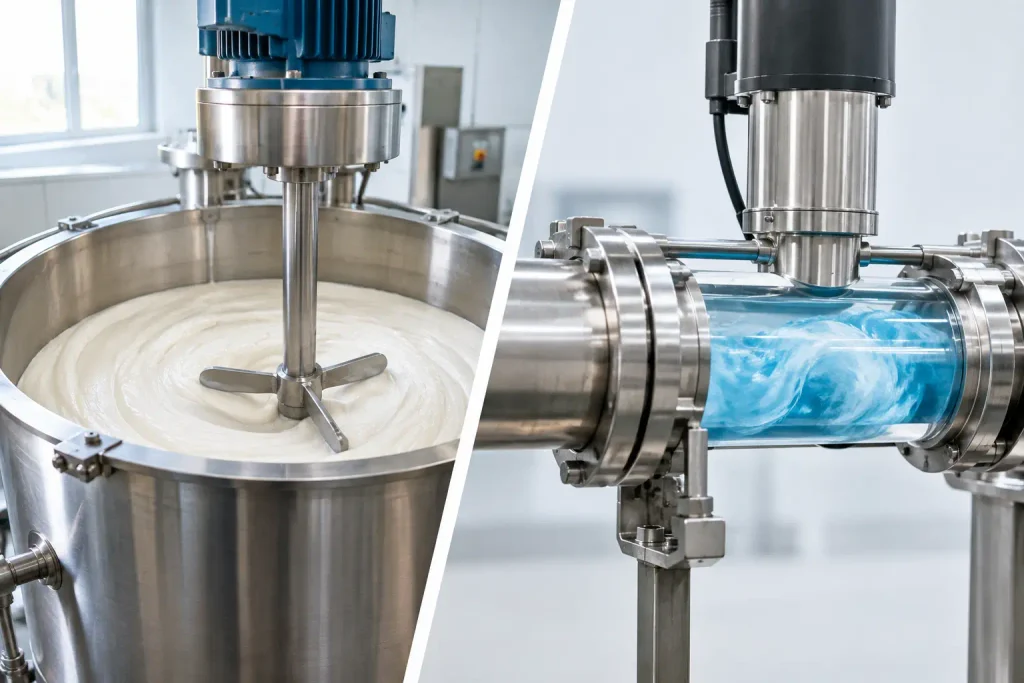
A mixing decision can determine whether a process holds specification or creates rework, waste, and production delays. The choice between batch vs inline mixing is not simply a question of tank versus pipe. It affects residence time, shear exposure, labor requirements, cleaning strategy, chemical inventory, and the ability to maintain a consistent product as throughput changes.
For many industrial operations, both methods have a place. A batch tank may be the right answer for a high-viscosity blend or a recipe with staged additions. An inline static mixer may be the more efficient choice for continuous chemical injection, dilution, pH adjustment, or rapid blending in a closed pipeline. The correct selection starts with the process objective, then matches mixing energy and equipment geometry to the fluid behavior.
Batch vs Inline Mixing: The Core Difference
Batch mixing occurs in a vessel. Ingredients are charged into a tank and mixed for a defined period using a top-entry, side-entry, portable, or high-shear mechanical mixer. The batch is tested or released after the required blend, dispersion, reaction, or temperature profile is achieved.
Inline mixing occurs as fluids travel through a pipe. A secondary fluid, powder slurry, or chemical stream enters the main process flow, often through an injection quill. A static mixer or inline high-shear mixer then divides, redirects, and recombines the flow until the required uniformity is reached. In many applications, the process continues without a holding vessel.
The practical difference is control of time and volume. Batch systems work with a defined volume and a defined mixing cycle. Inline systems work with flow rate, pressure drop, injection location, and residence time within the piping circuit. Neither is universally better. The operating conditions decide the result.
When Batch Mixing Is the Better Process Choice
Batch mixing is often preferred when the process needs flexibility. Plants producing multiple formulations can use one tank to make different recipes, change addition order, adjust mixing time, and verify results before sending material downstream. This is especially valuable for specialty chemicals, coatings, adhesives, food ingredients, polymers, and products with variable raw-material properties.
A vessel also provides useful working volume when ingredients require a long hydration period, heat transfer, vacuum deaeration, or reaction time. If solids must be slowly added without forming agglomerates, operators can control the feed rate while observing the batch. A high-shear mixer can break down difficult dispersions, while a separate low-speed agitator maintains circulation without excessive shear.
Batch Mixing Handles Complex Formulations
Mechanical tank mixers can be configured around the actual duty. Impeller selection, shaft length, motor horsepower, tank geometry, baffles, seal design, and mounting style all affect circulation and blend time. For viscous fluids, a properly designed impeller and vessel arrangement are usually more effective than relying on pipeline turbulence alone.
Batch equipment also makes sense where production is intermittent. If a plant runs one or two campaigns per week, the capital savings of eliminating a batch tank may not justify an inline system. The tank can double as a staging, reaction, or surge vessel, giving the operation more control over scheduling.
Batch Mixing Has Operating Costs
The trade-off is that a batch process requires space, cleaning, charging, and handling. Tanks hold inventory. Operators may need to load ingredients, wait for the cycle to finish, sample the batch, and transfer it to the next step. A poor tank design can create dead zones, surface vortexing, air entrainment, or unmixed material near the wall and bottom.
Scale-up also requires care. Doubling batch volume does not mean doubling agitation speed. The relationship between impeller diameter, power input, fluid viscosity, tank shape, and mixing time must be evaluated. A mixer that performs well in a pilot vessel may not deliver the same circulation pattern in a full-scale production tank.
Where Inline Mixing Delivers an Advantage
Inline mixing is built for continuous operations. When a plant already has a defined process flow, it can introduce a chemical or additive at a controlled rate and mix it immediately in the pipe. This approach reduces tank inventory, shortens the path from dosing to use, and can support highly repeatable results when flow conditions remain within the design range.
Static mixers are particularly effective for blending miscible liquids, diluting concentrated chemicals, distributing injected reagents, conditioning flow, and improving contact between process streams. With no moving parts, a static mixer requires no motor, gearbox, shaft seal, or electrical connection. The mixing elements use the energy already present in the flowing stream.
For chemical injection, an injection quill and static mixer can create a controlled, enclosed mixing point. This is valuable for water and wastewater treatment, disinfection, neutralization, polymer activation, corrosion inhibition, and other processes where chemical distribution must be consistent and operator exposure should be minimized.
Inline Systems Depend on Stable Process Conditions
An inline mixer is designed around a specific flow range, fluid viscosity, density, pressure, pipe size, and required mixing quality. If flow falls too low, there may not be enough energy for the intended mixing performance. If it rises beyond the design point, pressure drop may become excessive or equipment velocity may be unsuitable for the service.
Pressure drop is the central engineering trade-off. More static mixing elements generally increase mixing intensity, but they also increase resistance to flow. The right design balances blend quality with the available pump head and allowable energy use. For challenging emulsions, dispersion duties, or particle-size reduction, an inline high-shear mixer may be required rather than a static element assembly.
Inline equipment can also be less forgiving of upset conditions. A sudden change in viscosity, a partially plugged injection point, or an unstable carrier flow can affect chemical distribution immediately. Good instrumentation, flow control, and proper injection placement are essential.
Compare the Process Requirements Before Selecting Equipment
The strongest equipment selection begins with process data, not a catalog category. Start with the materials being combined. Are they miscible liquids, suspended solids, immiscible phases, or gases? Is the goal simple blending, dilution, heat transfer, gas dispersion, emulsification, or a chemical reaction?
Next, define the operating window. Required flow rate, batch size, viscosity range, specific gravity, temperature, pressure, solids content, and allowable pressure drop all influence the mixer design. Connection type and material compatibility matter just as much in corrosive, sanitary, abrasive, or high-purity service. Stainless steel may be appropriate for one application, while PVC, CPVC, PVDF, PFA-lined construction, or a specialty alloy may be necessary for another.
The required level of uniformity should be stated clearly. A process that needs a broadly blended additive stream has different requirements than one needing tight concentration control at a downstream analyzer. Likewise, a product that can tolerate several minutes of blending is different from a neutralization process that must reach uniform pH before entering a reactor or discharge line.
Hybrid Systems Often Solve the Real Problem
The decision does not always need to be batch or inline. Many plants benefit from a hybrid design. A tank mixer can prepare a concentrated solution, while an inline static mixer dilutes and distributes that solution into the main process stream. A recirculation loop can pull material from a batch vessel, pass it through an inline high-shear mixer, and return it to the tank for faster dispersion.
This arrangement is common when a formulation needs both long residence time and high-intensity mixing. It allows the tank to manage volume and recipe control while the inline equipment provides concentrated shear or continuous conditioning. It can also reduce the time that a mechanical mixer must run at high energy.
A complete system may include the storage or mix tank, transfer pump, calibration column, injection quill, static mixer, flow meter, valves, and controls. Treating these components as one process system prevents a common failure point: specifying a capable mixer without accounting for injection velocity, piping layout, pump capacity, or chemical feed accuracy.
Build for Maintenance, Safety, and Throughput
Mechanical mixers require attention to bearings, seals, gearboxes, motors, and shafts. The benefit is adjustable mixing energy and the ability to work in demanding vessel applications. Static mixers eliminate moving parts, but they must be selected with cleaning access, fouling potential, and pressure-drop limits in mind.
For either approach, safe chemical injection deserves early attention. Injection points should prevent chemical impingement on pipe walls, promote immediate distribution, and allow maintenance without exposing personnel to hazardous fluid. Retractable injection quills can be especially useful where removal and inspection must occur without shutting down the main line.
ProMixUSA engineers mixing and chemical-injection equipment around the actual fluid, operating range, materials, and connection requirements. That application-level approach matters because a mixer is only effective when the entire process can support it.
The best next step is to define what must be uniform, how quickly it must become uniform, and what process constraints cannot be compromised. Those answers will point clearly toward a batch vessel, an inline mixer, or a combined system built to keep production moving.