
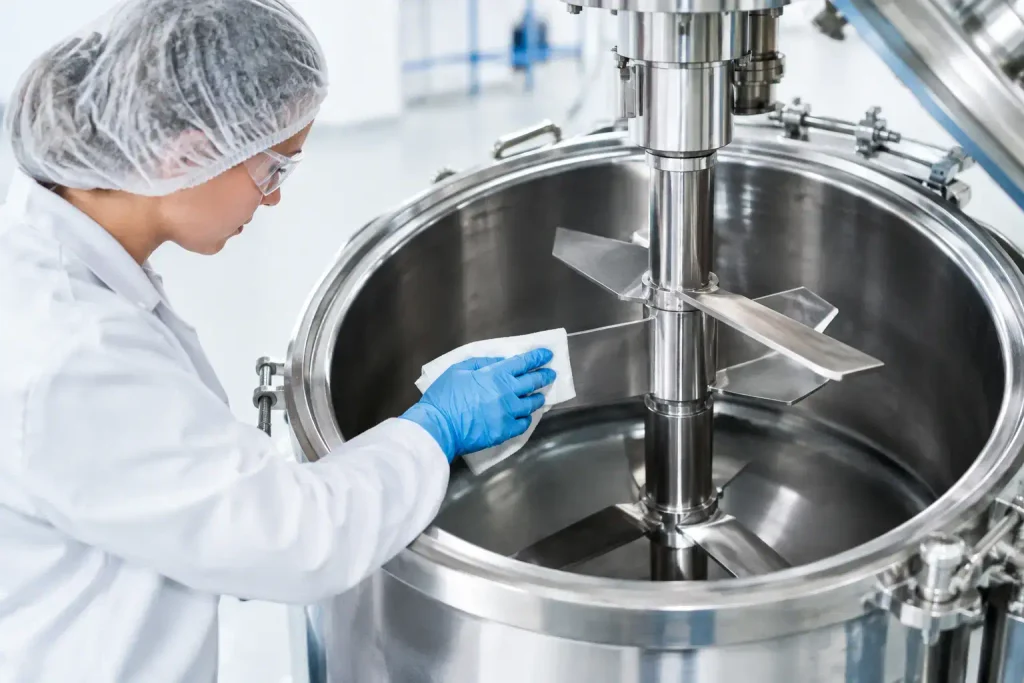
A mixer can be built from 316L stainless steel, carry sanitary connections, and still become the hardest component in a process line to clean. The question, "are sanitary mixers cleanable," cannot be answered by material or product category alone. Cleanability depends on whether every product-contact surface can be reached by cleaning fluid, fully drained, inspected where required, and returned to service without leaving residue or microbiological risk behind.
For food, beverage, dairy, pharmaceutical, biotechnology, and personal-care operations, that distinction matters. A mixing device that performs well hydraulically but traps product behind a seal, in a crevice, or between static mixing elements can extend sanitation time, increase water and chemical use, and compromise batch quality. The right sanitary mixer is engineered for both process performance and a repeatable cleaning method.
Are Sanitary Mixers Cleanable by Design?
Yes, properly specified sanitary mixers can be highly cleanable. But "sanitary" is not a universal guarantee of clean-in-place performance. It generally indicates that the equipment uses hygienic materials, finishes, connections, and geometry appropriate for sanitary service. The actual cleaning result still depends on the mixer style, product characteristics, installation orientation, cleaning parameters, and operating procedures.
A low-viscosity beverage ingredient is far less demanding to remove than a protein concentrate, starch slurry, chocolate base, ointment, or shear-sensitive emulsion. Products that are sticky, fatty, heat-sensitive, particulate-laden, or prone to drying onto metal surfaces place greater demands on both equipment geometry and cleaning-cycle design.
The practical question is not simply whether a mixer is cleanable. It is whether it is cleanable using the plant's available CIP or COP process, at the required sanitation standard, in a commercially acceptable cycle time.
What Makes a Mixer Cleanable?
Cleanability starts with hygienic geometry. Product-contact areas should avoid dead legs, sharp internal corners, threaded crevices, gaps at joints, and unvented cavities where liquid can stagnate. Surfaces should drain under the intended installation angle rather than retain pools after production or rinse cycles.
Surface finish matters as well. A smoother internal finish reduces places where product can adhere and makes cleaning action more predictable. For many sanitary applications, electropolished or mechanically polished stainless steel may be appropriate, particularly where residue control, corrosion resistance, or microbial control is critical. The required finish should be defined by the process specification, not selected as a cosmetic upgrade.
Connection design also affects cleaning. Sanitary clamp connections simplify disassembly and inspection compared with many threaded or mechanically trapped joints. Weld quality is equally important. A poorly finished weld can create a rough, difficult-to-clean surface even when the surrounding tubing meets sanitary requirements.
Finally, a cleanable mixer must allow cleaning solution to generate sufficient contact, velocity, turbulence, or impingement throughout the wetted area. This is where equipment geometry and CIP engineering must work together.
Static Mixers: Efficient, but Application-Specific
Sanitary inline static mixers contain fixed elements that divide, rotate, and recombine flow. Because there are no moving internal parts, seals, shafts, or motors in the product stream, they can be an excellent option for continuous blending, dilution, pH adjustment, chemical injection, and controlled emulsification.
Their fixed-element design, however, means cleaning fluid must travel effectively through the same passages used by the process fluid. A static mixer that handles a high-viscosity product at low velocity may not receive enough cleaning velocity during a standard rinse. Product can remain in element contact zones if the CIP cycle is not designed for the mixer length, diameter, element geometry, and product characteristics.
For cleanable sanitary static mixers, engineers should evaluate element accessibility, internal finish, weld construction, drainability, and pressure drop during both production and CIP. A removable element assembly may be useful when periodic manual inspection is required. A permanently welded design may be preferable where crevice control and process containment take priority, provided the CIP process is validated for the application.
Static mixer selection is therefore a balance. More elements can improve mixing uniformity, but they also add wetted surface area and may increase cleaning complexity. The best design achieves the target blend or reaction performance without adding unnecessary length or residence volume.
Mechanical Mixers Require Attention to Seals and Shadow Areas
Top-entry, side-entry, portable, and high-shear mixers introduce additional cleanability considerations because their shafts, impellers, seals, and vessel mounting details interact with the product.
Impeller geometry can create shadow areas if spray coverage or recirculated CIP flow does not reach beneath blades, hubs, or support structures. High-shear rotor-stator heads deserve special review because their narrow clearances are designed to produce intense shear. Those same clearances must be adequately flushed during cleaning.
The shaft seal is often the most critical area. A sanitary mechanical seal should be selected for the product, pressure, temperature, cleaning chemistry, and operating schedule. Single and double mechanical seals each have a role, but neither should be treated as a default solution. Seal flush arrangements, barrier fluids, and housing design must prevent product buildup while supporting safe maintenance.
Retractable mixer designs can offer operational advantages in vessels where removal and inspection are needed without opening the tank for extended periods. They still require a clear cleaning plan for the wetted shaft and any components exposed during insertion or withdrawal.
CIP Is a System Requirement, Not a Mixer Feature
A mixer cannot make an inadequate CIP system effective. Cleaning performance depends on the complete circuit: tank geometry, piping, pumps, spray devices, flow rate, temperature, detergent concentration, cycle duration, and return path.
The well-known cleaning factors of time, temperature, chemistry, and mechanical action apply directly to mixers. If one factor is limited, another may need to increase. For example, lower cleaning temperatures may require more time or stronger chemistry. But chemical concentration alone cannot compensate for poor drainage or a dead zone behind an improperly installed component.
When specifying a mixer for CIP service, establish the expected cleaning method early. Define whether the unit will be cleaned in place, removed for cleaning out of place, manually cleaned between batches, or exposed to steam-in-place conditions. Ask for the anticipated CIP flow direction and rate, the cleaning media, temperature range, and allowable pressure drop. These details directly influence the right internal configuration and materials selection.
How to Evaluate Cleanability Before Purchase
A productive equipment review focuses on the full process rather than a catalog label. Start with the product itself: viscosity, solids content, adhesion tendency, temperature sensitivity, and microbiological risk. Then define the production flow range and required mixing result. A mixer should not be oversized for mixing performance if that creates excess hold-up volume or an impractical cleaning burden.
Next, review all product-contact construction details. Confirm alloy, elastomer compatibility, internal surface finish, connection type, weld specifications, and drain orientation. If the mixer includes removable parts, clarify how often they must be removed, what tools are required, and whether reassembly can be verified consistently.
For CIP applications, request cleaning-flow guidance for the actual mixer configuration, not only the process-flow recommendation. This is especially important for custom static mixers, injection assemblies, high-shear devices, and skid-mounted systems where valves, instruments, sample points, and piping transitions can affect cleanability.
Validation should match the risk level of the operation. Some applications may rely on visual inspection, conductivity checks, or rinse-water testing. Others may require documented riboflavin coverage studies, swab testing, allergen validation, microbial testing, or a formal CIP validation protocol. The appropriate method depends on the industry, product, regulatory obligations, and internal quality requirements.
Common Cleanability Mistakes
The most frequent mistake is assuming that stainless steel automatically means hygienic performance. Material selection is essential, but it cannot correct poor geometry, rough welds, trapped gaskets, or inadequate cleaning flow.
Another mistake is treating production velocity and CIP velocity as the same design condition. A mixer may operate at one flow rate while cleaning occurs at another. Both conditions must be evaluated. Similarly, a static mixer installed horizontally may behave differently from one installed vertically when drainage is a concern.
Plants also run into trouble when a cleaning procedure is developed after equipment installation. By that point, a vessel nozzle location, pipe slope, pump limitation, or lack of access may restrict the available options. Early coordination between process engineering, sanitation, maintenance, and equipment suppliers avoids expensive revisions.
Specify the Mixer Around the Sanitation Standard
Cleanable sanitary mixing equipment is not a single product class. It is the result of matching mixer geometry, materials, installation, and cleaning conditions to the product and the required sanitation outcome. For a simple inline dilution, a compact sanitary static mixer may provide excellent results with minimal maintenance. For viscous or difficult-to-clean products, a custom configuration, removable internals, specialized finish, or different mixing approach may be justified.
ProMixUSA helps process teams evaluate mixing performance alongside practical fabrication, connection, material, and cleanability requirements. The most effective specification gives sanitation the same engineering weight as blend uniformity, pressure drop, shear, and throughput. That is how a mixer becomes easier to operate between batches, not just effective while production is running.