
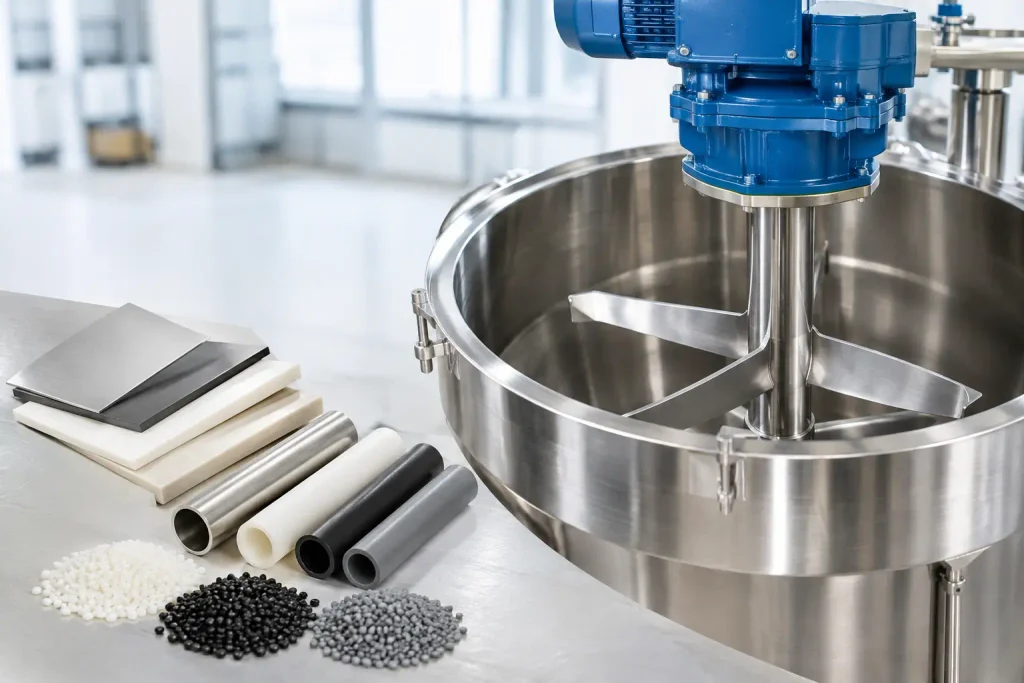
A mixer can deliver the right flow pattern and still become the weak point in a process line. Corrosion at a weld, polymer swelling at a flange, product buildup on a shaft, or seal-face damage can interrupt production long before the mixer reaches its expected mechanical life. This industrial mixer material guide focuses on selecting wetted materials that match actual process duty, not just the chemical name on a safety data sheet.
Material Selection Starts With the Entire Process
The correct material is determined by more than fluid chemistry. Temperature, concentration, pressure, velocity, solids loading, clean-in-place requirements, batch frequency, and the consequences of contamination all change the recommendation. A material that performs well in a low-temperature transfer line may fail quickly in a high-shear mixer, injection quill, or static mixer where local turbulence and chemical concentration are higher.
For example, a dilute acid may be manageable in stainless steel at ambient temperature, yet become aggressive when heated or injected at full concentration into a small pipe. Chlorides can accelerate pitting and crevice corrosion, especially around threaded joints, gasketed connections, weld heat-affected zones, and stagnant areas behind mixing elements. Abrasive solids introduce a different problem: material loss through erosion rather than corrosion.
Specify the process window, not a single operating point. Include normal, startup, shutdown, cleaning, upset, and maximum design conditions. If a chemical is periodically flushed with caustic or an oxidizing cleaner, that cleaning cycle belongs in the materials review.
Common Industrial Mixer Materials and Their Roles
Stainless Steel for General Process Service
304 stainless steel is widely used for water, many food products, mild chemicals, and general industrial service. It is practical, readily fabricated, and economical, but it is not the automatic choice for chloride-bearing fluids or more corrosive chemical injection duty.
316 and 316L stainless steel provide improved corrosion resistance through molybdenum content. For many industrial mixing applications, 316L is the starting point for wetted shafts, impellers, static mixer housings, mixing elements, and sanitary assemblies. The low-carbon grade is particularly useful when welded fabrication is required because it reduces the risk of sensitization near welds.
Even 316L has limits. Hot chlorides, hydrochloric acid, bleach solutions, and certain sulfur-bearing fluids can cause pitting, crevice corrosion, or stress-corrosion cracking. Material selection should never stop at the phrase stainless steel. The alloy grade, surface condition, weld quality, and process environment all matter.
Specialty Alloys for Aggressive Chemicals
When standard stainless steel cannot carry the corrosion risk, specialty alloys can provide the required service life. Duplex stainless steels may be considered where chloride resistance and higher mechanical strength are needed. Nickel alloys, including Alloy C-276 and related high-alloy materials, are often specified for severe acids, chlorides, oxidizers, and difficult chemical processes.
The trade-off is cost, availability, and fabrication complexity. A specialty alloy may be necessary for a wetted injection quill tip or static mixer element, while the surrounding skid can remain stainless steel. That targeted approach can control project cost without compromising the component exposed to the most severe conditions.
PVC, CPVC, PVDF, and PFA for Chemical Compatibility
Engineered polymers are often the best answer for corrosive liquid service. PVC is commonly used for water treatment, dilute acids, caustics, and chemical feed applications within its temperature and pressure limits. CPVC extends temperature capability and is often selected when PVC is not suitable for hotter process streams.
PVDF offers broad chemical resistance and higher temperature capability than PVC or CPVC. It is a strong option for many acids, solvents, ultrapure water applications, and aggressive chemical injection services. PFA provides exceptional chemical resistance and is frequently used as a lining or wetted barrier where metal exposure is unacceptable.
Polymers require a different engineering review than metals. Confirm pressure rating at operating temperature, vacuum conditions, UV exposure, mechanical support, thermal expansion, and compatibility with solvents. A polymer housing may be chemically suitable but unsuitable for high line pressure, large unsupported spans, or a process that cycles rapidly between hot and cold conditions.
Surface Finish Is Part of the Material Decision
For sanitary, food, beverage, pharmaceutical, and high-purity service, alloy selection is only one part of the specification. Surface finish controls cleanability, product retention, and the likelihood of microbial growth or cross-batch contamination. Crevices, rough welds, unpolished shafts, and dead zones can defeat an otherwise sound material selection.
Sanitary mixer components are commonly built in 316L stainless steel with controlled internal finishes, cleanable geometry, and appropriate sanitary connections. Electropolishing may be justified where enhanced cleanability and corrosion resistance are required. The correct finish depends on the product, cleaning procedure, regulatory requirements, and whether the process is batch, continuous, or aseptic.
Do not apply sanitary standards where they do not add value, but do not substitute a standard industrial finish into a hygienic process simply because the base alloy is 316L. The fabrication details determine whether a mixer can be cleaned and inspected reliably.
Static Mixers, Tank Mixers, and Injection Equipment Face Different Risks
A static mixer housing and elements are continuously exposed to process flow. Their material must withstand chemical attack, velocity, pressure drop, and any solids moving through the line. In corrosive service, an all-metal static mixer may not be the best configuration. PVDF, PFA-lined, or other polymer-based constructions can extend service life when compatible with the operating envelope.
Tank mixers add mechanical loading to the equation. The shaft, impeller, mounting flange, wetted fasteners, and seal arrangement must handle torque, vibration, liquid level changes, and possible dry-running conditions. In abrasive slurry applications, a higher-alloy shaft alone will not solve wear at the impeller or seal. The complete wetted assembly needs review.
Injection quills experience concentrated chemical exposure at the point of discharge. Material selection should account for the injected chemical, the carrier stream, injection velocity, and the possibility of backflow. A retractable quill may need a corrosion-resistant wetted tip, while the isolation assembly and external hardware require materials suited to the surrounding plant environment.
Seals, Gaskets, and Fasteners Cannot Be Afterthoughts
A chemically compatible mixer body can still fail through an incompatible elastomer or seal-face combination. EPDM, FKM, PTFE, perfluoroelastomers, ceramic, silicon carbide, tungsten carbide, and carbon faces all have distinct strengths and limitations. Seal selection depends on fluid lubricity, crystallization risk, temperature, pressure, abrasive particles, and whether the mixer runs continuously or intermittently.
Gaskets deserve the same scrutiny. PTFE offers broad compatibility but can cold-flow under load. Elastomeric gaskets may seal well but swell, harden, or degrade in solvents and oxidizers. Wetted fasteners must also match the process. A high-alloy mixer body paired with lower-grade bolts in a wet, chloride-rich area can create a predictable maintenance problem.
A Practical Material Selection Workflow
Use a documented review before releasing a mixer, static mixing skid, or chemical injection assembly for fabrication. The following inputs prevent most material-selection errors:
- Identify every process fluid, including cleaning chemicals, flush water, and upset chemicals.
- Define concentration, temperature, pressure, flow rate, solids content, and expected operating cycles.
- Review high-velocity zones, stagnant zones, welds, seals, and connection points separately.
- Establish contamination, sanitary, emissions, and maintenance requirements before choosing a final construction.
This review often identifies mixed-material solutions that make more sense than one expensive alloy throughout. A stainless steel tank mixer may use a PVDF or PFA-lined wetted component for a specific chemical contact point. A static mixer skid may combine a corrosion-resistant process section with a standard structural frame and non-wetted instrumentation supports.
When Custom Construction Is the Better Commercial Choice
Stock equipment supports fast project execution, but unusual chemistry, nonstandard connections, elevated temperature, or constrained installation space can require custom construction. The right custom solution is not merely a different alloy. It may include a revised element geometry, lined housing, specialized flange, sanitary finish, retractable injection assembly, upgraded seal system, or a complete skid engineered around the operating sequence.
ProMixUSA helps industrial teams evaluate these decisions across static mixing, tank agitation, high-shear mixing, and chemical injection equipment. The objective is practical: deliver the required process performance without building unnecessary cost or avoidable maintenance into the system.
Choose mixer materials with the same discipline used to select flow rate, shear level, and connection size. A well-matched material package protects product quality, keeps maintenance predictable, and gives the process team confidence when operating conditions become less forgiving.