
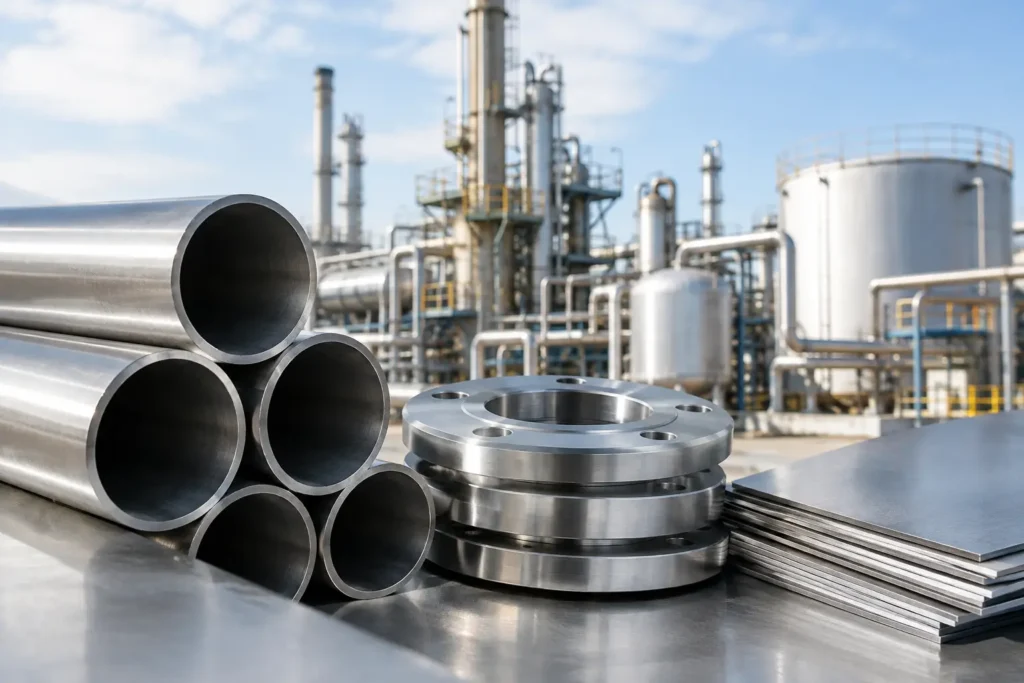
Corrosion failures rarely begin with a dramatic equipment event. More often, they start at a weld heat tint, beneath a deposit, inside an injection zone, or in a stagnant pocket near a flange. This corrosion resistant alloy guide is built for process teams selecting mixers, injection quills, static mixers, piping components, and skid hardware that must perform under real chemical, thermal, and flow conditions.
The correct material is not simply the alloy with the highest price or the strongest published corrosion rating. It is the material that fits the actual fluid chemistry, concentration, temperature, pressure, velocity, cleaning method, fabrication details, and required service life. A material that performs well in a laboratory sample may fail quickly when an oxidizer is injected through a quill, chlorides concentrate during evaporation, or a batch mixer sits idle between campaigns.
Start With the Actual Corrosion Mechanism
General corrosion is the easiest condition to understand. The metal loses material at a relatively uniform rate, and corrosion allowance may provide a workable design margin. The more difficult failures are localized: pitting, crevice corrosion, stress corrosion cracking, intergranular attack, galvanic corrosion, and erosion-corrosion. These mechanisms can penetrate a wall with little overall metal loss.
Chloride-bearing service is a common example. Type 316L stainless steel may be appropriate for many water-based process streams, but chloride concentration, elevated temperature, low oxygen conditions, and crevices can change that answer quickly. A static mixer, for example, contains element edges and welds where deposits or low-flow zones may develop. An injection quill can create a highly concentrated chemical zone before the injected fluid disperses into the main stream.
The first engineering question should be: what chemical condition will the equipment surface actually see? That includes startup, shutdown, cleaning, upset conditions, and chemical injection transients, not just the normal bulk-fluid specification.
Corrosion Resistant Alloy Guide: Common Material Choices
316L Stainless Steel
316L is a practical starting point for a wide range of industrial equipment. Its molybdenum content improves resistance to many chlorides and chemical solutions compared with 304 stainless steel, while the low-carbon grade supports welded fabrication. It is widely used for process piping, sanitary equipment, tank components, static mixers, and moderate chemical service.
Its limits matter. 316L is not a universal chloride solution, and it should not be assumed suitable for hot salt solutions, aggressive halides, strong reducing acids, or high-temperature caustic service. It can also suffer pitting beneath deposits and crevice corrosion at gaskets, threaded interfaces, and poorly drained assemblies.
Duplex Stainless Steel 2205
Duplex 2205 combines austenitic and ferritic stainless structures to provide higher strength and improved resistance to chloride stress corrosion cracking compared with 316L. It is often a strong choice for chloride-containing water, produced water, brackish service, and applications where pressure rating or wall-thickness reduction adds value.
Fabrication control is essential. Welding procedure, filler selection, heat input, and post-weld cleaning all affect duplex performance. A duplex alloy specified without qualified fabrication practices can lose the very corrosion resistance it was selected to provide.
Super Duplex and 6% Molybdenum Alloys
Where chloride pitting and crevice corrosion are major threats, super duplex alloys and 6% molybdenum stainless alloys can offer a substantial step up. These materials are often considered for high-chloride streams, seawater-adjacent systems, concentrated brines, and demanding chemical process applications.
The choice between them depends on more than corrosion resistance. Super duplex offers high mechanical strength, while 6% molybdenum materials may be preferred where fabrication requirements, connection geometry, or specific chemical compatibility favor an austenitic structure. Availability, welding capability, and the lead time for custom components should be reviewed early.
Alloy 20 and Nickel Alloys
Alloy 20 is commonly selected for sulfuric acid and other acid services where stainless steel grades are not adequate. It provides useful resistance across a range of sulfuric acid concentrations, but no alloy should be approved based on acid name alone. Temperature, concentration, contaminants, oxidizing conditions, and fluid velocity all influence performance.
Nickel alloys such as Alloy C-276 are used where mixed acids, chlorides, reducing environments, oxidizers, or difficult chemical combinations exceed the range of stainless and duplex steels. They can be the right answer for severe chemical injection and process duties, but they come with higher material and fabrication cost. That cost is justified when it prevents unplanned outages, contamination, or safety risk. It is less justified when a properly selected stainless alloy, fluoropolymer lining, or PVDF component will meet the actual duty.
Titanium and Nonmetallic Alternatives
Titanium can perform exceptionally well in certain chloride and oxidizing services, especially where seawater or hypochlorite-compatible conditions are involved. However, titanium is not universally compatible with reducing acids, fluoride-containing fluids, or every high-temperature process condition.
For corrosive chemical injection, a metal alloy may not be the best wetted material at all. PVC, CPVC, PVDF, PFA, PTFE-lined constructions, and other engineered materials can outperform metals in specific acid, caustic, and solvent services. Their trade-offs are pressure capability, temperature limits, mechanical strength, permeation, connection design, and abrasion resistance. Material selection should compare all viable wetted constructions rather than treating specialty alloys as the automatic premium solution.
Match the Alloy to Equipment Geometry
A material selection that looks good on a datasheet can still fail because of equipment design. Crevices, dead legs, threaded assemblies, gasketed joints, sharp flow changes, and poorly drained low points can create the local chemistry that drives corrosion.
For static mixers, review the housing, mixing elements, welds, end connections, and any internal retention features. The mixing elements see high velocity and continuous wetting, while downstream sections may experience settling or deposits. For custom static mixer designs, element geometry should support mixing performance without creating unnecessary stagnant areas in difficult fluids.
For tank mixers, consider more than the impeller material. The shaft, wetted fasteners, hub, mechanical seal faces, seal flush system, mounting flange, and vapor-space exposure may each face different conditions. A side-entry mixer can see loading and seal conditions that differ materially from a top-entry configuration. Material compatibility must account for the entire wetted assembly.
Injection quills require especially careful review because they may be exposed to undiluted chemical at the outlet. A quill material compatible with the diluted main stream can be wrong for the injected chemical. Tip geometry, insertion length, discharge direction, and the location relative to a static mixer or pump suction all affect both mixing quality and corrosion exposure.
Temperature, Velocity, and Concentration Change the Answer
Published compatibility tables are useful screening tools, not final designs. A small temperature increase can accelerate corrosion substantially. Likewise, increased concentration during batch evaporation, heat transfer, or poor flushing can turn an acceptable process stream into an aggressive one.
Velocity creates a separate trade-off. Higher velocity may reduce deposits and concentration cells, but excessive velocity can strip protective films or cause erosion-corrosion, especially where solids are present. Abrasive slurry service may require a harder alloy, thicker wall, a replaceable wear component, or a geometry that reduces direct impingement.
Chemical injection often combines all three variables: concentrated fluid, localized temperature differences, and high discharge velocity. The selection process should use the chemical condition at the point of first contact, not only the downstream process concentration.
Fabrication Quality Is Part of the Material Specification
An alloy grade alone does not guarantee corrosion performance. Weld discoloration, embedded carbon steel, incomplete cleaning, improper passivation, incompatible filler metal, and rough internal surfaces can create failure sites. This is particularly relevant in sanitary, high-purity, pharmaceutical, food, and aggressive chemical applications where cleanability and surface condition directly affect both product quality and equipment life.
Specify the required finish, weld procedures, inspection level, and post-fabrication cleaning process when the service is demanding. Also consider galvanic coupling. Connecting a noble nickel alloy component to carbon steel piping in a conductive electrolyte can shift corrosion to the less noble material. Electrical isolation, compatible fasteners, and thoughtful connection design can prevent an avoidable problem.
Build a Selection Package Before You Request Equipment
A complete request gives engineering and procurement teams a faster path to the right equipment. Include the fluid composition, normal and upset concentrations, temperature range, pressure, solids content, chlorides or halides, pH, cleaning chemicals, expected flow rate, batch or continuous operation, and desired design life. Identify whether the material must withstand external washdown, vapor exposure, or only internal wetted service.
For custom mixing and injection equipment, provide piping size, connection standard, available insertion length, vessel geometry, mixer duty, and installation constraints. This information allows the supplier to evaluate alloy selection alongside hydraulics, shear requirement, pressure drop, and mounting configuration rather than treating material as an isolated purchasing line item.
ProMixUSA engineers process equipment across stainless, specialty alloy, polymer, and lined material options because material choice must support the complete operating system. The goal is not to specify the most exotic alloy. It is to deliver equipment that remains safe, repeatable, maintainable, and commercially sensible in the service it will actually see.
When corrosion risk is uncertain, define the worst credible chemical and operating condition before finalizing a purchase order. That early engineering step is usually far less expensive than replacing a failed mixer, quill, or static mixing assembly after startup.