
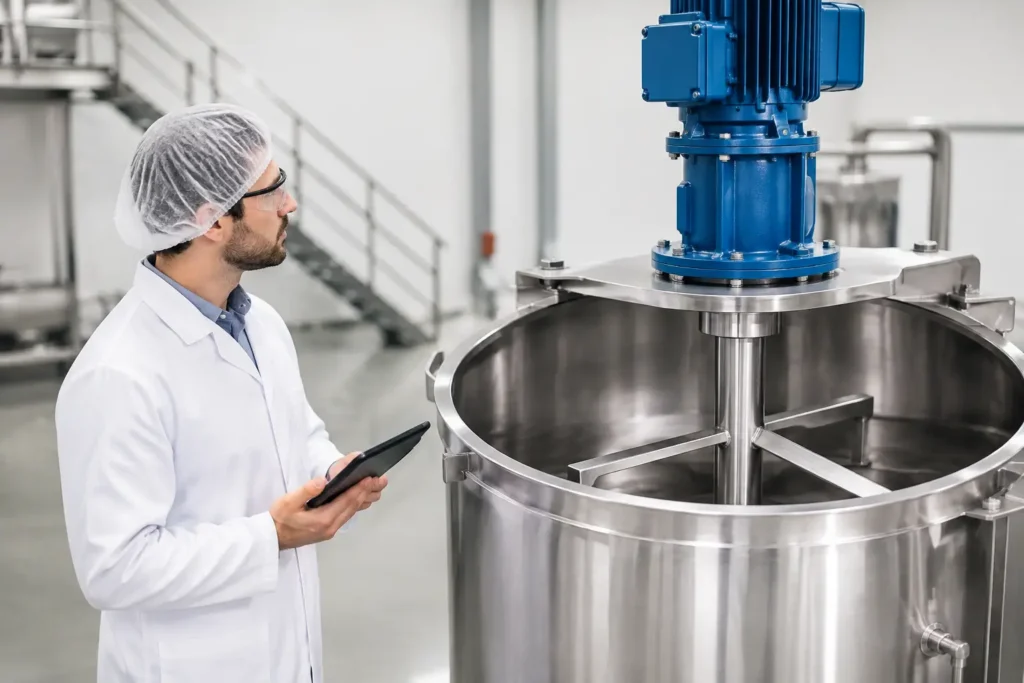
A mixer that looks well rated on a specification sheet can still miss the process completely. Useful industrial mixer reviews begin with the actual duty: what must be dispersed, blended, suspended, emulsified, or injected, under what flow conditions, and with what consequences if performance drifts.
For process engineers and plant buyers, a review should not be a popularity contest between brands or a comparison of motor horsepower alone. It should establish whether the equipment can produce repeatable results in the real vessel or pipeline, tolerate the process chemistry, fit the installation, and remain serviceable over its operating life.
What Industrial Mixer Reviews Should Measure
The first question is simple: what is the mixer required to do? Mixing is not one duty. A tank mixer used to maintain uniformity in a low-viscosity chemical solution has different requirements from a high-shear unit producing an emulsion, a static mixer blending two continuous process streams, or an injection quill introducing a treatment chemical into a high-velocity pipeline.
A credible review identifies the desired outcome and the conditions that govern it. For tank applications, that includes vessel diameter and geometry, liquid level, viscosity range, density, batch volume, solids loading, temperature, and whether the process needs complete turnover, solids suspension, gas dispersion, or heat-transfer support. For inline applications, reviewers should consider pipe size, flow rate, flow regime, pressure drop, fluid ratio, viscosity difference, and available straight-run piping.
If a review simply says a mixer is powerful, durable, or suitable for chemical service, it is incomplete. Power without an impeller selection, rotational speed, and tank geometry is not a process answer. Likewise, a static mixer with excellent blending efficiency may be the wrong selection when its pressure-drop requirement exceeds the available pumping head.
Start With Mixing Mechanism, Not Motor Size
Mechanical and static mixers create mixing through very different mechanisms. A top-entry, side-entry, or portable mixer delivers energy through an impeller. Its results depend on impeller type, diameter, tip speed, placement, shaft design, and the way fluid circulates through the vessel.
Axial-flow impellers are often selected for bulk blending and solids suspension because they generate strong top-to-bottom circulation. Radial-flow designs can serve gas dispersion and higher-shear duties but may demand different baffling and power input. High-shear rotor-stator mixers apply concentrated mechanical action for difficult dispersions, emulsions, particle reduction, and product development work where ordinary agitation cannot achieve the target result.
Static mixers have no motor, seal, shaft, or moving internal parts. Fixed elements divide and redirect flow repeatedly, creating controlled mixing inside the pipe. That simplicity can reduce maintenance substantially, but it does not make static mixing automatic. Element geometry, mixer length, Reynolds number, viscosity, and allowable pressure drop determine whether the installation achieves the required blend quality.
Read Reviews Through the Lens of Your Process
A review from a water-treatment operation may be relevant to a chemical plant only if the flow and chemical conditions are comparable. Plant teams should separate general product feedback from application evidence.
For example, a polymer dilution application may involve highly viscosity-sensitive fluids and require low-shear handling to protect polymer chains. A review praising aggressive dispersion capability would not make that mixer suitable. In contrast, a surfactant-oil emulsion may require high localized shear and controlled recirculation. The same low-shear design that protects polymer could leave the emulsion unstable.
When reviewing equipment performance, ask whether the reported duty matches these operating realities:
- Fluid viscosity at minimum, normal, and maximum operating temperature
- Required batch time or continuous-flow residence time
- Density differences between components and tendency to stratify
- Solids size, concentration, settling behavior, and abrasiveness
- Chemical compatibility with wetted materials, seals, and elastomers
- Cleaning, sanitary finish, drainability, and validation requirements
These details are more valuable than generic star ratings because they expose the process conditions behind the reported outcome. A successful installation is evidence. It is not a universal guarantee.
Examine the Installation as Carefully as the Mixer
Many mixer problems originate outside the mixer itself. A correctly selected unit can underperform if it is mounted off-center without accounting for vortexing, installed in an unbaffled vessel where baffling is needed, or placed at an elevation that leaves stagnant zones near the tank bottom.
For side-entry tank mixers, nozzle orientation, shaft angle, impeller elevation, and tank diameter affect circulation and settling control. For portable mixers, support rigidity, clamp selection, tank size, and operator handling requirements matter. A portable unit may be the most cost-effective answer for intermittent batches, but it is not always the right choice for a high-volume process requiring fixed, validated operating conditions.
Inline systems deserve the same scrutiny. Injection location, quill design, available pipe length, upstream turbulence, and downstream sampling point all affect chemical distribution. A static mixer cannot compensate for an injection point that causes chemical to contact the pipe wall, precipitate, or enter the main stream poorly. Safe chemical injection is a system design issue, not a single-component purchase.
Materials and Seals Are Performance Criteria
Industrial mixer reviews often give too little attention to materials of construction. That is a costly omission. A mixer can deliver the correct blend and still fail early through corrosion, stress cracking, swollen seals, or abrasive wear.
Stainless steel is widely used, but grade selection matters. Chlorides, acids, caustics, solvents, oxidizers, and elevated temperatures can change the appropriate choice. PVC, CPVC, PVDF, PFA, lined constructions, sanitary alloys, and specialty metals each address different chemical and process requirements. The connection type must also suit the piping or vessel standard, whether threaded, flanged, tri-clamp, socket weld, or another engineered configuration.
Seals deserve equal attention on mechanically driven equipment. A seal plan should account for pressure, temperature, dry-running risk, vapor exposure, solids, and the consequences of leakage. Magnetic-drive mixers can eliminate the traditional dynamic shaft seal in appropriate services, reducing a potential leak path. The trade-off is that torque limits, viscosity, temperature, and magnetic coupling selection must be evaluated carefully.
Compare Ownership Costs, Not Just Purchase Prices
The lowest initial quote can become the highest-cost option if it creates batch delays, inconsistent product, excessive energy demand, or frequent maintenance calls. A thorough equipment review considers total operating impact.
Static mixers can be attractive where continuous blending is needed and a pressure-drop budget is available. With no moving parts, they can provide long service life and low maintenance. However, fouling service, high solids loading, or a process with insufficient pumping head may favor a different geometry, a removable-element design, or mechanical agitation.
Top-entry tank mixers can handle large volumes and demanding blend duties, but they require a suitable vessel opening, support structure, seal arrangement, and maintenance access. Side-entry mixers offer practical advantages for large storage tanks and can be serviced in certain configurations without taking the tank out of operation. High-shear equipment can solve difficult dispersion work quickly, but it typically requires more power and should be specified only where the process needs that intensity.
Lead time also belongs in the comparison. An engineered unit that is ideal on paper but unavailable for a shutdown window can be a poor commercial choice. Ready-to-ship inventory helps when the duty fits a standard configuration. Custom engineering is the better path when materials, connections, geometry, or process conditions require a purpose-built answer.
Questions That Expose a Weak Review
Before acting on a recommendation, request the underlying basis for it. What flow rate, viscosity, tank dimensions, and operating temperature were used? What blend uniformity or droplet-size target was achieved? Was the unit tested at production scale, or was it selected from a standard sizing rule? What pressure drop is expected across the inline mixer at maximum flow?
Also ask about maintenance access, replacement elements or impellers, shaft and seal service, cleaning requirements, and spare-parts availability. For critical operations, process simulation and application review can be more useful than a collection of anecdotal comments. They turn uncertain conditions into design inputs that can be evaluated before equipment reaches the plant.
ProMixUSA approaches mixer selection as an engineered process decision, combining standard equipment availability with custom static mixing, mechanical mixing, chemical injection, and skid-level system options for difficult service conditions.
The best review is the one that lets your team state the duty clearly, verify the selection against real operating limits, and purchase equipment with no unanswered questions waiting for startup day.