
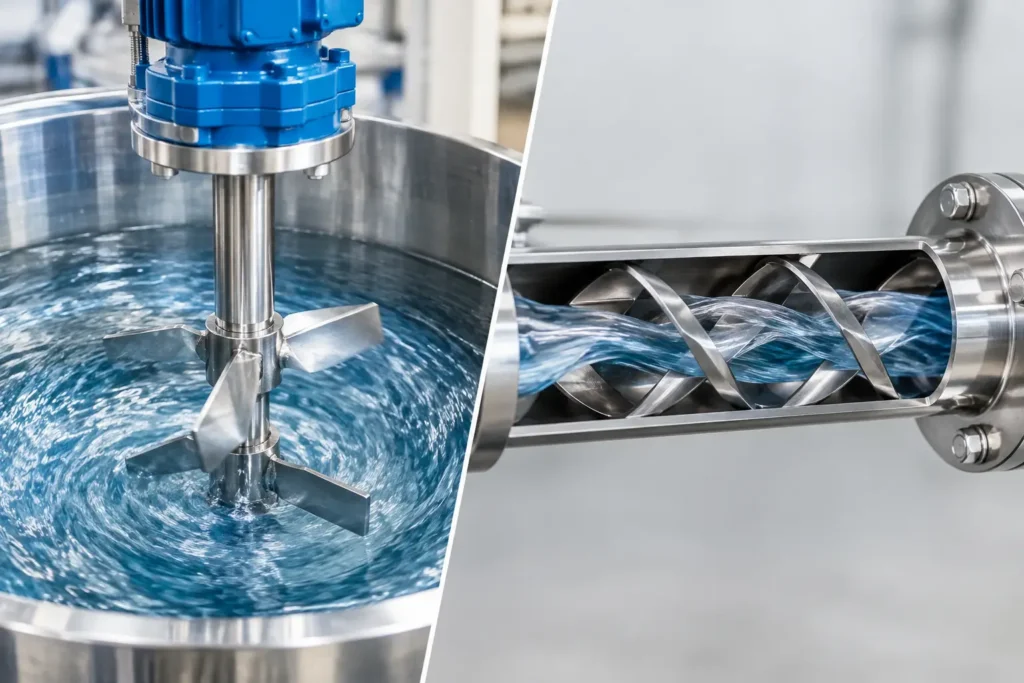
A poor mixer selection rarely fails at startup. It fails when product quality shifts, a dosing point plugs, a batch cycle stretches, or a maintenance shutdown exposes the real cost of moving fluid. The decision between mechanical versus static mixing affects far more than blend uniformity. It determines where energy enters the process, how much pressure the system needs, how operators control the result, and how reliably the equipment performs as conditions change.
For industrial buyers, the right answer is not simply “static for pipes” and “mechanical for tanks.” That is a useful starting point, but it misses the factors that drive actual performance: viscosity range, flow regime, required shear, batch versus continuous operation, solids behavior, allowable pressure drop, cleaning requirements, and chemical compatibility.
Mechanical Versus Static Mixing: The Core Difference
A mechanical mixer adds energy directly through a rotating shaft, impeller, propeller, turbine, rotor-stator head, or other driven component. The motor and mixing geometry create bulk circulation, localized shear, or both. This makes mechanical equipment particularly effective in vessels where the process needs active turnover, suspension, dispersion, or emulsification.
A static mixer has no moving parts. It uses fixed internal elements installed in a pipe or housing to repeatedly divide, rotate, and recombine flowing material. The energy source is the process flow itself. As liquid, gas, or slurry passes through the elements, velocity gradients and flow redistribution produce a controlled, repeatable mix.
That basic distinction creates the central trade-off. Mechanical mixing consumes electrical power and introduces rotating equipment, seals, bearings, and controls. Static mixing avoids those components, but it creates pressure drop and depends on sufficient process flow to do its work.
When a Static Mixer Is the Better Process Tool
Static mixing is often the direct choice for continuous chemical injection, blending, pH adjustment, polymer addition, dilution, heat transfer, and gas-liquid contact in a pipeline. It is especially valuable when the process already has consistent flow and needs uniform composition downstream of an injection point.
A properly engineered inline static mixer delivers repeatable mixing without operator intervention. There are no speed settings to change and no shaft seal to monitor. For a continuous system, that simplicity can reduce maintenance exposure and improve consistency between shifts.
Static mixers are also well suited to applications where space is limited. A compact element assembly can replace a larger skid-mounted mixing package when the process has enough available pressure and the required residence time is short. In many chemical dosing systems, pairing a correctly positioned injection quill with a static mixer prevents concentration streaks that could otherwise create corrosion, poor reaction control, or inaccurate downstream measurements.
The limitation is not whether static mixers can handle challenging fluids. They can be engineered for laminar, transitional, and turbulent regimes, including viscous services. The question is whether the piping system can supply the pressure drop required by the selected element geometry and mixer length. High-viscosity laminar flow can demand a significant pressure budget, even where mixing performance is excellent.
Static mixing deserves close attention when the process has:
- Continuous, reasonably stable flow
- A defined injection point and adequate downstream piping
- Limited tolerance for rotating-equipment maintenance
- A need for consistent inline blending or reaction control
- Sufficient available pressure drop
Material selection matters as much as the element design. Stainless steel may suit many industrial liquids, while PVC, CPVC, PVDF, PFA, lined construction, sanitary finishes, or specialty alloys may be required for corrosion resistance, purity, temperature, or regulatory requirements.
When Mechanical Mixing Earns Its Place
Mechanical mixing is the stronger option when the process occurs in a tank and requires broad vessel circulation. Batch production, make-down operations, solids suspension, blending of changing liquid levels, and difficult viscosity changes are common examples.
The impeller can be selected to match the job. Axial-flow impellers are often used for bulk turnover and solids suspension. Radial-flow designs can provide higher local shear. High-shear and ultra-high-shear mixers use rotor-stator action to break down droplets, disperse powders, and support demanding emulsification duties that a conventional static element may not achieve alone.
Mechanical agitation also gives operators control. Speed can be adjusted as viscosity changes, as a batch reaches final concentration, or as a powder addition begins. That flexibility has real value in processes with variable raw materials or multiple formulations. A static mixer performs predictably at a specified flow condition; a mechanical mixer can be actively tuned during the cycle.
That flexibility comes with equipment responsibilities. Shaft-driven mixers need suitable mounting, motor sizing, gearbox selection where applicable, shaft design, bearing support, seal selection, and access for inspection. A top-entry mixer may be ideal for a large batch vessel, while a side-entry configuration can support tank circulation with limited top access. Portable mixers fit smaller or changing operations, and magnetic-drive designs can be useful where seal leakage is unacceptable.
For tanks with high viscosity or non-Newtonian behavior, the mixer must be engineered around more than horsepower. Impeller diameter, tank geometry, baffles, fluid level, yield stress, and the desired turnover pattern all matter. An undersized unit may form a vortex near the surface while leaving dead zones at the tank wall or bottom.
Shear Is Not the Same as Mixing Quality
One of the most expensive specification errors is assuming that more shear automatically means better mixing. It does not.
Bulk blending of compatible low-viscosity liquids may need very little shear. The real requirement may be complete distribution throughout a line or tank. In that case, a static mixer or low-shear axial-flow impeller can be more efficient than a high-speed disperser.
Emulsions and dispersions are different. If one liquid must be broken into fine droplets within another, or if powders must be deagglomerated, local high shear may be essential. Mechanical rotor-stator equipment is often selected for this duty. Static mixers can contribute to emulsification in the right flow regime and may be highly effective in continuous processes, but performance must be evaluated against droplet-size requirements, viscosity ratio, interfacial tension, and available pressure.
The specification should define the outcome in process terms: concentration uniformity, particle or droplet size, reaction conversion, temperature uniformity, suspension quality, or dosing accuracy. “Good mixing” is not a design criterion.
Pressure Drop, Energy, and Operating Cost
Static mixers are frequently described as energy-free because they have no motor. That description can be misleading. They use hydraulic energy, expressed as pressure drop across the mixer. If the existing pump has excess head, the incremental operating impact may be acceptable. If it does not, a larger pump or additional pumping energy may be required.
Mechanical mixers use direct electrical energy, but they may avoid excessive pumping requirements in a recirculation loop or tank operation. They also allow energy input to be concentrated where it is needed rather than forcing all material through a restrictive inline device.
The lowest-cost option depends on the full system. Compare installed cost, pump head, motor load, maintenance labor, seal and bearing replacement, cleaning downtime, production losses, and the cost of off-spec material. A low purchase price is not a process economy if it produces inconsistent results.
Use the Process Layout to Make the Decision
The process layout often makes the decision clear. If two streams enter a pipeline and must be uniform before reaching a reactor, filter, analyzer, or point of use, static mixing is usually the natural starting point. If ingredients are charged into a vessel over time and the batch must be circulated, suspended, or emulsified, mechanical mixing is usually the better foundation.
Some applications require both. A tank mixer may prepare and maintain a bulk solution, while an inline static mixer completes a final dilution or blends an injected chemical immediately before use. A mechanical high-shear mixer may create an emulsion, followed by a static mixer that maintains uniformity through transfer piping. These are not competing technologies in every process. They are complementary tools when placed at the correct stage.
Engineering Details That Should Not Be Left to Assumption
Selection should start with operating data, not a catalog image. Flow range, viscosity at process temperature, specific gravity, pipe size, pressure and temperature limits, desired pressure drop, solids loading, particle size, injection rate, and material compatibility should all be reviewed. For tank mixers, vessel diameter and height, liquid level range, baffle arrangement, batch volume, and required cycle time are equally critical.
Connection style can influence lead time and installation complexity. Flanged, threaded, sanitary, tri-clamp, weld-end, and custom connections should match plant standards and maintenance practices. For chemical injection, quill insertion depth and orientation affect how rapidly the injected stream enters the main flow and whether it can impinge on a pipe wall.
ProMixUSA supports this process with ready-to-ship equipment and application-specific engineering for static mixers, tank mixers, injection equipment, and complete mixing systems. The objective is not to force a standard mixer into an unusual service. It is to match geometry, materials, connections, and operating conditions to the result the process requires.
The best mixer is the one that makes the process less dependent on operator correction. Define the fluid behavior, the required result, and the limits of the system first. From there, the right mixing technology becomes an engineering decision rather than a purchasing guess.