
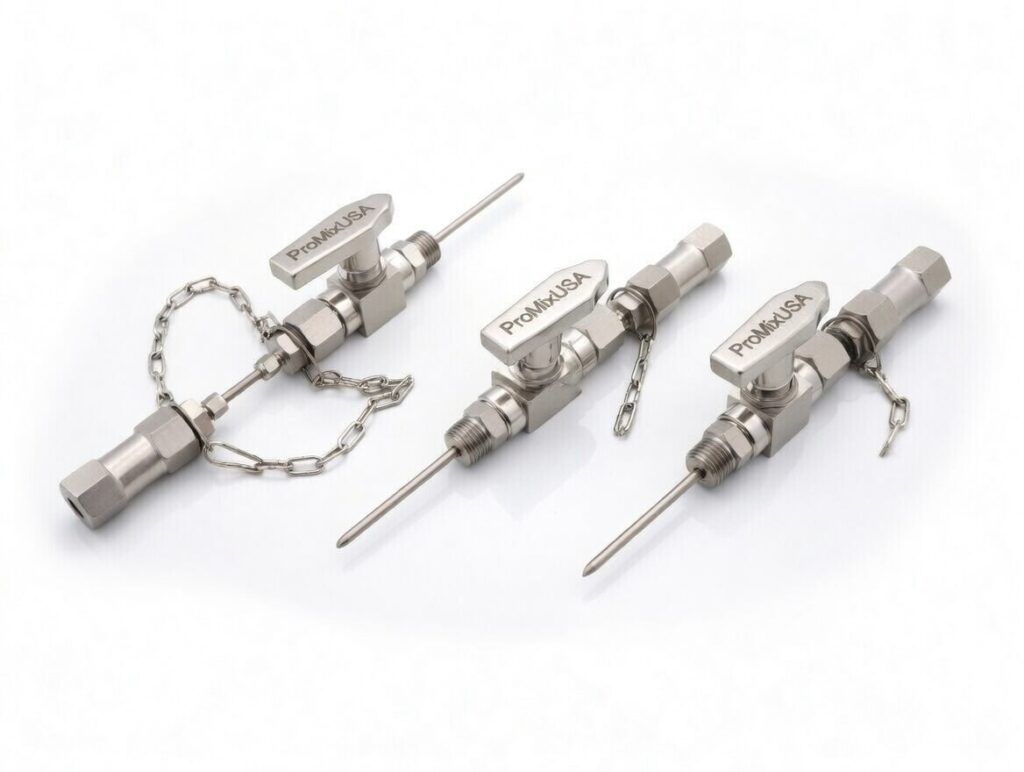
A chemical injection point becomes a maintenance problem the moment it plugs, corrodes, or needs inspection while the process line must remain online. Retractable injection quills address that problem by allowing an operator to withdraw the injection tube from a pressurized pipeline through an isolation assembly, rather than opening the line or scheduling a shutdown. For plants handling corrosive treatment chemicals, intermittent dosing, or critical continuous processes, that capability directly supports safer chemical injection and higher equipment availability.
Unlike a basic pipe nozzle, a properly specified retractable quill is part of the process design. Its insertion length, tip geometry, materials, pressure rating, isolation method, and connection details all affect whether the injected chemical disperses as intended and whether maintenance can be performed without creating an exposure risk.
What Retractable Injection Quills Do
A fixed injection quill extends into a pipe and delivers a chemical into the flowing process stream. It is effective when the point can be isolated and serviced during planned downtime. A retractable design performs the same dosing function but adds a mechanical means of removing the wetted quill while the pipeline remains in service.
The assembly commonly includes the injection lance, a mounting connection, an isolation valve, and a packing gland or other pressure-retaining withdrawal mechanism. Depending on the application, it may also include a travel stop, locking feature, drain or bleed connection, and a flange, threaded, or welded process connection. The exact arrangement depends on line pressure, chemical hazard, pipe orientation, available clearance, and plant maintenance practices.
The operational value is straightforward: operators can isolate the quill, retract it from the line, inspect the tip for fouling or wear, and return it to service without breaking containment on the main process line. That does not mean every quill can be safely retracted under every condition. Pressure limits, temperature, chemical compatibility, isolation integrity, and site procedures remain decisive.
Why Quill Location and Insertion Depth Matter
Chemical injection is not complete when a metering pump delivers the correct flow rate. The additive must enter the process stream at a location where it can disperse without attacking the pipe wall, accumulating at a dead zone, or reacting before it reaches the intended mixing stage.
A quill is often positioned so its outlet reaches beyond the low-velocity boundary layer near the pipe wall. Injecting into the moving core of the stream generally improves initial dispersion and reduces the risk of concentrated chemical impingement on the pipe. This is particularly relevant for acids, caustics, hypochlorite solutions, coagulants, corrosion inhibitors, polymers, and other reactive or deposit-forming chemicals.
There is no universal insertion depth. A point located too close to the wall may produce poor distribution or localized corrosion. A point placed too far into the pipe can experience higher vibration, interfere with pigging or internal devices, and create a structural concern in high-velocity service. Pipe diameter, flow regime, pressure, fluid properties, and downstream mixing requirements all matter.
Where rapid uniformity is required, the quill should be evaluated as one component of a complete injection and mixing system. A static mixer downstream of the injection point can deliver controlled blending where line velocity alone is not enough. In other services, a properly located quill and adequate downstream residence length may be sufficient. The right answer depends on the required concentration profile, not just the injection hardware.
Selecting Materials for the Actual Chemical Service
Material selection must account for both the injected chemical and the process fluid. The wetted quill may see a highly concentrated chemical at the tip even when the bulk process stream is relatively mild. That difference is one reason nominal pipe material is not always the right basis for quill selection.
Stainless steel is widely used for compatible water, hydrocarbon, and general chemical services. For more aggressive duties, specialty alloys, PVDF, PFA-lined construction, PVC, CPVC, or other engineered materials may be a better fit. Temperature, concentration, pressure, oxidation potential, chloride exposure, cleaning chemicals, and permeation risk should all be reviewed before finalizing the design.
Seals, packing, valve seats, and tubing connections need the same attention as the lance material. A corrosion-resistant tube paired with an incompatible elastomer can still become the failure point. For hazardous duty, buyers should also confirm the selected isolation valve, gland design, and fittings are rated for the full operating envelope, including startup conditions and pressure excursions.
Key Design Details That Affect Field Performance
The most reliable retractable injection quills are specified around the installation, not selected only by nominal pipe size. The process connection must match the piping design and provide sufficient structural support. Threaded connections can be practical for smaller lines and lower-duty applications, while flanged or welded configurations may be preferred for larger, higher-pressure, or more hazardous service.
Tip design also deserves attention. An open-end quill may be suitable for clean liquids and straightforward dosing. A beveled, angled, multiport, or atomizing-style tip may better suit applications requiring a particular injection direction or reduced wall contact. Each option has trade-offs. Smaller openings can improve discharge velocity but are more vulnerable to plugging. Multiple ports can improve distribution but may complicate cleaning and inspection.
The quill must also be engineered for mechanical loads. Flow-induced vibration, unsupported length, frequent retraction cycles, and pump pulsation can fatigue a poorly supported assembly. Long insertion lengths or higher line velocities may require a stiffer design, a guide arrangement, or a revised injection location. This is especially important in large-diameter pipe where the quill must reach deeper into the flow stream.
Operating and Maintaining a Retractable Assembly
A retractable system improves maintainability only when its operating method is clear and repeatable. Maintenance teams should have a documented procedure covering isolation, depressurization of the quill cavity where applicable, controlled withdrawal, containment of residual chemical, inspection, reinsertion, and leak verification.
Before retracting, verify that the process pressure and temperature are within the assembly's rated operating range. Confirm the isolation valve closes fully and that the chemical feed is stopped or secured according to site procedures. If the service is toxic, corrosive, flammable, or otherwise hazardous, personnel protection, secondary containment, and spill response requirements must be built into the job plan.
During inspection, look beyond obvious plugging. Check the discharge tip for erosion, crystallization, deposits, pitting, bent geometry, and signs of chemical attack. Examine packing condition, valve operation, threads or flange hardware, and any locking or travel-stop components. Repeated leakage at the gland is not merely a seal issue. It can indicate misalignment, surface damage, incorrect packing selection, or operation outside the intended duty cycle.
Common Specification Mistakes
The most frequent mistake is treating a retractable quill as a standard fitting. A buyer may specify pipe size and connection type but omit line pressure, temperature, fluid velocity, chemical concentration, and required insertion length. Those missing details determine whether the assembly will be safe and effective.
Another issue is assuming retraction eliminates shutdown planning. Retractability can avoid an unplanned line break, but it does not replace safe work procedures or equipment isolation discipline. Some high-pressure, high-temperature, or extremely hazardous services may require specialized designs, additional containment, or a shutdown regardless of the quill configuration.
Finally, chemical injection is often specified separately from mixing. When dosage accuracy, reaction time, or product consistency is critical, consider the entire system: metering pump behavior, injection point, quill geometry, downstream pipe length, flow conditions, and static mixing requirements. ProMixUSA supports this application-level approach with retractable quills and engineered mixing equipment selected around actual process conditions.
A well-designed retractable quill gives the maintenance team a controlled way to inspect the point where chemical dosing meets the process stream. Specify it with the same rigor as the pump, valve, and mixer downstream, and it can turn a difficult maintenance exposure into a planned, repeatable task.