
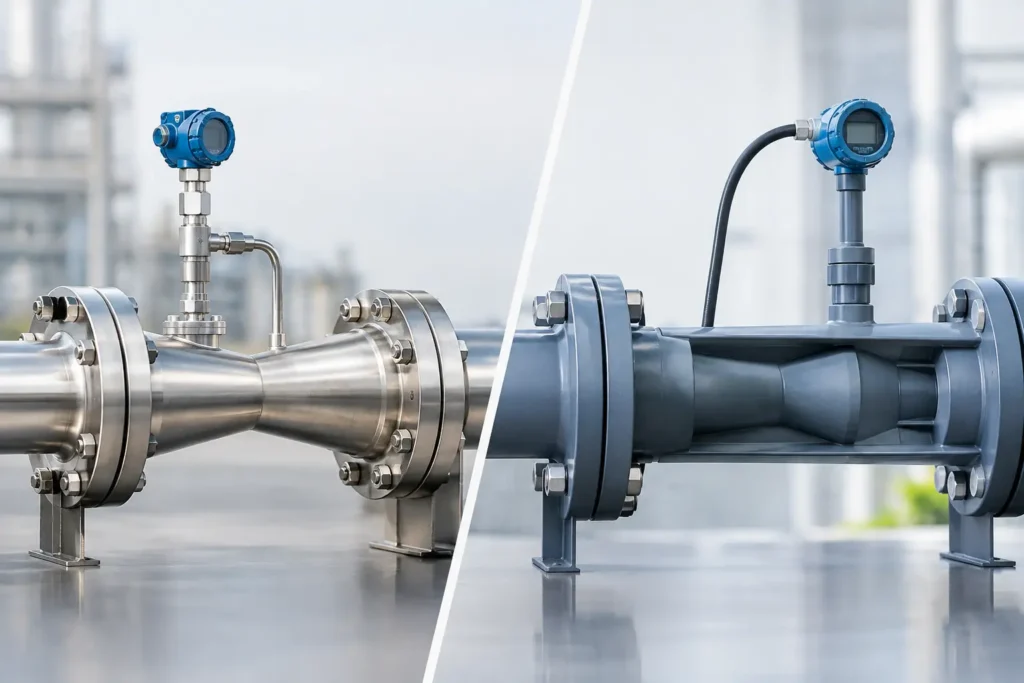
A venturi injector vs eductor comparison can look like a terminology question until the equipment reaches the plant floor. Both devices use a high-velocity motive stream to create a low-pressure zone and entrain another fluid. Yet the duty may be radically different: one unit may meter sodium hypochlorite into a water line, while another must recirculate corrosive liquid, entrain solids, or create tank turnover without a mechanical mixer. Selecting by name alone can lead to low suction, unstable dosing, excessive motive-water use, or an eductor that cannot achieve the required circulation rate.
Venturi Injector vs Eductor: The Core Difference
At the operating principle level, a venturi injector and an eductor are both jet devices. Pressurized motive fluid enters a nozzle, accelerates through a restricted section, and creates a pressure drop at a suction port. That low pressure draws in a secondary fluid. The combined stream then enters a diffuser, where some velocity is converted back to pressure.
The practical distinction is usually based on intended duty and geometry, not an absolute rule of fluid mechanics. A venturi injector is commonly specified for controlled chemical induction into a flowing line. It is often compact, installed inline or on a bypass, and sized around the available pressure differential and desired chemical draw rate. Common applications include disinfectant dosing, pH adjustment, polymer feed, nutrient injection, and gas induction.
An eductor is more often specified as a liquid jet pump for moving, mixing, recirculating, or agitating process fluid. It may be installed in a tank, at the end of a recirculation loop, or in a transfer arrangement. Tank eductors use the motive stream to entrain surrounding liquid and project a high-energy discharge plume, creating bulk circulation without shafts, seals, or submerged mechanical drives.
However, suppliers do not use these labels consistently. Some call nearly any jet pump an eductor. Others use venturi, injector, jet pump, and ejector interchangeably. The correct selection begins with the duty point: motive pressure, available suction conditions, primary and secondary flow rates, fluid properties, discharge backpressure, and required mixing or transport result.
What a Venturi Injector Does Best
A venturi injector is most effective when the process needs reliable induction of a secondary chemical or gas into a pressurized carrier stream. The device has no moving parts, which makes it attractive for chemical services where maintenance access is limited or where a simple, passive injection method is preferred.
The injector needs sufficient differential pressure from inlet to outlet to generate vacuum at the suction connection. This requirement is frequently overlooked. If downstream pressure rises, a control valve is moved, a filter fouls, or motive flow falls below design conditions, the vacuum can collapse. The chemical feed may slow, become inconsistent, or reverse if the system is not protected with appropriate check valves and isolation arrangements.
For chemical dosing, the venturi injector should not be treated as a metering device by itself. Its draw rate changes with motive pressure, discharge pressure, chemical viscosity, specific gravity, suction lift, and the condition of the injection tubing. A metering pump, calibration column, flow verification method, or controlled bypass arrangement may still be required where dose accuracy matters.
Venturi injectors are also useful for gas induction, including ozone, chlorine alternatives, air, carbon dioxide, and oxygen-containing streams. Gas service requires extra attention because gas compressibility and dissolved-gas behavior can affect performance. The injection point must also provide enough downstream mixing length or mechanical mixing energy to disperse the gas effectively.
Where an Injection Quill May Be the Better Choice
If the secondary chemical is already supplied by a positive-displacement metering pump and does not need vacuum induction, a fixed or retractable injection quill can be a more direct solution. The quill places the chemical at a controlled position in the pipe, often near the pipe centerline or in a region of higher velocity. It reduces wall wetting and helps prevent localized corrosion, scaling, or poor distribution.
A venturi injector adds pressure loss and requires motive energy. An injection quill requires a pump capable of overcoming line pressure. The better choice depends on the chemical-feed architecture, not simply the desired injection location.
What an Eductor Does Best
An eductor is a practical option when liquid movement and bulk mixing matter more than fine chemical metering. In a tank, liquid from a recirculation pump is sent through the eductor nozzle. The resulting jet entrains tank liquid and discharges a larger combined flow, producing circulation across the vessel.
This approach is well suited to corrosive, abrasive, hazardous, or maintenance-sensitive services. Because the energy source is external to the vessel, the tank may avoid rotating shafts, mechanical seals, gearbox maintenance, and submerged electrical components. Eductors are commonly used for blending low-viscosity liquids, keeping solids suspended where conditions permit, dissolving chemicals, maintaining uniform temperature, and improving turnover in plating, wastewater, pulp, mining, and chemical-processing tanks.
The trade-off is energy efficiency. A tank eductor does not create energy from nothing. It uses pump pressure and flow to produce entrainment and circulation. Its mixing performance depends on nozzle velocity, eductor placement, tank geometry, liquid level, viscosity, solids loading, and the number of units installed. For difficult blending, emulsification, high-viscosity materials, or demanding solids suspension, a mechanical tank mixer or high-shear mixer may be the stronger solution.
Eductors can also serve in transfer and evacuation duties. A liquid-powered eductor can pull liquid from a sump, drum, pit, or process vessel without a submerged pump. In these applications, consider the suction lift, entrained-fluid density, solids size, nozzle passage, discharge elevation, and any backpressure in the outlet piping. A design that works with clean water may perform poorly with a viscous acid, slurry, or temperature-sensitive product.
Compare the Operating Requirements Before Selecting
The most useful comparison is not product label versus product label. It is the operating envelope of the proposed device versus the actual process conditions.
First, establish the motive-fluid conditions. Record the minimum and maximum available pressure at the device inlet, not just the pump nameplate pressure. Include pressure losses from piping, strainers, valves, heat exchangers, and elevation. Jet devices are sensitive to real differential pressure, especially where the process has variable flow.
Next, define the secondary stream. For a venturi injector, identify the desired chemical draw rate, concentration, specific gravity, viscosity, vapor pressure, suction lift, and whether the source vessel is vented or pressurized. For an eductor, define the required entrained flow, particle size and concentration if solids are present, and the degree of circulation or turnover needed in the vessel.
Then evaluate discharge conditions. Backpressure is one of the most common causes of underperformance. The discharge side must have enough capacity for the combined motive and suction flows. A long discharge run, undersized pipe, elevated destination, or restrictive downstream equipment reduces the available pressure recovery and can sharply reduce suction performance.
Material selection is equally consequential. PVC, CPVC, PVDF, PFA-lined construction, stainless steel, duplex alloys, and specialty metals all have valid places in injector and eductor service. The right material depends on chemical compatibility, concentration, temperature, pressure, abrasion, cleaning requirements, and contamination risk. For sanitary process lines, surface finish, drainability, connection type, and clean-in-place requirements may control the design.
System Design Determines Mixing Results
A venturi injector can place chemical into a line, but it does not automatically guarantee homogeneous concentration downstream. Some applications have enough turbulent flow and straight-pipe residence time to finish the blend. Others need an inline static mixer after the injection point to eliminate concentration gradients before a sample point, sensor, membrane system, reactor, or product packaging step.
The same principle applies to eductors. An eductor can generate strong local motion while leaving dead zones behind baffles, in corners, beneath coils, or near a tank bottom. Placement matters. Multiple eductors directed to create a coordinated circulation pattern often outperform one oversized unit. For critical tank duties, process modeling or mixer simulation can determine whether jet location, nozzle angle, recirculation rate, and equipment count will meet the required blend time and solids-suspension target.
ProMixUSA engineers chemical injection, static mixing, tank mixing, and venturi equipment as connected process functions rather than isolated catalog components. That approach is valuable when a process needs more than suction at a port – it needs repeatable concentration, safe chemical handling, and dependable performance under real operating conditions.
When to Choose Each Device
Choose a venturi injector when the primary need is drawing a chemical or gas into a pressurized liquid stream and the system can maintain the required differential pressure. It is especially useful for passive induction, compact installations, and services where the absence of moving parts is an advantage.
Choose an eductor when the primary need is liquid entrainment, transfer, tank circulation, or jet-driven agitation. It is often the right fit for low-viscosity liquid mixing, corrosive tank service, and applications where eliminating in-tank rotating equipment improves maintainability or safety.
For either device, request performance data at the actual duty point rather than relying on nominal pipe size or a generic flow ratio. A properly sized jet device is simple, durable equipment. A poorly matched one can create a process problem that appears later as poor dosing control, inadequate tank turnover, or unexpected pump demand. Start with pressure, flows, fluid properties, and the result the process must achieve, then let the equipment configuration follow.