
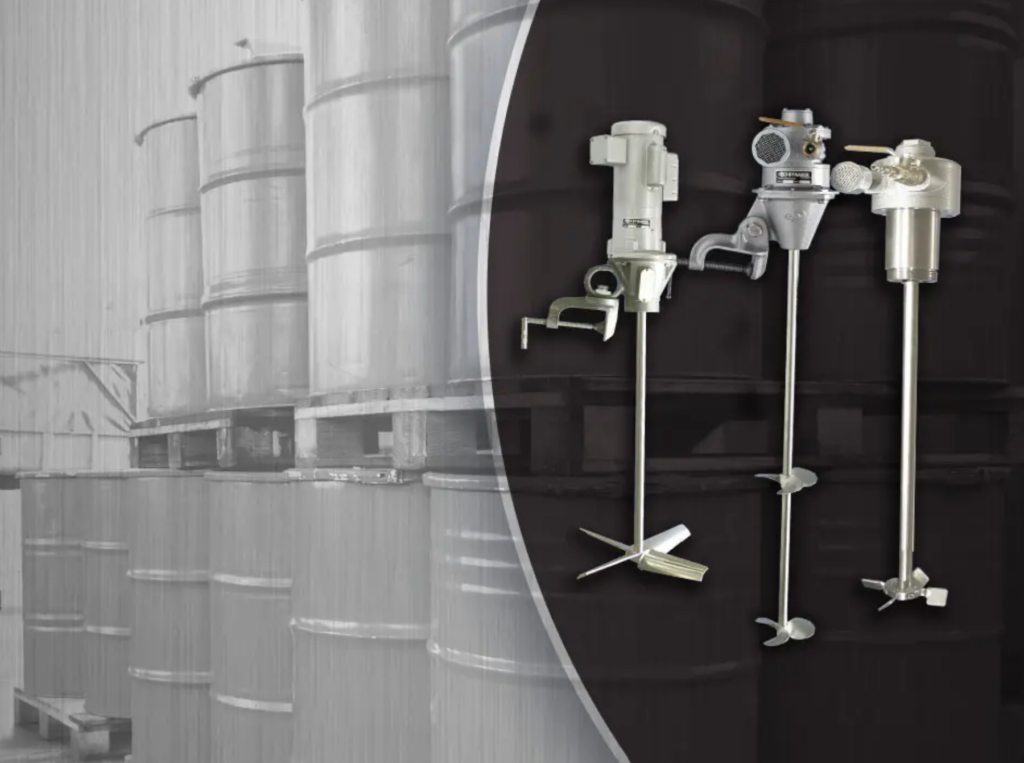
A 55-Gallon drum is not a small process tank. Its narrow opening, limited liquid depth, changing fill level, and often temporary location can make a standard agitation approach ineffective or unsafe. A properly specified portable mixer for drums brings controlled mechanical mixing directly to chemicals, additives, coatings, polymers, slurries, and other materials held in 55-gallon drums or similar containers.
For plant teams, the goal is rarely just to make a liquid move. The mixer must re-suspend settled solids, maintain a uniform batch, dissolve an additive, disperse a concentrate, or prepare material for transfer without creating excessive foam, air entrainment, heat, or operator exposure. That requires matching the portable mixer to the actual fluid and operating condition, not simply selecting the highest available horsepower.
What a Portable Mixer for 55-Gallon Drums Must Handle
Drum mixing is commonly used where material arrives in shipping containers, where a full production tank is unnecessary, or where batches are prepared near a point of use. Water-treatment chemicals, paint components, lubricants, food ingredients, adhesives, agricultural formulations, and specialty chemical intermediates all present different mixing demands.
The practical challenge is that drum contents often change during use. A drum may begin nearly full, then operate at half volume, then be drained to a low level. The impeller must continue to generate useful circulation across that range. A mixer that performs well only at one liquid level can leave solids packed at the bottom or create a surface vortex as the drum empties.
Portable equipment also sees more handling than permanent tank mixers. Operators install it, remove it, move it between work areas, and store it between batches. A sound design balances process performance with manageable weight, secure mounting, guarded rotating components, and a configuration that can be cleaned and serviced without excessive downtime.
Start With the Mixing Duty, Not the Drum Size
A 55-gallon drum is a useful starting point, but it is not enough information to size a mixer. The same drum can hold thin sodium hypochlorite, a viscous resin, a pigment slurry, or a shear-sensitive emulsion. Each may require a different drive speed, impeller geometry, wetted material, and mounting arrangement.
For low-viscosity liquids, the main requirement may be bulk turnover. An axial-flow impeller can produce top-to-bottom circulation that keeps a solution uniform and prevents mild settling. Higher-speed radial-flow impellers can provide more localized shear for certain dispersion duties, but they may also increase vortexing and air entrainment in an open drum.
When solids have settled into a compact layer, the requirement shifts from simple circulation to solids suspension. The mixer needs enough torque and appropriate impeller placement to lift material from the bottom. In these cases, a larger-diameter, lower-speed impeller often produces better bulk movement than a small, high-speed impeller. Starting a mixer in a settled slurry may also demand substantially more torque than maintaining an already suspended material.
Viscosity changes the selection further. Thin fluids respond quickly to impeller pumping action. Viscous coatings, gels, oils, and polymer solutions resist flow, may form stagnant regions near the drum wall, and can place a much higher load on the motor. A portable mixer should be selected against the maximum expected viscosity, including cold-start conditions, rather than the material's ideal laboratory value.
Define the Process Result
Before specifying equipment, establish what “mixed” means for the application. It may mean consistent concentration before dosing, complete dissolution of dry chemical, uniform color, no visible sediment, stable viscosity, or a measured particle distribution. These targets determine whether the duty needs gentle blending, solids suspension, dispersion, or high-shear processing.
A portable 55-Gallon drum mixer is highly effective for many preparation and maintenance tasks. It is not automatically the right choice for every emulsion or difficult dispersion. Materials requiring extreme emulsification, tightly controlled droplet size, or aggressive particle deagglomeration may need a high-shear mixer, rotor-stator head, recirculation loop, or a dedicated batch system instead.
Drive Speed, Torque, and Impeller Geometry
Motor horsepower alone does not describe mixer capability. Speed and torque must be evaluated together. A high-speed direct-drive unit can be effective for low-viscosity blending and moderate dispersion. A gear-reduced drive is generally more appropriate where viscosity is higher, solids loading is significant, or the process benefits from a larger, slower impeller.
Impeller selection controls the flow pattern inside the drum. Axial-flow designs push liquid downward or upward along the shaft and encourage full-volume turnover. They are a frequent choice for blending and suspension. Radial-flow designs discharge outward from the impeller and can create stronger local turbulence, which may help with certain mixing tasks but can be less efficient for top-to-bottom circulation in a tall, narrow vessel.
Impeller diameter must work within the drum opening and clear the container wall. This limits geometry compared with an open tank. Folding impellers can pass through a bung opening and open after insertion, offering an efficient option where closed-drum handling or limited access matters. The trade-off is added mechanical complexity and the need to verify that blades deploy reliably in the process fluid.
Shaft length matters as much as impeller type. The impeller should reach the active mixing zone without contacting the bottom. If the unit will operate across changing liquid levels, the mounting arrangement should allow practical adjustment. A shaft that is too short may circulate only the upper layer. One that is too long can interfere with drum handling or create bottom-contact risk.
Mounting and 55-Gallon Drum Access Affect Operator Safety
Portable mixers are often supplied with clamp mounts, bridge mounts, or bung-mounted configurations. The right arrangement depends on whether the drum is open, closed, stationary, or frequently exchanged.
An open-top drum provides the greatest flexibility for larger impellers and visual observation, but it also increases splash and exposure risk. A bung-mounted portable mixer can keep a closed container more contained, which is valuable for hazardous, odorous, or contamination-sensitive fluids. The opening size, drum closure configuration, and required venting must be considered before selecting this style.
The mount must resist motor torque and vibration without deforming the drum rim or slipping during operation. Operators should not have to hold or stabilize the mixer by hand. Guarding, power disconnect practices, and lockout procedures remain essential because a portable unit is handled more frequently than fixed equipment.
For combustible liquids, vapors, or dust-prone environments, motor and electrical specifications must match the classified area requirements. This is a system-level safety decision. A suitable mixer motor does not eliminate the need to evaluate grounding, bonding, static control, drum ventilation, and the surrounding process area.
Wetted Materials and Cleanability Are Process Decisions
The wetted shaft and impeller material must tolerate the chemical, temperature, and cleaning method. Stainless steel is widely used for general industrial service and many sanitary applications, but it is not universal. Chlorides, strong acids, caustics, solvents, and oxidizers can require higher alloys, coated components, or engineered polymers such as PVDF, PFA, PVC, or CPVC depending on service conditions.
Compatibility should account for more than the main ingredient. Concentration, temperature, trace contaminants, cleaning chemicals, and soak time can all change corrosion behavior. For food, beverage, pharmaceutical, and other hygiene-sensitive operations, surface finish, cleanability, and avoidance of crevices may be as important as base material selection.
If a mixer is shared across multiple products, establish a documented cleaning process and verify that the shaft, impeller, and mounting surfaces can be accessed. Portable equipment can reduce capital cost and floor-space demands, but cross-contamination risk rises when one unit moves between formulations without disciplined cleaning controls.
When a Drum Mixer Is the Wrong Tool
Portable drum mixers solve a defined class of problems well, but they have limits. Very high-viscosity materials may require a heavy-duty drum agitator, a follower plate system, or transfer equipment designed to force material toward the pump inlet. Materials that cannot tolerate vortexing may need baffles or a different vessel geometry. Highly abrasive slurries may require specialized impellers and increased attention to shaft wear.
There is also a production-scale question. If operators spend substantial time moving, cleaning, and monitoring a portable mixer, a fixed tank mixer or a complete skid may offer better repeatability and labor efficiency. For continuous chemical injection, an inline static mixer and injection quill can provide consistent blending without a batch agitation step.
The best selection follows the process rather than the container. ProMixUSA helps industrial teams evaluate fluid properties, mixing objectives, materials, mounting constraints, and required lead time so the equipment performs where it is installed, not only on a specification sheet.
A portable mixer should give operators a controlled, repeatable way to prepare material at the drum. Define the duty clearly, specify for the hardest operating condition, and the right unit becomes a dependable part of the process rather than another source of variation.