
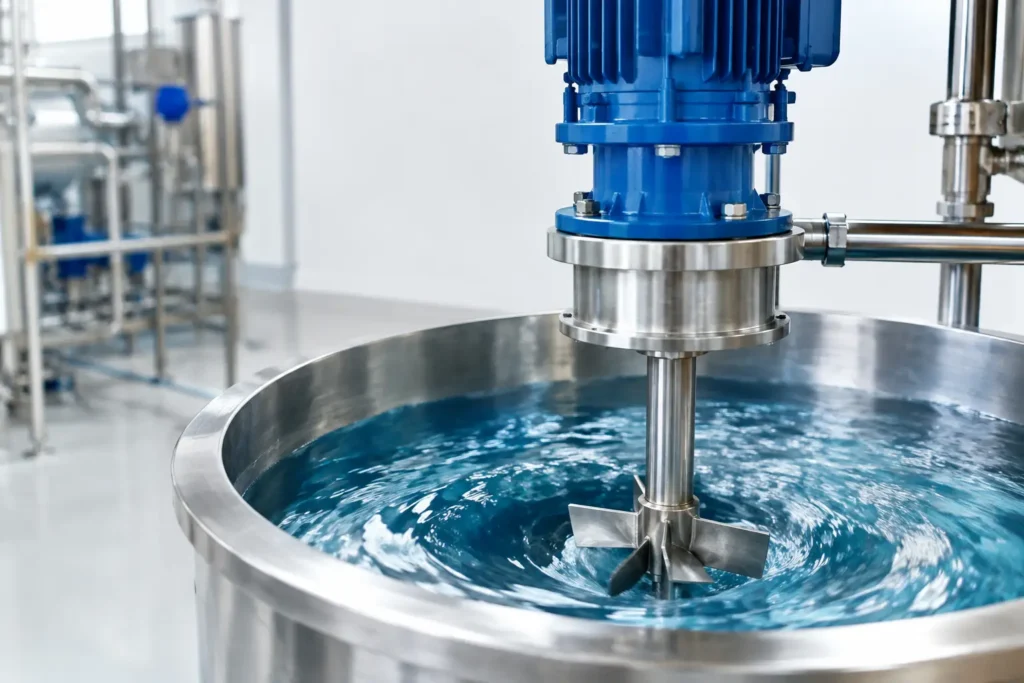
A leaking agitator seal is rarely a minor maintenance issue. In a reactor, blend tank, or chemical make-down vessel, it can mean lost product, exposure risk, unplanned cleanup, emissions concerns, and a shutdown that costs far more than the replacement parts. That is where magnetic drive mixer benefits become operationally significant. By transferring motor torque through a sealed containment barrier rather than a shaft penetration with a dynamic seal, a magnetic-drive mixer helps plants maintain mixing performance while reducing a common source of leakage.
For operations handling corrosive chemicals, volatile solvents, high-purity fluids, hazardous intermediates, or sanitary products, the design can be a practical control measure rather than a premium feature. It is not the right answer for every tank or every viscosity range. But where containment and uptime carry real value, it deserves early consideration during equipment specification.
How a Magnetic-Drive Mixer Changes the Seal Problem
A conventional top-entry mixer uses a rotating shaft that passes through the vessel boundary. Mechanical seals, packing, or other sealing arrangements manage that opening. Properly selected and maintained seals perform well in many applications, but they remain wear components exposed to shaft runout, dry-running conditions, pressure changes, crystallization, chemical attack, and thermal cycling.
A magnetic-drive mixer eliminates the direct rotating shaft penetration. The motor turns an outer magnetic assembly. Magnetic force passes through a stationary containment shell to an inner magnetic assembly connected to the mixer shaft and impeller. The vessel remains closed at the drive location because the containment shell does not rotate.
That configuration does not eliminate every maintenance requirement. Bearings, impellers, shafts, structural supports, and the drive system still require proper engineering. What it removes is the dynamic product seal as a routine failure point. For many process teams, that is the central advantage.
Magnetic Drive Mixer Benefits That Matter in Production
Improved containment for difficult fluids
The clearest benefit is reduced leak potential at the mixer drive. This matters when a process fluid is toxic, corrosive, flammable, odorous, moisture-sensitive, or expensive enough that small product losses are unacceptable. A sealed magnetic-drive arrangement can also support closed processing objectives where preventing outside contamination is as important as keeping product inside the vessel.
In chemical injection support systems, specialty chemical blending, coatings, pharmaceutical intermediates, and high-value formulations, containment affects more than housekeeping. It can influence worker safety procedures, secondary containment requirements, product batch disposition, and environmental reporting.
Less seal-focused maintenance
Mechanical seals require inspection and, eventually, repair or replacement. Plants may need seal flush plans, barrier fluid management, leak monitoring, spare seal inventory, and technician time. A magnetic drive reduces those activities because there is no rotating product seal to service.
The maintenance value is strongest when access is difficult or outages are disruptive. A mixer installed on an elevated vessel, inside a contained processing area, or within a tightly scheduled batch operation is expensive to take out of service. Removing predictable seal work can help maintenance teams shift effort toward planned inspections and condition-based service.
Better protection of product purity
In sanitary, high-purity, and sensitive chemical service, seal leakage is only part of the concern. Seal faces, flush fluids, wear particles, and external contaminants can create pathways that complicate quality control. A fully enclosed magnetic drive helps isolate the batch from the surrounding environment.
Material selection still determines whether the complete mixer is suitable. The containment shell, wetted shaft, impeller, bearings, and vessel connection must be compatible with the chemistry, cleaning method, and temperature. Stainless steel may fit many sanitary and general industrial applications, while PVDF, PFA-lined designs, specialty alloys, or other materials may be required for aggressive service.
Reliable mixing under closed-vessel conditions
A sealed drive is especially useful where the tank operates under vapor control, inert gas blanketing, vacuum, or pressure. Maintaining a closed boundary becomes more difficult when a rotating shaft must cross it. Magnetic drive designs allow the mixer to deliver agitation while preserving the vessel's sealed construction.
This is valuable for solvent systems, oxygen-sensitive materials, volatile ingredients, and processes where vapor containment protects both personnel and product. The mixer still needs to be specified for the vessel pressure rating and process conditions. A magnetic coupling is a design advantage, not permission to overlook mechanical limits.
Lower risk from dry-running seal failures
Many seal failures begin when operating conditions move away from the seal's intended environment. Loss of flush, inadequate lubrication, pressure excursions, temperature spikes, or process solids can rapidly damage seal faces. Because a magnetic-drive mixer does not rely on a dynamic shaft seal, those specific failure modes are removed from the agitation system.
For plants that have experienced repeat seal failures, this can turn an unreliable mixer location into a stable part of the process. The underlying cause should still be understood. Excessive shaft deflection, abnormal vibration, poor mounting rigidity, or an unsuitable impeller can affect any mixer design.
Where the Benefits Are Strongest
Magnetic-drive mixers are commonly considered for smaller to medium-duty batch tanks, closed vessels, laboratory and pilot-scale systems, chemical preparation tanks, sanitary blending, and corrosive liquid applications. They can be particularly effective where the process needs controlled agitation without an exposed shaft seal.
The right impeller remains critical. A low-viscosity blending duty may use a hydrofoil or pitched-blade impeller to establish bulk circulation. A heavier liquid, suspension duty, or heat-transfer application may need a different blade geometry, multiple impellers, baffling, or a different drive approach altogether. A leak-free drive cannot compensate for inadequate fluid turnover.
For emulsification or particle-size reduction, assess whether the duty requires high shear or ultra-high shear rather than conventional tank agitation. A magnetic-drive mixer may provide secure containment, but the process result depends on shear rate, residence time, recirculation pattern, and formulation behavior.
Specify the System, Not Just the Drive
A reliable magnetic-drive installation begins with application data. The process engineer or equipment buyer should establish the fluid viscosity range, specific gravity, solids level, tank geometry, operating volume, temperature, pressure, and expected batch cycle. Those details determine motor sizing, coupling torque, shaft design, bearing arrangement, impeller selection, and materials of construction.
Four questions should be resolved before specifying the mixer:
- What torque is required at maximum viscosity, not only at normal operating conditions?
- Could solids settle, crystallize, or accumulate around internal bearings and rotating components?
- Is the containment shell material suitable for the chemical, temperature, pressure, and cleaning regime?
- What happens if the impeller stalls, the batch thickens, or the process experiences a rapid temperature change?
Magnetic couplings have a finite torque capacity. If process resistance exceeds that capacity, the inner and outer magnetic assemblies can decouple. This is often called a slip condition. It can protect components from overload, but it also stops effective agitation and requires operator response. Conservative torque sizing and a realistic understanding of worst-case viscosity are essential.
The containment shell also deserves careful attention. Metallic shells can generate eddy-current losses as the magnetic field passes through them, adding heat and reducing efficiency. Nonmetallic or specialized shell designs may reduce this effect in suitable services, but the selection must account for pressure capability, chemical resistance, permeability, and mechanical strength. There is no universal best material.
Trade-Offs Against Conventional Sealed Mixers
Magnetic-drive equipment can carry a higher initial cost than a conventional mixer with a basic mechanical seal. For straightforward water-like liquids in nonhazardous, accessible tanks, a conventional sealed mixer may remain the most economical choice. The lifecycle calculation changes when seal maintenance, lost production, cleanup, safety exposure, and product loss are included.
Torque limitations can also make magnetic drive less attractive for high-viscosity mixing, severe solids handling, or large vessels requiring substantial horsepower. Some duties call for a heavy-duty gear drive, a specialized seal system, or a different agitator configuration. Process conditions decide the equipment, not a preference for any one drive technology.
Internal components must also be maintained with the same discipline applied to other wetted equipment. Depending on the design and fluid, bearings can wear, deposits can form, and chemical compatibility can change over time. A magnetic drive reduces a major maintenance exposure, but it does not make inspection planning unnecessary.
Build Containment Into the Mixer Decision
The best time to evaluate a magnetic-drive mixer is before the vessel, impeller, and operating envelope are locked into a purchase order. Matching the magnetic coupling, containment shell, wetted materials, mounting configuration, and impeller geometry to the actual process gives the design room to deliver its intended value.
For critical blending and chemical handling duties, ProMixUSA can help translate fluid properties and vessel constraints into an engineered mixing solution. A well-specified magnetic-drive mixer does more than avoid a seal leak. It gives the operation a more controlled path to safe, repeatable production.