
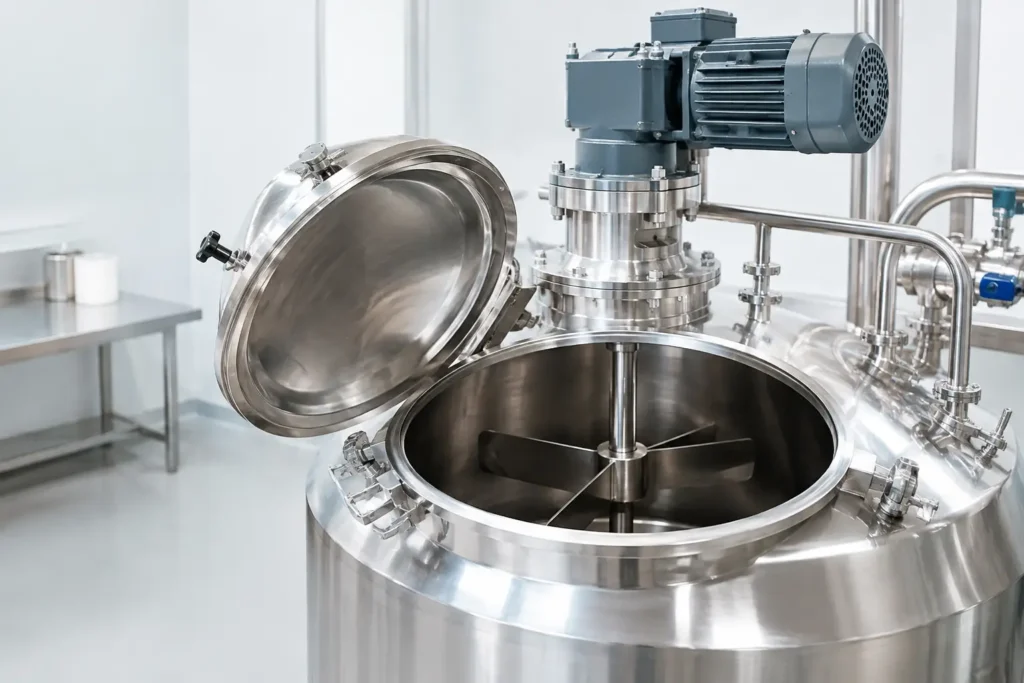
A mixer can hit the required blend time and still create a sanitation problem. Product retained behind an impeller hub, an undrainable pipe branch, a poorly selected seal, or a rough internal weld can turn a productive batch system into a source of rejected product and extended cleaning cycles. Sanitary mixing equipment must therefore do more than move fluid. It must deliver the intended blend, shear, and turnover while supporting reliable cleaning, inspection, and repeatable production.
For food, beverage, dairy, nutraceutical, biotechnology, and pharmaceutical operations, the right design starts with the process itself. Viscosity, solids loading, temperature, batch size, clean-in-place strategy, and required product texture all affect the mixer configuration. A sanitary finish alone does not solve a poor mixing application.
What Makes Mixing Equipment Sanitary?
Sanitary design is fundamentally about controlling places where product, microorganisms, cleaning chemicals, or rinse water can remain. Wetted surfaces should be compatible with the process fluid and sufficiently smooth for the cleaning method. Product-contact geometry should avoid crevices, unnecessary threaded connections, inaccessible gaps, and areas that do not drain.
In many applications, 316L stainless steel is the default wetted material because it offers strong corrosion resistance and is available with sanitary surface finishes. That does not make it universal. Chloride exposure, concentrated cleaning chemicals, abrasive solids, elevated temperatures, or specialized formulations may require a different alloy, electropolished surfaces, or carefully selected polymer components. Gaskets, O-rings, mechanical-seal faces, and lubricant isolation all need the same level of review as the vessel and mixer shaft.
Cleanability also depends on the entire assembly. A sanitary clamp connection may be appropriate at one point in the process but not compensate for a shaft seal that cannot tolerate cleaning conditions. Likewise, a polished tank mixer will not provide a clean system if the injection point or downstream piping creates a dead leg.
Surface Finish Is Only One Part of the Requirement
A lower roughness finish can reduce the tendency for product to cling to metal surfaces, particularly with protein-rich, sticky, or high-solids formulations. But finish specifications should be tied to the product and cleaning validation requirement, not selected as a default upgrade. Excessive polishing can add cost and lead time without improving the process where product is non-sticky and cleaning is straightforward.
Fabrication quality matters just as much. Consistent internal welds, properly finished transitions, and a geometry that allows cleaning solution to reach all wetted areas are more valuable than an attractive external polish. The objective is a repeatable hygienic process, not a cosmetic finish.
Match the Mixer to the Mixing Duty
The most common specification mistake is choosing equipment by vessel size alone. Two 500-gallon tanks can require completely different mixer designs when one holds a thin beverage base and the other contains a shear-sensitive suspension or a viscous concentrate. The required outcome determines the equipment.
For simple blending, maintaining uniformity, or preventing settling in a batch vessel, a top-entry tank mixer with the appropriate impeller style can provide efficient bulk circulation. Impeller diameter, shaft length, rotational speed, baffle arrangement, and liquid level all influence circulation patterns. A mixer that is too small may leave stagnant zones. One that is oversized can entrain air, damage delicate solids, or create unnecessary energy use.
High-shear mixers are suited to duties that require aggressive dispersion, emulsification, powder wet-out, particle reduction, or rapid incorporation of difficult ingredients. They are often necessary for stabilizers, gums, oils, and other components that resist simple agitation. The trade-off is that high shear can add heat, change particle structure, and affect viscosity or texture. It should be specified for a defined process need, not as a catch-all solution for difficult batches.
Inline static mixers are often an effective sanitary option when continuous flow already provides the energy for mixing. Fixed elements divide and recombine the process stream, producing controlled mixing without an electric motor, rotating shaft, or seal. They can be especially useful for dilution, ingredient injection, pH adjustment, color addition, and continuous blending. Performance depends on flow regime, pressure-drop allowance, viscosity ratio, and the number and geometry of mixing elements.
A static mixer is not automatically the right choice for every hygienic service. Highly viscous products, intermittent flow, fibrous material, and processes requiring intense emulsification may favor a mechanical mixer or a combined system. The correct decision comes from evaluating the fluid behavior at actual operating conditions.
Sanitary Mixing Equipment Selection Starts With Process Data
A complete request for quote should give an equipment supplier enough information to define performance instead of simply sizing hardware. Product viscosity at minimum and maximum temperature is essential. So are density, solids concentration, particle size, batch volume or flow rate, operating pressure and temperature, and the required mixing result.
The cleaning method deserves equal attention. Identify whether the equipment will be cleaned in place, cleaned out of place, or disassembled between batches. Provide the chemistry, concentration, temperature, and circulation conditions of cleaning solutions. A seal and elastomer that perform well in production may have a shorter service life under repeated caustic or acid cleaning exposure.
For vessel mixers, details such as tank diameter, straight-side height, cone or dish bottom, nozzle location, and available headroom affect both mounting and hydraulic performance. For inline equipment, pipe size, schedule, flow direction, allowable pressure drop, connection style, and available straight run should be defined early. These details prevent field modifications that compromise drainage or create difficult-to-clean pockets.
Mechanical Seals and Mounting Deserve Close Review
The shaft seal is often the highest-maintenance part of a sanitary tank mixer. A single mechanical seal may be suitable for many low-pressure applications, while a double seal or flushed arrangement can be justified where containment, product sensitivity, or operating pressure makes leakage unacceptable. Seal selection should consider dry-running risk, cleaning exposure, shaft speed, product lubricity, and available utilities.
Mounting style changes more than installation convenience. Top-entry mixers are common for batch processing and can support a broad range of impellers and shaft lengths. Portable mixers are useful for smaller vessels, production changes, pilot work, and flexible operations, but they still require secure mounting and a stable process geometry. Bottom-entry and side-entry arrangements may solve specific tank or process constraints, though accessibility and cleanability must be reviewed carefully.
Design for CIP Coverage and Full Drainage
A sanitary system should make cleaning predictable rather than dependent on operator workarounds. This means considering how cleaning solution enters, contacts, and leaves every wetted component. Spray devices, flow velocity, chemical concentration, temperature, and cleaning-cycle duration all matter, but the mixer must also be positioned so that its shaft, impeller, and internal features are exposed to the cleaning action.
Drainability is frequently overlooked during layout. Horizontal pipe runs, low points, injection quills, inline mixers, reducers, and valves should be evaluated for retained liquid after production and after cleaning. A small retained volume may be insignificant in a general industrial process but unacceptable in a high-value or microbiologically sensitive product line.
Injection hardware requires special care. The point where a minor ingredient, acid, base, sanitizer, or concentrate enters the main stream must provide sufficient mixing while avoiding product buildup and backflow. A properly engineered sanitary injection quill combined with an inline static mixer can deliver fast, repeatable incorporation. The design should account for injection pressure, chemical compatibility, insertion length, and the required downstream mixing distance.
Balance Standard Components With Application-Specific Engineering
Standard sanitary mixers and static mixing elements can shorten lead times and simplify maintenance. They are often the right answer when process conditions align with established equipment sizes and connection configurations. However, demanding services may require custom shaft lengths, specialized impeller geometry, sanitary ferrules, alloy upgrades, modified housings, or skid-mounted controls and instrumentation.
Customization should solve an operating requirement, not add complexity for its own sake. An engineered system is valuable when it improves cleanability, reduces batch time, fits a restricted vessel opening, manages an unusual viscosity range, or makes a sensitive dosing process more repeatable. It is less valuable when it creates proprietary maintenance burdens without a measurable process benefit.
ProMixUSA supports sanitary applications with mixing, injection, and flow-conditioning equipment that can be configured around actual process conditions rather than a one-size-fits-all catalog selection. That approach is especially useful when a tank mixer, injection quill, and inline mixer must work as one controlled process system.
Ask the Questions That Prevent Rework
Before releasing a purchase order, confirm the required blend time or concentration uniformity, allowable shear exposure, product-contact materials, internal finish, seal arrangement, connection type, and cleaning method. Confirm whether the equipment must meet a plant sanitary standard, a customer specification, or a documented hygienic-design requirement. Also verify the practical items: motor voltage, controls, lift requirements, spare parts, access for maintenance, and delivery schedule.
The best sanitary mixing equipment is not simply the cleanest-looking option. It is the equipment that produces the required result at production rate, cleans predictably, fits the plant, and remains serviceable over years of operation. Start with the fluid and the cleaning cycle, then let the equipment design follow.