
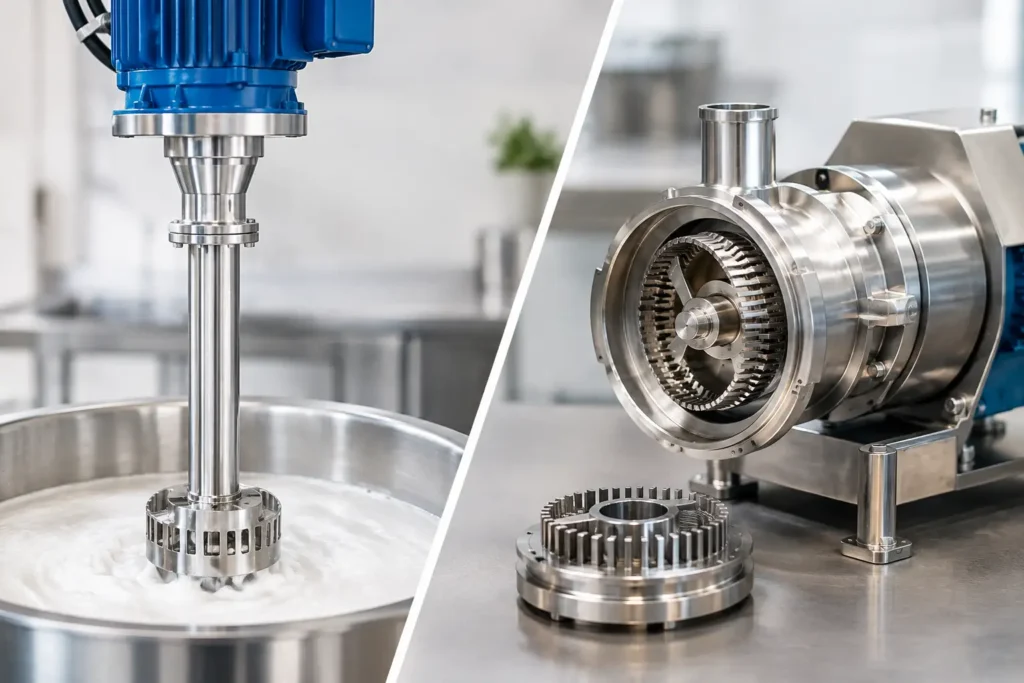
A stable emulsion can fail because the selected mixer creates the wrong kind of energy, not because the formulation is wrong. In the high shear versus colloid mills decision, both technologies reduce droplets and disperse solids, but they do it through different mechanical actions. That distinction affects product texture, batch time, recirculation requirements, wear rates, cleanability, and the size of equipment needed for production.
For process engineers and plant teams, the right question is not which machine delivers the highest shear on paper. It is whether the equipment will consistently achieve the required particle or droplet size at the target viscosity, flow rate, temperature, and sanitation standard.
High Shear Versus Colloid Mills: The Core Difference
High-shear mixers commonly use a high-speed rotor-stator assembly. Product enters the rotor-stator workhead, accelerates through openings in the rotor, and is forced through the stationary stator at high velocity. The resulting hydraulic shear, turbulence, and intense localized circulation are effective for dispersing powders, breaking agglomerates, emulsifying immiscible liquids, and reducing droplets in a continuous or batch process.
A colloid mill uses a rotor and stator with an adjustable, very narrow gap. Product passes through that gap under mechanical and hydraulic forces. Along with shear, the mill can apply compression, friction, and grinding action. This makes it especially effective where controlled particle reduction or a very fine, uniform dispersion is required.
The overlap is real. Either unit may process emulsions, suspensions, slurries, creams, coatings, food products, and chemical formulations. The difference is in process intent. A high-shear mixer is often selected for rapid dispersion and emulsification. A colloid mill is often selected when the formulation needs milling action and precise control over the rotor-stator clearance.
When a High-Shear Mixer Is the Better Fit
High-shear mixers are strong candidates when a process needs aggressive localized energy without relying on an extremely tight mechanical gap. Inline units are particularly useful for continuous processing and recirculation loops, where every pass through the workhead builds dispersion quality.
For example, a chemical producer adding a difficult-to-wet powder into a liquid carrier may use an inline high-shear mixer to break fish eyes and distribute the solids before the material reaches a holding tank. A batch vessel fitted with a top-entry high-shear mixer may be better when the product must be circulated throughout the tank while emulsification takes place.
High-shear equipment is also practical when operators need flexibility across products. Interchangeable or application-specific rotor-stator geometries can be selected for coarse dispersion, emulsification, powder induction, or finer processing. This gives a plant more room to adapt than a mill set up around one narrow-gap operating condition.
That flexibility does not mean a high-shear mixer is automatically the lower-maintenance choice. Rotor-stator heads still wear in abrasive service, and performance falls as clearances grow. However, the equipment may be more forgiving than a colloid mill where abrasive solids, hard particles, or upset conditions repeatedly pass through a tight milling gap.
Where a Colloid Mill Adds Value
A colloid mill earns its place when the process requires fine size reduction combined with highly uniform treatment. The adjustable gap is the defining advantage. It allows operators to tune the mill toward the finished-product specification rather than relying only on speed, flow, and number of passes.
This is valuable in applications such as sauces, dressings, pigments, ointments, certain polymer dispersions, chemical slurries, and products containing soft solids that need to be reduced or smoothed. If a formulation contains agglomerates that must be physically worked down, a colloid mill can produce a more controlled result than a standard high-shear workhead.
The trade-off is that colloid mills demand more attention to feed consistency and operating conditions. Product that is too viscous, oversized solids, inadequate feed pressure, or an improperly set gap can reduce throughput or cause excessive heat and wear. A mill is not a substitute for upstream screening, proper powder wet-out, or sensible formulation design.
Heat generation deserves special attention. The close rotor-stator clearance and frictional forces in a colloid mill can raise product temperature quickly, especially at low flow rates or during multiple passes. Heat-sensitive products may need a jacketed recirculation tank, an inline heat exchanger, or a carefully controlled single-pass setup.
Throughput, Viscosity, and Passes Matter More Than Labels
Equipment comparisons often fail because a supplier is asked whether a high-shear mixer or colloid mill is “better” without production data. Neither answer is useful until the operating envelope is defined.
Start with the actual flow rate or batch volume, not the desired motor horsepower. A high-shear inline mixer may support high continuous flow, but only a portion of its total flow is in the intense shear zone at any moment. Recirculation time and pass count therefore matter. A colloid mill may achieve a finer result in one pass, yet its permissible throughput can be constrained by viscosity, gap setting, and temperature rise.
Viscosity changes the decision as well. Low-viscosity liquids can move readily through inline equipment, but they may require sufficient residence time or multiple passes for complete emulsification. Higher-viscosity materials often need positive displacement feeding, a recirculation loop, or a tank mixer to maintain turnover. Very high viscosity may call for specialized mixing geometry before either high-shear or colloid milling equipment can perform effectively.
Particle characteristics are equally important. Soft agglomerates may disperse readily in a high-shear mixer. Hard, abrasive particles can shorten the service life of either machine, but a narrow-gap colloid mill can be especially exposed to wear. Large particles or foreign material should be removed upstream to protect close-tolerance components.
Materials, Sanitation, and Maintenance Requirements
The fluid is only part of the specification. Wetted materials, seals, connections, surface finish, and clean-in-place requirements determine whether the equipment will remain reliable in service.
Stainless steel is common in food, beverage, pharmaceutical, and general chemical applications, while specialty alloys or polymer-lined constructions may be necessary for corrosive acids, caustics, solvents, or reactive chemicals. Seal selection must match pressure, temperature, lubricity, solids content, and any dry-run risk. For sanitary duty, the unit should be engineered around drainability, finish requirements, gasket compatibility, and validated cleaning practices rather than adapted after installation.
Maintenance planning should be direct. High-shear mixers require inspection of rotor-stator components, bearings, seals, and drive systems. Colloid mills require the same discipline, with added focus on rotor and stator condition, gap repeatability, and evidence of contact or abrasion. A low purchase price does not offset frequent teardown, lost production, or inconsistent finished quality.
Specify the System, Not Just the Mixer
A mixer is one part of the process. Feed pumps, pipe diameter, suction conditions, pressure drop, tank geometry, injection location, temperature control, and downstream filtration can determine whether the selected equipment performs as expected.
An inline high-shear mixer may need a properly designed recirculation loop and a tank agitator to eliminate dead zones. A colloid mill may need controlled feed pressure, upstream screening, and cooling capacity. For chemical injection or low-dose additions, a static mixer may provide the final blending stage after high-energy dispersion is complete. These combinations often deliver better repeatability than asking one machine to solve every mixing problem.
ProMixUSA engineers mixing and flow-conditioning equipment around actual process constraints, including connection requirements, material compatibility, shear targets, and ready-to-ship or custom delivery needs. Providing a representative viscosity profile, particle size, batch or flow rate, temperature range, and desired final result gives the engineering team a practical basis for selection.
The best choice becomes clearer once the finished-product requirement is defined. Select high shear for fast dispersion, flexible emulsification, and recirculating or continuous processing. Select a colloid mill when controlled gap milling and fine, uniform reduction are central to product performance. Then validate the choice against real operating conditions before the equipment reaches the production floor.