
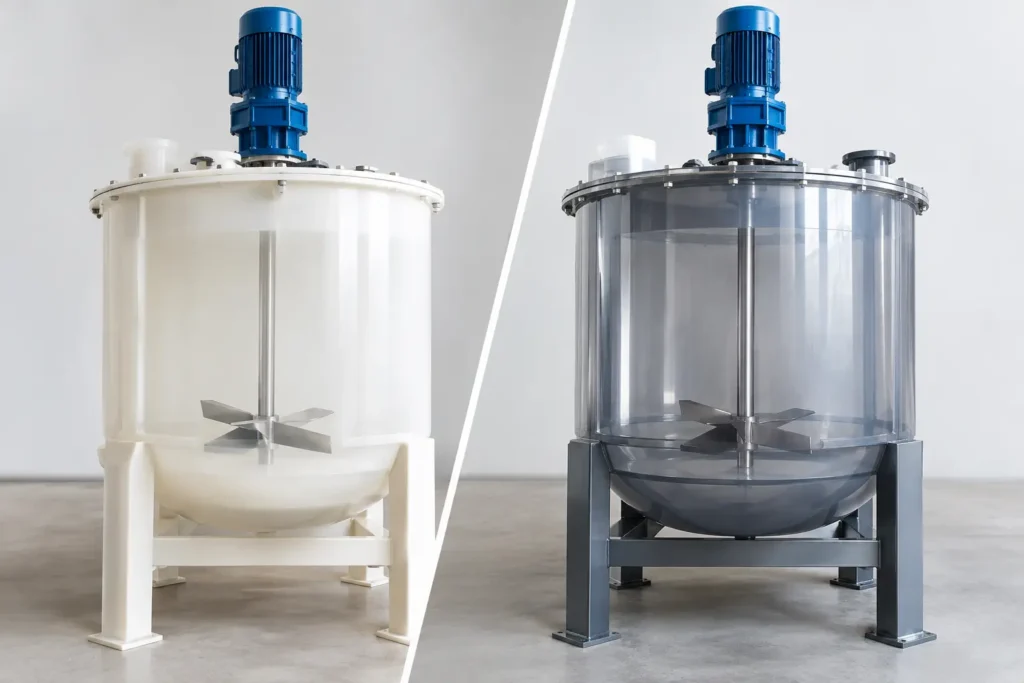
A PVC vs PVDF mixer decision is rarely settled by purchase price alone. In chemical feed, water treatment, metal finishing, and high-purity process lines, the mixer body is part of the containment boundary. A material that handles the fluid chemically but softens at operating temperature, creeps at a flange, or cracks after repeated thermal cycles can turn a simple inline installation into an avoidable shutdown.
For static mixers, injection quills, and polymer-bodied mixing assemblies, PVC and PVDF both have legitimate places in industrial service. The right choice depends on the actual process window: chemical concentration, temperature, pressure, vacuum exposure, line velocity, cleaning requirements, connection design, and the consequences of an unplanned leak.
PVC vs PVDF Mixer Materials at a Glance
PVC is the practical, cost-conscious choice for many ambient-temperature water and chemical applications. It is widely available, easy to fabricate, and compatible with a broad range of acids, bases, salts, and water-treatment chemicals. For a static mixer handling sodium hypochlorite, ferric chloride, caustic, or pH-adjustment chemicals within a controlled temperature and pressure range, PVC can provide reliable performance at a favorable installed cost.
PVDF is selected when the service becomes more demanding. It retains mechanical properties at substantially higher temperatures than PVC, offers excellent chemical resistance across a wider range of aggressive fluids, and is often preferred where purity, low extractables, or repeated cleaning cycles matter. Its higher material and fabrication cost is real, but so is its value in applications where PVC is close to its operating limits.
Neither material improves mixing performance by itself. Mixing quality still comes from element geometry, mixer length, flow regime, viscosity ratio, injection location, and pressure-drop allowance. Material selection determines whether that engineered mixer can stay in service safely and predictably.
Start With the Actual Chemical, Not the Chemical Family
Saying a process handles “acid” or “solvent” is not enough to specify a mixer. Chemical compatibility changes with concentration, temperature, contaminants, and exposure time. A material that performs well in a dilute acid at room temperature may not be suitable for a concentrated oxidizing solution at elevated temperature.
PVC performs well in many aqueous chemical duties. This makes it a common option for municipal and industrial water treatment, wastewater treatment, chemical dosing, scrubber systems, and general corrosive-process piping. It is often a strong fit where the liquid is water-based, temperatures remain moderate, and the system does not require high-purity fluoropolymer construction.
PVDF is more broadly capable with aggressive chemicals, including many solvents and oxidizing media that can challenge PVC. It is frequently specified for concentrated chemical service, semiconductor and high-purity process systems, specialty chemical production, pharmaceutical utilities, and applications involving demanding clean-in-place conditions. However, PVDF is not universally compatible with every chemical either. Strong bases at higher temperatures, certain polar solvents, and unusual process mixtures still require a material review.
The same discipline applies to chemical injection. The bulk carrier fluid may be benign, while the injected chemical creates a concentrated zone at the quill outlet and through the first mixing elements. That local exposure can control the material decision. A properly placed injection quill and correctly sized static mixer reduce chemical hot spots, but they do not eliminate the need to select materials for the worst credible concentration.
Temperature Is Often the Deciding Variable
Temperature separates many PVC and PVDF applications. PVC loses stiffness as temperature rises. Even when the fluid is chemically compatible, higher operating temperature can reduce pressure capability, increase creep at joints, and shorten long-term service life. A design that appears acceptable at room temperature should not be carried into hot process service without reviewing the derated pressure rating and the full operating cycle.
PVDF offers a wider temperature margin and maintains useful mechanical strength in services that exceed conventional PVC limits. That margin matters in batch processes with heat-up cycles, hot chemical transfer, recirculating loops, and systems cleaned with elevated-temperature water or chemicals. It also provides more confidence when the process may run hotter than its normal setpoint during upset conditions.
Do not select based only on the average temperature. Consider startup, shutdown, heat tracing, CIP exposure, summer ambient conditions, and the temperature at the injection point. The highest sustained temperature, not the normal control-room reading, should guide the material decision.
Pressure, Vacuum, and Mechanical Loading Matter
A mixer is not simply a section of pipe. Static mixing elements introduce pressure drop, and that pressure drop rises with flow rate, viscosity, density, and element count. The body, flanges, threaded connections, and supports must all be evaluated at the required operating pressure and temperature.
PVC works effectively in low- to moderate-pressure systems when piping support and connection practices are correct. Its lower cost can be especially attractive on large-diameter water-treatment lines or on skids with multiple chemical-feed branches. But PVC is more sensitive to mechanical abuse, impact, and sustained loading than PVDF. Poor pipe alignment, unsupported valve weight, overtightened connections, or repeated vibration can create stress concentrations that shorten service life.
PVDF generally offers greater toughness and better resistance to fatigue under demanding conditions. It is often the better choice where vibration, frequent thermal cycling, or more severe pressure conditions are present. That does not mean PVDF can be treated as indestructible. Polymer systems still need proper support spacing, compatible gaskets, controlled bolt torque, and realistic pressure-temperature design limits.
Vacuum service deserves separate attention. A line that sees pump suction, tank drawdown, draining, or blocked vent conditions may require a different design than a positive-pressure line. Evaluate the complete assembly, including the mixer housing, pipe wall, flanges, and any transition components, for external-pressure stability.
Purity, Cleanability, and Contamination Risk
PVC is a sound industrial material, but it is not always the preferred choice where product purity is a primary specification. High-purity water, electronic chemicals, pharmaceutical process fluids, and certain specialty formulations may call for PVDF because of its lower contamination risk, smoother available finishes, and established role in high-purity chemical handling.
PVDF can also be advantageous where the process must tolerate more aggressive cleaning agents. Repeated sanitation or CIP cycles impose both chemical and thermal stress, particularly at joints and dead zones. A mixer should be designed with cleanability in mind: suitable connection style, drainability where required, accessible geometry, and materials that match the cleaning protocol as well as the process fluid.
For sanitary or ultra-clean applications, do not assume a polymer mixer body is sufficient simply because the main fluid is compatible. Ask whether the mixing elements, seals, gaskets, injection quill, valves, and downstream piping create a consistent materials package. One mismatched component can become the limiting factor.
Cost Should Include the Cost of Being Wrong
PVC usually wins the initial-cost comparison. It is readily sourced, straightforward to machine and fabricate, and commonly available with standard industrial connections. For many ambient chemical-feed and water-treatment duties, choosing PVDF instead would add cost without delivering a meaningful operating benefit.
PVDF carries a premium in material cost and may require longer fabrication lead time for custom geometries or nonstandard connections. Yet its life-cycle cost can be lower when it prevents early replacement, reduces contamination risk, or avoids a process interruption in high-value production. The financial question is not whether PVDF costs more. It is whether the operating conditions justify paying for extra chemical, thermal, and mechanical margin.
A useful specification process identifies the fluid, concentration, minimum and maximum temperature, operating and upset pressure, flow range, viscosity, solids content, cleaning media, connection type, and required design life. With that information, an engineering team can evaluate PVC, PVDF, CPVC, PFA, lined steel, stainless steel, or specialty alloys without forcing a material into service because it is familiar or inexpensive.
Specify the Mixer as a Complete Assembly
The body material is only one part of the decision. For an inline static mixer, confirm the element material, housing schedule or wall construction, flange or union style, gasket selection, injection point, pressure drop, and support requirements. For a tank or portable mixer, review wetted shaft, impeller, seal, bearings, mounting hardware, and motor environment alongside the polymer components.
Custom static mixers are especially valuable when a standard PVC or PVDF unit does not fit the available spool length, flange pattern, chemical injection location, or target pressure drop. ProMixUSA engineers complete mixing systems around the process conditions, including material selection and connection options, rather than treating the mixer as an isolated catalog item.
The strongest material choice is the one with enough operating margin to handle normal production, cleaning, and foreseeable upset conditions without overbuilding the project. Provide complete process data early, and the PVC vs PVDF mixer decision becomes a controlled engineering choice instead of a field replacement waiting to happen.