
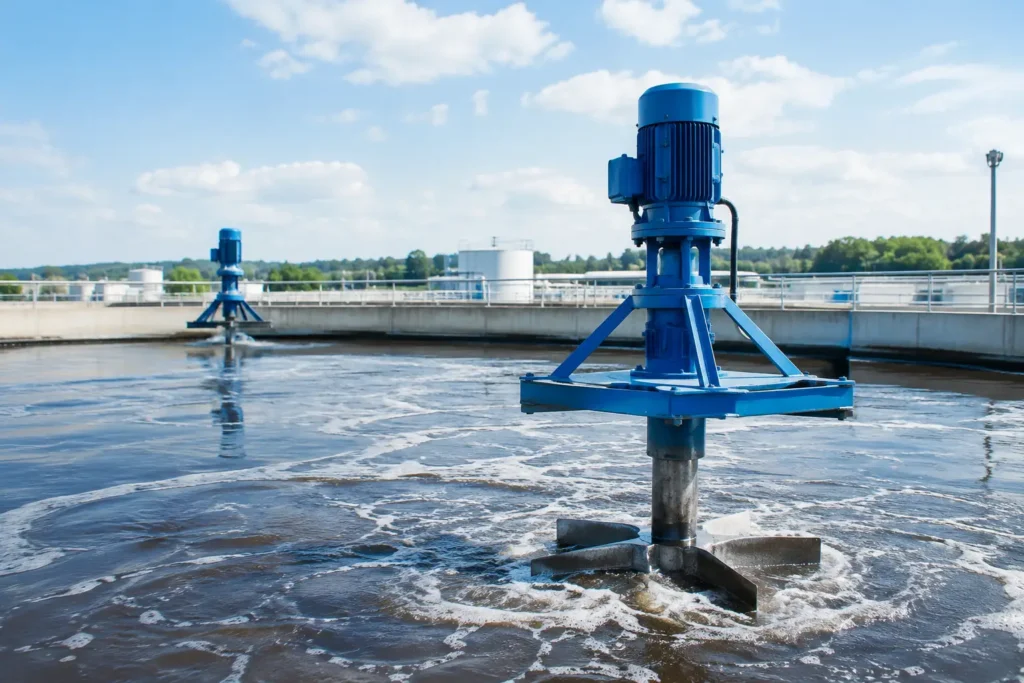
A wastewater tank can look adequately mixed from the surface while solids settle in corners, polymer forms fisheyes, or a coagulant short-circuits to the outlet. That is why selecting the best agitators for wastewater treatment is not a matter of choosing the largest motor or the highest impeller speed. The right unit must create the required bulk circulation, suspension, dispersion, or flocculation without damaging the process or consuming unnecessary power.
For municipal and industrial facilities, the answer depends on the treatment stage, tank geometry, solids loading, liquid viscosity, chemical compatibility, and the degree of shear the process can tolerate. A mixer that performs well in an equalization basin may be the wrong choice for a flocculation tank or anaerobic digester.
Best Agitators for Wastewater Treatment by Process Duty
Wastewater treatment rarely has one universal mixing duty. Reliable specifications begin by defining what the agitator must accomplish in each vessel.
Equalization and holding tanks
Equalization tanks require continuous or intermittent bulk blending to prevent stratification, keep suspended solids from depositing, and even out swings in pH, loading, temperature, and chemical oxygen demand. Slow-speed top-entry agitators with axial-flow impellers are often the preferred configuration for open or covered tanks with accessible center mounting.
Large-diameter, low-speed hydrofoil or pitched-blade impellers move significant liquid volume with comparatively low shear and efficient power use. They establish tank-wide circulation rather than a concentrated vortex near the shaft. For rectangular basins, offset mounting, multiple mixers, or directional submersible units may be more effective than a single center-mounted mixer.
Coagulation and rapid chemical dispersion
Coagulants such as ferric chloride, alum, lime slurry, or specialty metal salts must disperse rapidly after injection. This is a high-intensity, short-residence-time duty. A compact high-shear mixer can be appropriate when a chemical must be dispersed quickly into a sidestream before entering the main treatment flow.
In many applications, the better equipment package combines a properly positioned injection quill with an inline static mixer. Static mixers provide repeatable mixing at a defined flow rate with no rotating seals, motors, or maintenance-intensive wetted moving parts. They are particularly effective for continuous chemical feed lines where pressure drop is available and the process does not require tank-level solids suspension.
Flocculation basins
Flocculation demands the opposite approach. After coagulation destabilizes particles, the process needs gentle, controlled movement that brings particles into contact without breaking the floc that has already formed. Low-speed mechanical agitators with large impellers and modest tip speeds are commonly specified.
The design target is controlled velocity gradient, often expressed as G value, rather than maximum turbulence. Impeller selection, operating speed, basin baffling, and staged flocculation zones all influence performance. A high-shear mixer that succeeds in the coagulation step can destroy floc in the next tank.
Sludge storage, thickening, and digestion
Sludge presents a different hydraulic problem. Solids concentration, yield stress, ragging potential, gas generation, and changing viscosity can make conventional water-like mixing assumptions unreliable. Slow-speed top-entry mixers with high-torque gear drives and axial-flow impellers are frequently used in sludge storage and digestion vessels.
The goal may be complete solids suspension, temperature uniformity, prevention of crust formation, or consistent feed to dewatering equipment. In difficult sludge service, impeller diameter and torque reserve usually matter more than speed. Shaft design, seal selection, and bearing arrangement must also account for long operating cycles and abrasive solids.
Match the Mixer to the Tank, Not Just the Flow Rate
A quoted gallons-per-minute circulation rate does not prove that an agitator will mix a particular tank. Tank diameter, liquid height, bottom geometry, inlet location, outlet location, baffles, internal structures, and minimum operating level all affect circulation patterns.
For a round tank, a top-entry unit mounted near center with correctly sized baffles can produce predictable axial flow. Without baffles, liquid may rotate as a mass, forming a vortex while leaving dead zones near the floor and wall. In unbaffled wastewater tanks, an offset mixer location or an angled shaft can reduce swirl and improve vertical turnover.
Rectangular basins need equally careful analysis. Corners and long channel-like dimensions create areas where solids can accumulate. Multiple lower-horsepower mixers positioned to establish a circulation loop may outperform one large unit. For deep tanks, a lower impeller position or multiple impellers on one shaft may be required to reach the bottom zone.
This is where mixer simulation and application review add value. A credible design evaluates the actual vessel and operating conditions, not only the total tank volume. Computational modeling can identify dead zones, surface vortex risk, localized shear, and likely solids deposition before equipment is fabricated.
Select Impeller Geometry for the Required Shear
The impeller is the working end of the agitator. Motor horsepower alone says little about how a mixer will perform.
Axial-flow hydrofoil and pitched-blade impellers are generally favored for large-volume blending and solids suspension because they generate strong top-to-bottom circulation at relatively low power. They are a practical choice for equalization, storage, and many sludge applications.
Radial-flow turbines generate more localized turbulence and higher shear. They can suit rapid reaction or dispersion duties, especially in smaller vessels, but they are less efficient for broad tank turnover. Their use requires care when solids are fragile or when flocculation is the target.
High-shear rotor-stator mixers are designed for intense size reduction, emulsification, and dispersion. They are useful for certain polymer, chemical, and slurry preparation applications, but they are not a default replacement for a large tank agitator. In wastewater treatment, the right approach is often a combination: high shear for chemical make-down or sidestream conditioning, followed by low-shear bulk mixing in the process tank.
Materials, Seals, and Drives Are Process Decisions
Wastewater chemistry can be aggressive even when the tank contents appear ordinary. Chlorides, acids, caustics, oxidizers, hydrogen sulfide, ferric compounds, and cleaning chemicals can quickly expose poor materials selection. Wetted construction may range from 304 or 316 stainless steel to duplex alloys, specialty alloys, PVC, CPVC, PVDF, PFA-lined components, or other engineered materials.
The right material depends on concentration, temperature, contaminants, and expected upset conditions. A mixer suitable for neutral wastewater may not survive a chemical storage tank feeding that process. Specify all normal and abnormal chemicals, including cleaning solutions and residuals, before finalizing wetted materials.
Seal selection is equally important. Open tanks may allow a simpler arrangement, while enclosed vessels, odor-control systems, digesters, and hazardous chemical services can require more sophisticated sealing. Mechanical seals, dry-running capability, vapor containment, shaft guards, and corrosion-resistant hardware should be reviewed as part of the equipment package, not added after the mixer is selected.
Variable frequency drives are valuable when treatment flows and solids loadings change. They allow operators to reduce energy use during low-demand periods, increase circulation during solids accumulation, and tune flocculation intensity. However, a VFD cannot compensate for an undersized impeller or poor mixer placement.
Avoid the Most Common Specification Errors
The most costly error is sizing from tank volume alone. Two 50,000-gallon tanks can require very different agitation systems based on geometry, solids, viscosity, and the required process result.
Another common mistake is treating every wastewater duty as solids suspension. Some tanks need uniform concentration, some need rapid chemical dispersion, and some need gentle floc growth. Defining the duty in process terms prevents overmixing and undermixing.
Procurement teams should also avoid specifying only horsepower, RPM, and material. A complete agitator specification should identify vessel dimensions, working volume range, liquid properties, solids characteristics, operating temperature, chemical exposure, mounting arrangement, required mixing objective, controls, and any site constraints for lifting and maintenance.
Build for Serviceability and Delivery Certainty
Wastewater equipment is expected to run for years in wet, corrosive, and often difficult operating conditions. Maintenance access matters. Consider motor location, gearbox service, lifting clearance, shaft removal, impeller installation, spare-parts strategy, and whether the mixer can be serviced without taking an entire process train offline.
For standard applications, ready-to-ship equipment can reduce project risk. For unusual vessel geometry, corrosive chemical service, or demanding solids behavior, custom engineering is usually the stronger investment. ProMixUSA supports both paths with mechanical mixers, static mixing systems, chemical injection equipment, and application-specific material and connection options.
The best selection is the one that produces the required process result at the lowest practical lifecycle cost. Start with the treatment duty, validate it against the tank and fluid, then specify an agitator built to keep working when influent conditions stop behaving like the design basis.