
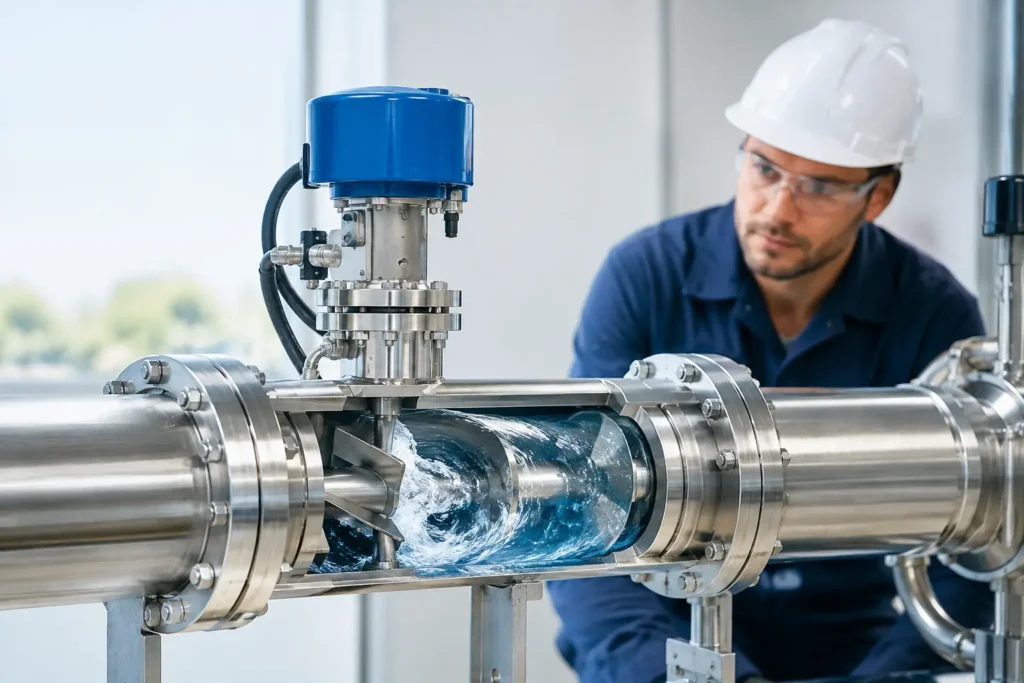
A static mixer that produces a clean sample at startup can still miss the required blend ratio, droplet size, or reaction consistency once the process reaches normal flow. Inline mixer performance is not determined by element count alone. It is the combined result of fluid properties, flow regime, injection geometry, available pressure drop, mixer design, and how closely the installed equipment matches the duty it was specified to handle.
For process engineers and plant teams, the practical question is not whether an inline mixer creates mixing. It does. The question is whether it produces repeatable mixing at the required throughput, over the full operating range, without imposing unacceptable pressure loss, maintenance exposure, or material compatibility risk.
What Inline Mixer Performance Actually Measures
Performance should be defined by the process result, not by the presence of a mixer body in the line. In a chemical dosing application, that may mean concentration uniformity downstream of an injection point. In an emulsification process, it may mean droplet-size distribution and stability. For pH adjustment, polymer activation, heat transfer, or gas-liquid contact, the useful measure changes again.
A properly specified inline mixer can improve distribution, radial mixing, axial dispersion control, and contact between process streams. Static mixer elements repeatedly divide, rotate, and recombine the flowing material. Mechanical inline mixers add energy through a rotating rotor, often where higher shear is needed. Neither approach is automatically better. The right selection depends on the mixing objective and the energy available from the process.
The key performance measures usually include blend uniformity, pressure drop, residence time distribution, shear exposure, throughput, and consistency across changing flow rates. These measures often compete. Increasing element length may improve uniformity, for example, but it also raises pressure loss. A high-shear mixer can reduce droplet size, but may damage shear-sensitive products or add maintenance requirements that a static design avoids.
Flow Regime Sets the Starting Point
The same mixer geometry behaves differently in laminar, transitional, and turbulent flow. This is why a design that performs well during water trials may not produce the same outcome with viscous resin, polymer solution, slurry, oil, or temperature-sensitive product.
In turbulent flow, momentum and turbulence support rapid blending. Static mixing elements create controlled splitting and redirection, accelerating the mixing process with relatively short installed lengths. Many liquid-liquid dilution and chemical injection duties fall into this category when line velocity is sufficient.
Laminar flow requires a different expectation. Viscous material does not naturally mix across the pipe radius simply because it travels farther downstream. The mixer must force the material through repeated divisions and reorientations. Element geometry, number of elements, viscosity profile, and flow rate become central to performance. A low-viscosity carrier and a high-viscosity additive can also create uneven results if the additive is introduced poorly or remains near the pipe wall.
Transitional flow deserves particular attention because it can be less predictable. A process may move between flow regimes as production rate, temperature, or viscosity changes. When that occurs, a mixer selected around one nominal condition may deliver variable results during startup, turndown, or seasonal temperature swings. Design for the actual operating envelope, not only the maximum stated flow rate.
Calculate With Real Fluid Data
Useful process data includes minimum, normal, and maximum flow; viscosity at process temperature; density or specific gravity; line size; allowable pressure drop; solids content; and the required quality target. For multi-stream systems, each stream needs its own flow and physical-property data.
Temperature is often the missing variable. A product that flows easily through a mixer at elevated temperature may become substantially more viscous during cold startup. If the mixer is designed only around the warm condition, pressure drop can rise sharply and blend quality can shift when the process is least forgiving.
Injection Location Can Make or Break the Result
An inline mixer cannot correct every upstream injection problem. If a reagent is injected into a stagnant zone, allowed to coat the pipe wall, or introduced as a poorly positioned large stream, the mixer must overcome a much more difficult starting condition.
The injection point should place the additive where it enters the primary flow effectively and where the mixer can act on it immediately. Injection quills are frequently used to control insertion depth and discharge location. Their design should account for pipe diameter, flow direction, pressure, corrosion resistance, and the chemistry being injected. A poorly selected quill can create vibration, erosion, plugging, or inconsistent distribution before the mixture reaches the first element.
For reactive chemicals, the distance between injection and static mixer matters. Too much open pipe can permit wall contact, localized reaction, or uneven concentration. Too little space can create mechanical interference or prevent a practical installation. The correct arrangement is application-specific, particularly for acids, caustics, hypochlorite, coagulants, polymers, and other aggressive or shear-sensitive chemicals.
Pressure Drop Is a Process Cost, Not a Footnote
Static mixers use the pressure energy already present in the flowing stream. That makes them compact, dependable, and free of rotating parts, but the energy is not free. Every element creates resistance. If the available differential pressure is limited, an aggressive element design or long mixer assembly may compromise pump capacity, control-valve authority, or total system throughput.
Pressure-drop calculations should be evaluated at the complete range of operating conditions. At minimum flow, the concern may be insufficient mixing energy. At maximum flow, the concern may be excessive pressure loss. With viscous fluids, a modest change in temperature or composition can materially affect the result.
This is where custom static mixer sizing has value. Pipe size does not have to dictate mixer diameter in every case. A reduced-diameter mixing section can increase velocity and mixing intensity, while an expanded section may lower pressure drop. Either choice introduces trade-offs involving pump load, connection configuration, cleanability, and solids-handling capability. There is no universal optimum.
Select Geometry for the Required Mixing Mechanism
Element design determines how the flowing streams are divided and redistributed. Helical elements, corrugated elements, plate-style designs, and custom geometries do not produce identical flow patterns. The best configuration depends on whether the duty calls for simple blending, viscous laminar mixing, liquid-liquid dispersion, gas dispersion, heat transfer enhancement, or reaction control.
A short static mixer may be sufficient for blending compatible low-viscosity liquids at stable flow. A difficult emulsion may require a high-shear inline mixer or a staged system combining controlled injection, static mixing, and mechanical shear. For polymer addition, too much shear can reduce product effectiveness. For immiscible fluids, too little shear can leave large droplets and unstable downstream separation.
Solids also change the selection criteria. Narrow passages may improve distributive mixing but can increase plugging risk with fibers, crystals, or suspended particulates. When clean-in-place service, sanitary processing, or frequent inspection is required, element accessibility and surface finish deserve the same attention as mixing intensity.
Materials and Connections Protect Long-Term Performance
A mixer can be hydraulically correct and still fail early if the wetted materials are wrong. Chemical concentration, temperature, chloride exposure, solvent compatibility, abrasion, and cleaning chemistry all influence material selection. Stainless steel is suitable for many duties, but it is not a default answer for every corrosive service. PVC, CPVC, PVDF, PFA-lined construction, specialty alloys, and sanitary materials each serve specific operating conditions.
Connections affect both installation quality and maintainability. Flanged, threaded, sanitary clamp, grooved, socket-weld, and custom connection options should match the plant standard and the service demands. A mixer installed with unnecessary reducers, abrupt elbows, or poor support can experience uneven inlet conditions, vibration, and service complications that were not visible on the original process sketch.
For high-consequence chemical injection, the assembly should be considered as a system: injection quill, isolation points, check valves where required, static mixer, pressure monitoring, support, and downstream sample location. This approach improves safety and makes performance verification far easier after startup.
Verify Performance in the Field
Commissioning should confirm the process result at representative operating conditions. Sampling immediately after the mixer is not always meaningful, especially when downstream pipe length, valves, or branches influence the final distribution. Establish a sample plan that reflects where the mixed stream actually matters.
Trend pressure drop, flow, temperature, concentration, and product-quality indicators. A rising pressure differential can indicate fouling, viscosity changes, or an unintended process shift. An unexplained reduction in differential pressure can also matter, particularly if bypassing, erosion, or altered flow paths are possible.
When the duty is complex, simulation and application review can prevent expensive trial-and-error changes in the field. ProMixUSA supports complete static mixing systems and application-specific mixer configurations for processes where repeatability, material compatibility, and delivery timing are critical.
The strongest inline mixing solution is the one that remains predictable when the operating conditions stop being ideal. Start with the process target, validate the full flow and viscosity range, and make every component from injection point to downstream sampling serve that target.