
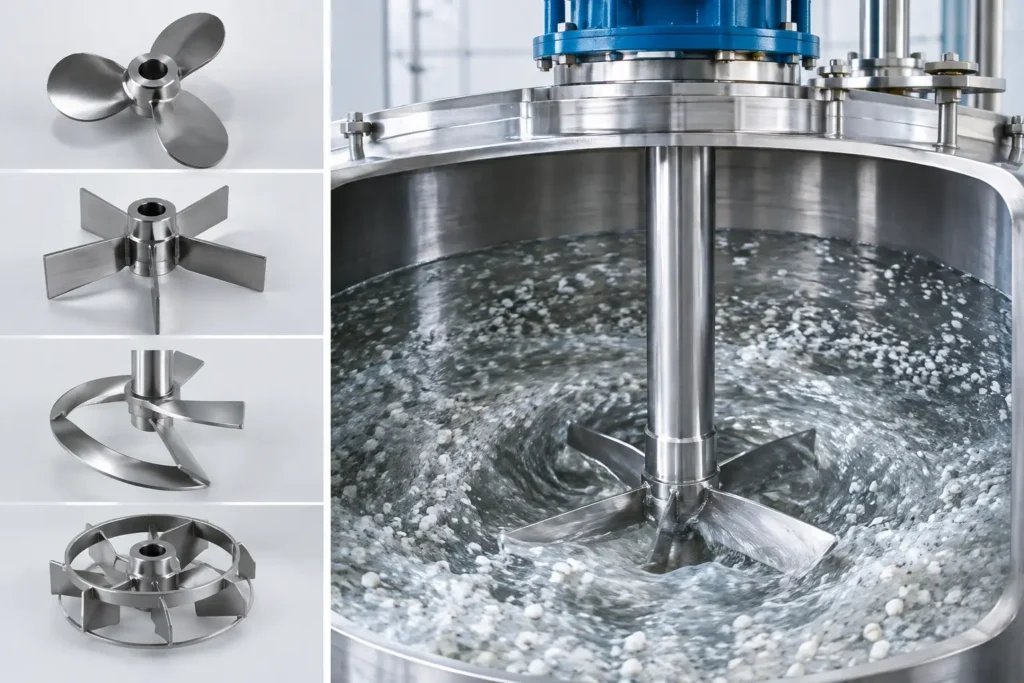
A tank can look well mixed while dense particles collect in the dish bottom, around supports, or beneath the impeller. Selecting the best impeller types for solids starts with that reality: surface movement is not proof of solids suspension. The right design must generate enough directional flow and local velocity at the tank floor to lift particles, keep them moving, and prevent a changing slurry concentration from disrupting downstream operations.
For industrial slurry service, impeller selection is a system decision. Particle size and density, solids concentration, liquid viscosity, vessel geometry, batch volume, and the required degree of uniformity all affect the answer. A geometry that handles light polymer beads can fail completely with abrasive mineral fines or fibrous solids.
Start With the Solids, Not the Impeller Catalog
The first question is whether the process requires complete off-bottom suspension or only enough agitation to prevent hard settling during a short hold period. Complete suspension is commonly defined by the point at which no solids remain stationary on the tank bottom for more than a brief interval. This condition requires more power than basic blending, and it is often the correct target for reactions, consistent feed slurries, crystallization, leaching, and batch transfer.
Particle settling behavior drives the selection. Large, dense, fast-settling particles need strong bottom-directed circulation and adequate impeller tip speed. Fine particles may remain suspended more easily, but they can increase apparent viscosity sharply at higher concentrations. Fibers, flakes, and irregular particles introduce another concern: they can wrap around shafts, bridge between blades, or accumulate in low-velocity regions.
Process engineers should also determine whether the solids must be dispersed, dissolved, wetted, or simply held in suspension. Those are different mixing duties. A high-shear dispersion head may break agglomerates effectively, for example, but it is not automatically the best primary impeller for circulating a high-volume slurry through a large tank.
Best Impeller Types for Solids by Mixing Duty
Hydrofoil impellers for efficient suspension
Hydrofoil impellers are often the first choice for low- to moderate-viscosity slurries where energy efficiency and high bulk circulation matter. Their contoured blades produce a strong axial flow pattern with less power draw than many radial designs. In a baffled tank, a down-pumping hydrofoil can drive liquid toward the bottom and outward across the vessel floor, creating the circulation needed to pick up settling solids.
Hydrofoils work particularly well for fine crystals, precipitates, polymer particles, and moderate-density mineral slurries. They are less forgiving when solids are very coarse, highly abrasive, or present at concentrations that push the batch into transitional or laminar flow. Blade thickness, material selection, and hub construction also matter in abrasive service, where erosion can change hydraulic performance over time.
Pitched-blade turbines for versatile slurry duty
Pitched-blade turbines remain a practical, proven choice for solids suspension. A 45-degree pitched blade can generate axial flow while tolerating a broad range of operating conditions. Compared with a hydrofoil, it generally consumes more power for the same circulation rate, but it can provide a useful balance of pumping, turbulence, and mechanical durability.
Down-pumping pitched-blade turbines are frequently specified when a process needs reliable floor sweep and suspension without extreme viscosity. They are well suited to general chemical slurries, wastewater solids, pigment intermediates, and applications where the feed characteristics vary from batch to batch. For taller tanks, multiple pitched-blade impellers on one shaft may be more effective than increasing the diameter or speed of a single unit.
Retreat-curve impellers for demanding solids loading
Retreat-curve impellers are engineered for slurry mixing where conventional blades can overload the drive or lose efficiency. Their curved blade profile supports axial pumping with a favorable torque characteristic as slurry density and solids loading rise. This makes them a strong option for mineral processing, abrasive suspensions, high-specific-gravity solids, and other services with substantial variation in slurry rheology.
The benefit is not only pumping capacity. In difficult slurry duty, retreat-curve designs can help manage the torque demand that determines gearbox, shaft, and motor sizing. That does not eliminate the need for a full mechanical review. High-density slurry service still requires attention to shaft deflection, bearing loads, seal selection, and startup conditions after a process interruption.
Anchor, gate, and helical-ribbon impellers for viscous slurries
When solids loading increases viscosity enough to limit turbulent circulation, large axial impellers alone may no longer deliver reliable results. Anchor and gate impellers move material near the vessel wall and improve heat transfer through the jacket. Helical-ribbon impellers provide more deliberate top-to-bottom turnover in highly viscous, non-Newtonian, or paste-like products.
These designs are common in adhesive compounds, filled polymers, coatings, sealants, food pastes, and concentrated chemical formulations. They operate at lower speed than turbines, but require substantial torque. A close-clearance design can reduce stagnant zones, although the vessel must be fabricated to maintain the necessary wall and bottom clearances without contact during operation.
In many heavy slurry applications, the most effective arrangement is a dual-motion system: an anchor or ribbon for wall sweeping and bulk movement, combined with a central disperser or axial impeller for localized mixing. The correct combination depends on whether the limiting issue is solids settling, powder incorporation, heat transfer, or agglomerate breakdown.
High-shear dispersers for wetting and deagglomeration
Sawtooth dispersers and rotor-stator high-shear mixers have a specific role in solids processing. They rapidly wet powders, reduce soft agglomerates, and improve dispersion quality in the zone surrounding the head. They are highly effective for pigments, fillers, thickeners, emulsions, and formulations where particle clusters create quality defects.
Their limitation is scale. A high-shear head creates intense local shear, not necessarily tank-wide circulation. For larger vessels or fast-settling solids, it often needs support from an axial-flow impeller or a recirculation loop. Specifying high shear when the real requirement is off-bottom suspension can lead to unnecessary energy use and an unmixed tank bottom.
Tank Geometry Can Change the Right Answer
Even the correct impeller geometry will underperform in the wrong vessel arrangement. Standard vertical tanks usually need baffles to prevent vortexing and convert rotation into useful circulation. Without baffles, the liquid can spin as a mass while solids remain settled or migrate into a central mound.
Bottom shape matters as well. Dished, cone-bottom, and flat-bottom vessels each create different low-velocity areas. Impeller clearance from the tank floor is especially important for solids suspension. Too high, and the flow may not reach the bottom with enough velocity. Too low, and the impeller can create excessive wear, reduce effective circulation, or interfere with drain geometry.
Tank diameter, liquid height, and impeller-to-tank diameter ratio must be evaluated together. Tall vessels often need two or more impellers spaced along the shaft to prevent stratification. Eccentric mounting may help in smaller unbaffled tanks, but it is not a substitute for an engineered solids-suspension design in production-scale service.
Size the Drive for Startup, Not Just Normal Operation
A mixer that runs acceptably after the slurry is moving may still fail at startup. Settled solids can form a compact bed with a much higher breakaway torque requirement than the normal operating load. This is one reason that motor horsepower alone is an incomplete selection criterion.
The drive train should account for slurry density, viscosity, impeller diameter, operating speed, and the worst credible startup condition. Gear reducers, shafts, couplings, bearings, and mechanical seals must carry the same duty. In abrasive or corrosive service, wetted materials should be selected for both chemical compatibility and wear life. Stainless steel may be suitable for some applications, while specialty alloys, lined designs, or polymeric wetted components may be required for others.
Variable-frequency drives add useful operating control, particularly when solids concentration changes by batch. They allow operators to use a higher speed to establish suspension and then reduce speed to the minimum level that maintains it. That approach can lower energy use and wear, provided the process has been validated across its expected operating range.
Specify Performance Around the Real Process
A useful mixer specification states more than tank volume and liquid viscosity. Include particle size distribution, particle density, concentration by weight or volume, settling observations, batch temperature, anticipated viscosity range, tank dimensions, bottom configuration, and the required result. If the product must remain homogeneous during transfer, include the transfer rate and draw-off location.
For critical applications, mixing simulation and pilot testing can reduce uncertainty before equipment is built. Computational modeling is valuable for comparing flow patterns, but it should be grounded in realistic slurry properties and verified where the cost of poor suspension is high. This is especially relevant for scale-up, where a design that succeeds in a pilot vessel may not produce the same circulation path in a production tank.
ProMixUSA engineers tank mixers around the complete mixing duty, including impeller technology, mounting configuration, shaft design, materials, and drive requirements. The practical objective is not simply to make the tank look active. It is to keep solids where the process needs them – suspended, dispersed, moving through the system, and ready for repeatable production.