
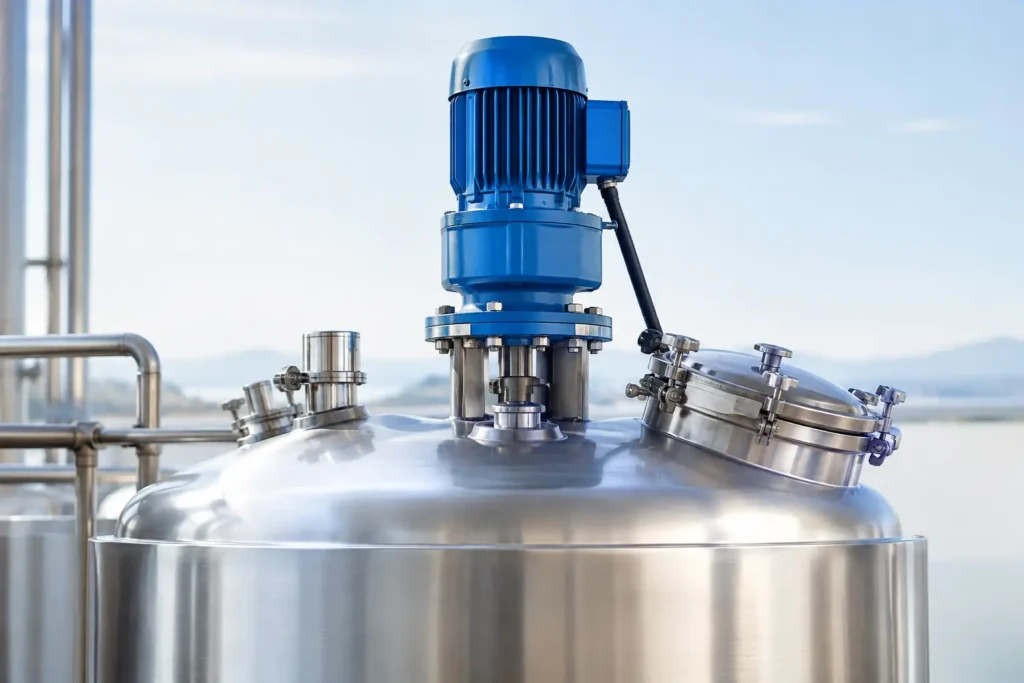
A top entry mixer selection can look straightforward until a tank develops a surface vortex, leaves solids on the floor, aerates a batch, or requires a rebuild far earlier than planned. The mixer is not an isolated purchase. Its performance depends on the vessel, product rheology, operating cycle, and the mechanical loads created by the selected impeller and shaft arrangement.
For process engineers and plant teams, the goal is not simply to move liquid. It is to produce a repeatable result at the required batch time, without excess energy use, product damage, seal failures, or unnecessary maintenance. A properly engineered top-entry unit can handle blending, solids suspension, heat transfer, reaction support, and liquid-liquid dispersion across a wide range of industrial duties. The right configuration depends on the job the fluid must perform in the tank.
Top Entry Mixer Selection Starts With the Process Result
Start with the required result, not motor horsepower or a familiar impeller style. “Mixing” can mean blending two miscible liquids, holding abrasive solids in suspension, dispersing a polymer, eliminating thermal gradients, or creating enough bulk circulation to support a chemical reaction. Those duties place very different demands on the equipment.
Blending low-viscosity liquids often requires strong bulk turnover throughout the vessel. A product with settling solids needs sufficient velocity near the tank bottom to prevent deposition. Gas dispersion or emulsification may require localized shear in addition to circulation. High-viscosity materials may move poorly through the tank even when the impeller is turning at a high speed, making impeller diameter, clearance, and shaft geometry more influential than speed alone.
Batch time is equally important. If a formulation must reach uniformity in 10 minutes, a mixer sized for a 45-minute blend is not an acceptable lower-cost option. Conversely, oversizing to force a short blend time can introduce vortexing, air entrainment, heat buildup, or shear damage. State the target concentration uniformity, allowable cycle time, temperature range, and whether the duty is continuous, intermittent, or variable-speed before sizing begins.
Define the Tank Before Choosing the Mixer
Tank dimensions control how an impeller transfers energy into the fluid. Diameter, straight-side height, liquid level range, bottom shape, and head configuration all affect circulation patterns. A mixer selected only from working volume can create acceptable results in one vessel and poor results in another with the same gallon capacity.
A tall, narrow vessel generally needs a different impeller arrangement than a wide, shallow tank. As liquid level changes, the distance between the impeller and surface changes as well, which can alter vortex behavior and mixing time. Dished, cone-bottom, and flat-bottom vessels each require attention to impeller elevation when solids suspension is part of the duty.
Baffles deserve early consideration. In many low-viscosity applications, properly sized baffles break rotational flow and convert it into useful top-to-bottom circulation. Without them, a high-speed mixer can form a deep vortex while leaving portions of the batch inadequately mixed. Some sanitary or portable vessels cannot use permanent baffles, so the mixer may need an off-center mount, angled shaft, or alternate impeller geometry. These are application decisions, not accessories to address after startup.
Match Impeller Geometry to Fluid Behavior
Impeller selection determines whether the mixer delivers flow, shear, or a controlled balance of both. Axial-flow impellers are commonly selected for bulk blending, solids suspension, and heat-transfer circulation because they move liquid vertically through the vessel. Radial-flow designs can provide higher localized shear and are often considered for dispersion duties, though they may require more power for a given bulk pumping rate.
For water-like fluids and moderate viscosities, hydrofoil or pitched-blade geometries can produce efficient circulation at lower power draw. For thicker products, close-clearance designs, anchor-style impellers, helical ribbons, or multiple impeller stages may be more appropriate. The transition from turbulent to laminar flow is especially important. A mixer that performs well with a thin solvent blend may not adequately turn over a high-viscosity resin, slurry, or polymer solution at the same rotational speed.
Particle characteristics also matter. Fine, low-density solids are not the same as coarse, dense, abrasive materials. The required just-suspended condition, settling rate, particle concentration, and risk of attrition should guide the impeller and speed selection. When product quality depends on preserving crystal shape or avoiding foam, aggressive shear is a liability rather than an advantage.
Size Speed, Power, and Shaft as One System
Motor power, gearbox ratio, shaft diameter, and impeller diameter must be evaluated together. Specifying horsepower first can lead to a mechanically capable package that does not deliver the required fluid movement. The better approach is to determine the fluid power needed for the process, then account for drivetrain efficiency, startup conditions, viscosity changes, and an appropriate service factor.
Variable frequency drives are often valuable when a process has multiple stages. A batch may need higher speed during initial addition, lower speed during hold, and controlled ramping to prevent surface drawdown. A VFD also gives operators room to respond to changes in raw-material viscosity or fill level. It does not correct a fundamentally unsuitable impeller, but it can make a well-engineered mixer more flexible in service.
Shaft design should receive the same attention as the motor. Long shafts, multiple impellers, high-density fluids, and high-speed operation create bending and critical-speed concerns. Excessive shaft deflection can shorten seal life, damage bearings, and produce vibration that operators notice long before a formal failure analysis is completed. A larger shaft is not automatically the answer, since increased stiffness, weight, and drive loads must be balanced within the complete mechanical design.
Specify Seals, Materials, and Mounting for the Actual Service
The wetted material must tolerate the product, cleaning chemistry, temperature, and potential upset conditions. Stainless steel is a common choice, but chlorides, strong acids, caustics, solvents, and high-purity service may require specialty alloys, PVDF, PFA-lined components, or sanitary construction. Material selection should include the shaft, impeller, wetted fasteners, seal faces, gaskets, and any tank nozzle interfaces.
Seal selection depends on pressure, vapor exposure, product lubricity, abrasiveness, and emissions requirements. A simple packing arrangement may be suitable for some open or low-risk applications. Mechanical seals are often needed where leakage control, pressure containment, or product protection is critical. For difficult services, evaluate dry-running risk, flush requirements, seal support hardware, and the maintenance access available around the tank top.
Top entry mounting offers strong mechanical support and direct access from above, but the available headroom can limit installation and service. Confirm nozzle size, flange rating, roof reinforcement, agitator lifting needs, and clearance for removing the drive or shaft. For tanks in hazardous locations, the motor, controls, and electrical classification must match the installed area. These details prevent an engineered mixer from becoming a costly field modification.
Provide Complete Application Data Early
A reliable quotation and design review require more than tank volume and liquid name. Process teams should provide the following information when available:
- Tank drawings with diameter, height, nozzle details, bottom profile, and normal liquid levels
- Fluid density, viscosity range, solids concentration, particle size, and temperature range
- Required mixing duty, batch time, operating schedule, and quality target
- Available utilities, electrical classification, control requirements, and installation constraints
- Chemical compatibility information for product, cleaning fluids, and possible upset conditions
If the application includes reactions, gas addition, viscosity changes, or heat-transfer jackets, include those operating details as well. A single mixer may be expected to support several process steps, and the governing condition is often not the normal operating point. It may be startup, maximum viscosity, minimum liquid level, or a short but demanding dispersion step.
Use Testing and Simulation When the Margin Is Tight
Standard mixer configurations are effective for many blending duties, particularly when tank geometry and fluid properties are well defined. Complex applications deserve a higher level of validation. Computational mixing analysis, scale-up review, or pilot testing can identify stagnant regions, excess surface turbulence, inadequate solids suspension, and uneven residence behavior before equipment reaches the plant.
This is particularly useful for large tanks, expensive batch materials, non-Newtonian fluids, and processes where off-spec production carries a significant cost. Simulation does not replace experienced application engineering, because input assumptions must reflect actual operating conditions. Used correctly, it gives the project team a clear basis for comparing impeller configurations, baffle arrangements, and operating speeds.
ProMixUSA supports this type of application-driven approach with top-entry mixers engineered around vessel geometry, fluid conditions, material compatibility, and required process performance. Ready-to-ship equipment can shorten routine replacement timelines, while custom configurations address specialized mounting, shaft, seal, and impeller requirements.
The most useful next step is to put the real process data beside the proposed mixer arrangement before issuing a purchase order. When the tank, fluid, mechanical design, and production target agree on paper, the first batch is far more likely to perform as planned.