
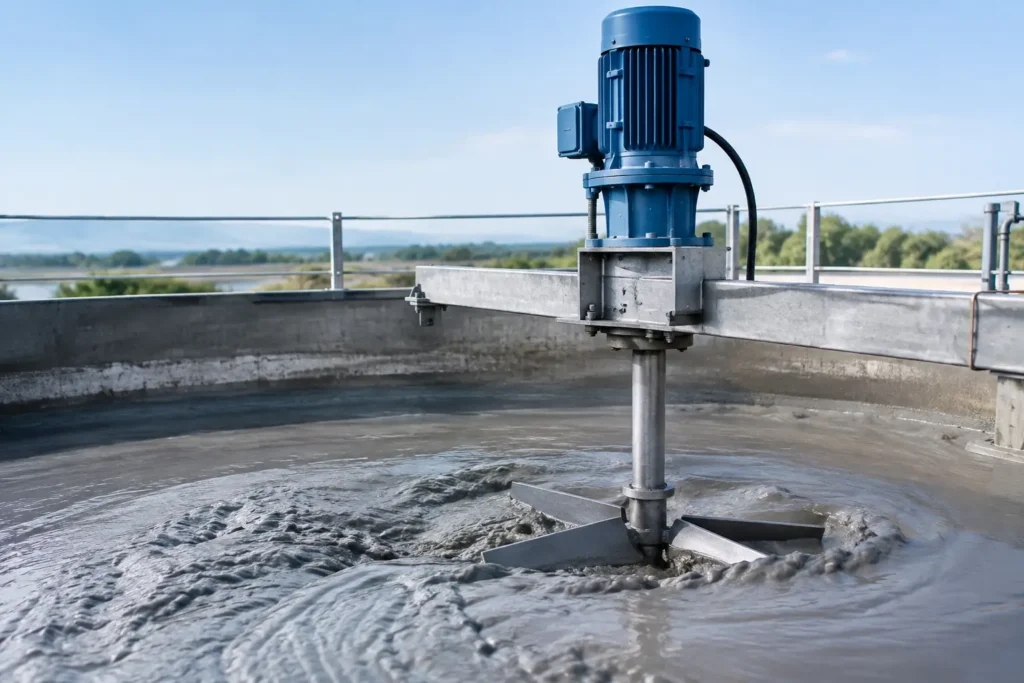
A slurry that looks uniform at startup can turn into a settled bed, a rotating surface vortex, or a stalled gearbox before the shift is over. The best tank mixers for slurries are not defined by motor horsepower alone. They are selected around particle settling behavior, slurry rheology, vessel geometry, required suspension level, and the equipment’s ability to withstand abrasive service.
For process engineers and plant operators, the target is usually specific: prevent solids from accumulating on the tank floor, keep concentration consistent at the outlet, promote dissolution or reaction, or maintain a pumpable feed. Each duty calls for a different mixing approach. A mixer that provides excellent blending in a low-viscosity liquid may perform poorly once solids concentration rises or particle size changes.
What Makes Slurry Mixing Different
Slurries combine a liquid carrier with suspended solids that may settle, float, agglomerate, dissolve, react, or erode equipment. Their behavior is affected by density difference between the solids and liquid, particle-size distribution, solids loading, particle shape, and fluid viscosity. Fine mineral solids in water do not behave like fibrous biomass, polymer powders, metal oxides, or dense catalyst particles.
The first selection question is not simply, “What mixer is best?” It is, “What suspension result is required?” Some processes require complete off-bottom suspension, where no particles remain stationary on the tank floor. Others only need partial suspension or uniformity near a withdrawal point. Designing every application for maximum agitation wastes energy and can accelerate impeller, shaft, and vessel wear.
A useful engineering reference is just-suspended speed, commonly expressed as Njs. This is the minimum impeller speed at which particles no longer remain on the bottom for more than a brief period. It is a starting point, not a complete design basis. A process may need higher speed for concentration uniformity, heat transfer, gas dispersion, reaction kinetics, or to break weak agglomerates.
Best Tank Mixers for Slurries by Mixing Duty
For most slurry suspension duties, a top-entry mixer with an axial-flow impeller is the strongest starting point. Axial impellers drive fluid downward and outward, creating the bulk circulation needed to sweep solids from the bottom and carry them through the tank. Pitched-blade turbines remain a practical choice for many medium-duty slurry applications, particularly where the process needs dependable circulation and moderate shear.
High-efficiency hydrofoil impellers can move substantial liquid volume with lower power draw than more conventional turbine designs. They are often well suited to lower-viscosity slurries with moderate solids loading, provided the particles are not so large or abrasive that blade durability becomes the limiting factor. Their value is in bulk flow, not aggressive particle size reduction.
For dense, settling slurries, larger-diameter axial impellers running at lower speed frequently outperform smaller, high-speed impellers. The larger impeller reaches more of the tank volume and produces stronger bottom circulation. That approach can reduce localized shear while delivering the torque needed to keep solids moving.
High-shear mixers have a different role. They are effective when slurry preparation requires rapid wetting, powder incorporation, deagglomeration, emulsification, or fine dispersion. They should not automatically be treated as the main suspension device for a large tank. A high-shear unit may prepare the material near its rotor-stator head while a separate top-entry agitator maintains bulk circulation throughout the vessel. In demanding applications, this two-stage approach offers better control than forcing one mixer to perform every task.
Side-entry mixers can be effective in large storage tanks where top access is limited or where the vessel configuration makes a central top-entry shaft impractical. Their horizontal flow pattern can maintain circulation across large diameters, but nozzle position, impeller angle, and tank internals require careful review. They are not a drop-in substitute for every vertical slurry mixer.
Portable mixers are useful for smaller batches, temporary processing, pilot work, and formulation adjustments. For continuous production of abrasive or high-solids slurry, a permanently mounted mixer with the correct shaft support, sealing arrangement, and drive design is generally the more reliable investment.
Impeller Size, Speed, and Torque Must Work Together
Slurry mixing is often limited by torque rather than nameplate horsepower. As viscosity rises or solids concentrate, the mixer must overcome greater resistance at startup and during operation. A drive sized only for normal running conditions can trip, overload, or fail to restart after a shutdown when solids have settled.
Variable-frequency drives are especially valuable for slurry service. They allow operators to start at a controlled speed, establish circulation, and adjust agitation as solids loading or batch conditions change. They also provide a practical way to identify the lowest operating speed that meets suspension requirements, reducing unnecessary energy use and mechanical wear.
Impeller diameter should be selected in relation to tank diameter, liquid height, bottom shape, and the presence of baffles, coils, draft tubes, or internal piping. A mixer that works well in an open cylindrical tank may create dead zones in a tall, narrow vessel or around a heating coil. Bottom clearance matters as well. An impeller positioned too high can leave a settled cone below it; one placed too low may concentrate abrasion near the tank bottom and restrict circulation.
Multiple impellers are often required in tall tanks or where liquid height exceeds the effective pumping range of a single impeller. The lower impeller can sweep the bottom while an upper impeller maintains vertical turnover. This arrangement is particularly useful when the slurry must remain uniform from the bottom discharge to the liquid surface.
Vessel Geometry and Baffles Decide Whether Flow Reaches the Solids
A mixer does not operate independently from the vessel. In unbaffled round tanks, rotation can create a vortex that pulls air into the slurry while reducing useful circulation. Baffles interrupt rotational flow and convert more mixer energy into top-to-bottom movement. Their dimensions and placement must account for cleaning requirements, abrasive wear, and any process restrictions.
Conical-bottom tanks, dished-bottom tanks, and flat-bottom tanks each need different flow strategies. A conical bottom may help solids move toward discharge, but it can also form a concentrated zone that requires focused agitation. Flat-bottom tanks typically demand strong sweeping flow if dense particles settle quickly.
Inlet location matters. Feeding powder or dense solids directly into a poorly circulated region can create ropes, fish eyes, or compacted deposits that no mixer can quickly correct. The feed point should be coordinated with the impeller’s circulation pattern, especially when powders must wet out before they can be dispersed.
Build for Abrasion, Corrosion, and Maintenance Access
Slurry mixers live with wear. Abrasive particles can erode impeller leading edges, shafts, mechanical seals, bearings, and tank internals. Corrosive liquids add another layer of material-selection risk. Stainless steel may be appropriate for many applications, but it is not a universal answer. Alloy selection must reflect chlorides, pH, temperature, solids chemistry, and cleaning chemicals. Polymer-lined or specialty-alloy components may be required for aggressive service.
Seal selection is equally important. A standard mechanical seal may be sufficient for a nonhazardous, low-pressure slurry, while difficult chemical service may require an upgraded seal plan, dry-running protection, or a different mixer arrangement. The cost of a seal failure is not limited to parts replacement. It can include lost batch time, environmental exposure, cleanup, and safety risk.
Specify access for inspection and maintenance from the beginning. Shaft removal clearance, lifting points, gearbox service access, and spare-part availability can determine whether routine maintenance takes hours or creates a production outage. In abrasive service, planned replacement of wear components is preferable to waiting for a failure.
When Custom Engineering Is the Better Choice
Catalog mixers provide a dependable starting point, but slurry applications often deserve application-specific review. A custom solution may be necessary when the tank has unusual dimensions, high solids concentration, non-Newtonian rheology, multiple feed points, internal coils, strict sanitary requirements, or a hazardous operating environment.
Mixer simulation can clarify whether the proposed impeller creates complete circulation, where settling is likely to occur, and how changes in speed or geometry affect power demand. It is particularly valuable when the cost of an undersized mixer is a blocked discharge or inconsistent product, and the cost of an oversized mixer is excess energy, wear, and unwanted shear.
ProMixUSA supports slurry mixing projects with top-entry, side-entry, portable, and high-shear equipment configurations engineered around the vessel, process fluid, materials requirements, and operating objective. The strongest specification starts with real process data: particle density and size, solids percentage, viscosity range, tank dimensions, liquid level, temperature, and the exact definition of acceptable suspension.
The right slurry mixer should make the process predictable, not merely keep the tank moving. When the mixer, impeller geometry, tank internals, drive torque, and materials are matched to the actual duty, operators gain stable concentration, cleaner discharges, fewer shutdowns, and a system built to hold performance as production conditions change.