
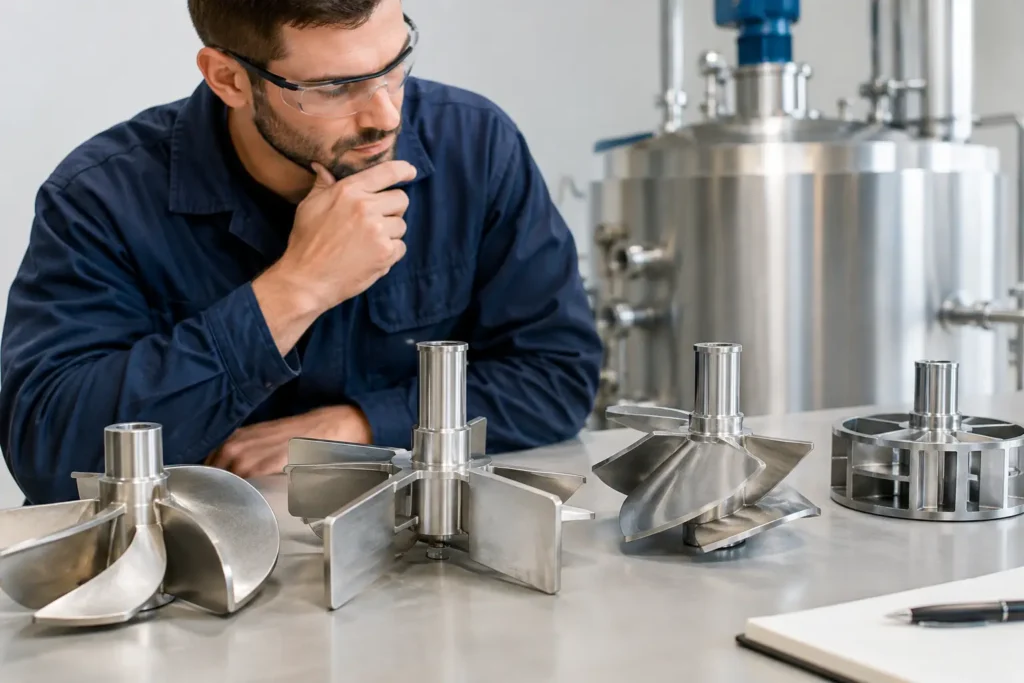
A tank mixer can have adequate motor horsepower, a properly sized shaft, and a quality seal yet still miss the process target because the impeller is wrong. When engineers ask how to choose mixer impellers, the answer begins with the required fluid movement, not with a familiar blade style or a nominal tank volume. The impeller determines circulation pattern, shear exposure, gas handling, solids suspension, and the power transferred into the batch.
A useful selection process connects the process duty to the fluid's behavior, then verifies that the impeller, vessel, drive, and materials work as one system. That is how a mixer moves from simply turning to delivering repeatable production results.
Start With the Mixing Duty
Define what must happen in the vessel before selecting geometry. Blending two miscible liquids, maintaining uniform temperature, dissolving powder, suspending settled solids, dispersing gas, and creating an emulsion are different duties. One impeller type rarely optimizes all of them equally.
For example, a low-viscosity chemical blend usually needs bulk turnover through the full vessel. A high-speed radial turbine may create intense local turbulence near the blades but leave upper and outer vessel zones under-circulated. Conversely, a large axial-flow impeller can produce strong top-to-bottom turnover with relatively moderate shear. For a polymer solution, that may be exactly the right result. For droplet-size reduction in an emulsion, it may not be enough.
Specify the acceptance criterion in process terms: blend uniformity within a defined time, no settled solids after a production hold, target particle or droplet size, complete heat-transfer uniformity, or a required gas dispersion rate. That criterion gives the engineering team a basis for selecting impeller style, speed, and installed power.
How to Choose Mixer Impellers by Flow Pattern
Impeller geometry generally produces axial, radial, or mixed flow. The best choice depends on where process energy must go.
Axial-flow impellers for turnover and suspension
Hydrofoil and pitched-blade designs push fluid parallel to the shaft axis. In a top-entry mixer, downward-pumping axial flow is common because it drives liquid toward the vessel bottom, outward along the floor, and back up the wall. This broad circulation loop is effective for blending, heat transfer, and keeping moderate solids from settling.
Hydrofoils are often selected where energy efficiency matters. Their streamlined blades can move high liquid volumes at lower power draw than a radial turbine. They are a strong fit for large batches, low-to-medium viscosity fluids, and processes where long operating hours make energy and mechanical loading meaningful cost factors.
Pitched-blade turbines provide an established, versatile axial-flow option and can tolerate a wide range of services. Their trade-off is generally higher shear and power demand than a hydrofoil at comparable pumping duty. That can be beneficial when the process needs more local turbulence, but it should not be treated as a free upgrade.
Radial-flow impellers for local turbulence and dispersion
Radial turbines discharge fluid perpendicular to the shaft. They are frequently used for gas dispersion, liquid-liquid dispersions, and applications needing concentrated turbulence near the impeller. A disc-style turbine can break gas streams into smaller bubbles, though its performance depends heavily on gas rate, liquid properties, impeller submergence, and baffle arrangement.
The trade-off is that radial flow does not naturally sweep the entire tank as efficiently as axial flow. Large vessels may need multiple impellers or a combined arrangement, such as an axial impeller for bulk turnover and a radial impeller near the gas addition point for dispersion.
High-shear impellers when particle or droplet reduction matters
High-shear rotors and rotor-stator systems are selected when the objective is more than blending. They are designed for emulsification, deagglomeration, wetting powders, and rapid dispersion of difficult ingredients. They create high velocity gradients in a defined processing zone.
That localized intensity comes with limits. A high-shear device may require adequate recirculation to expose the full batch to the shear zone, and it can add heat, entrain air, or damage shear-sensitive materials. For demanding emulsification or fine dispersion, an in-tank high-shear mixer may be paired with inline processing rather than expected to solve every stage alone.
Match Impeller Diameter and Speed to the Fluid
Viscosity changes the selection dramatically. Low-viscosity fluids readily form turbulent flow and respond well to conventional axial or radial impellers. As viscosity rises, fluid motion becomes more laminar, and the circulation created by a small, fast impeller may decay before it reaches the tank wall.
High-viscosity products often require larger-diameter, slower-speed impellers with blades shaped to sweep close to the vessel wall. Anchor, gate, helical ribbon, and similar close-clearance designs are built for this duty. They move material that would otherwise cling to the wall or rotate as a single mass with little internal mixing.
Do not evaluate speed by rpm alone. Tip speed, impeller diameter, fluid density, viscosity, and blade design collectively determine shear and power draw. Increasing rpm can improve dispersion, but it also raises shaft stress, seal demands, vortex risk, and the chance of aeration. Increasing diameter often improves bulk pumping more efficiently, provided vessel clearances and mechanical design support it.
Non-Newtonian fluids require added care. A shear-thinning material may appear highly viscous at rest but flow readily near the impeller. Yield-stress materials can develop stagnant regions unless the impeller creates sufficient stress throughout the vessel. These applications benefit from application data, pilot testing, or mixer simulation rather than a selection based on apparent viscosity from a single data sheet.
Account for the Vessel, Not Just the Product
The same impeller behaves differently in different tanks. Vessel diameter, straight-side height, bottom shape, liquid level range, nozzle location, and internal obstructions all influence the result. A mixer should be specified for the actual working volume, including minimum and maximum liquid levels, rather than only the nominal vessel capacity.
Baffles are especially important in low-viscosity top-entry mixing. Without them, a fast axial or radial impeller can form a vortex and cause the liquid to rotate with the shaft. That wastes energy, pulls in air, and reduces effective mixing. Standard baffles interrupt rotational flow and redirect it into useful circulation. In sanitary or difficult-to-clean vessels, alternative anti-vortex arrangements may be required.
Impeller elevation also matters. A bottom-mounted axial impeller improves lower-zone turnover and solids pickup, while multiple impellers are often necessary for tall tanks. As a practical rule, increasing liquid height relative to tank diameter increases the likelihood that one impeller will not adequately cover the full batch.
Select Materials and Mechanical Features for Service Conditions
The impeller must survive the chemistry, temperature, cleaning cycle, and operating environment. Stainless steel is common for general industrial and sanitary service, but chlorides, strong acids, caustics, solvents, and elevated temperatures may require upgraded alloys, polymer construction, fluoropolymer linings, or specialty materials.
Material selection also includes the shaft, wetted fasteners, hub, weld finish, and seal components. A corrosion-resistant impeller paired with an unsuitable shaft or elastomer is not a durable system. For food, beverage, pharmaceutical, and other hygienic processes, surface finish, cleanability, drainability, and sanitary connections should be specified as part of the impeller assembly.
Mechanical details deserve equal attention. Confirm shaft length and critical speed, impeller mounting method, allowable overhung load, seal type, gearbox service factor, and whether the mixer must operate under vacuum or pressure. Side-entry mixers, portable mixers, and magnetic-drive units each introduce different constraints that can affect impeller selection.
Avoid the Common Selection Shortcuts
Three shortcuts create many field problems: sizing from tank volume alone, copying an impeller from a different product line, and selecting the highest available horsepower as insurance. Volume does not describe viscosity, density, solids loading, or vessel geometry. A successful impeller on water-like material may fail completely on a shear-thinning slurry. Extra horsepower cannot correct poor flow direction and can create unnecessary wear or product damage.
Instead, provide complete application data: fluid properties across operating temperature, batch size, required mixing time, solids characteristics, gas or powder addition method, vessel drawing, available power, and material compatibility requirements. If the process includes multiple stages, identify each stage. A mixer that handles initial powder wet-out may need a different operating speed or impeller arrangement for final batch uniformity.
For complex duties, ProMixUSA can apply mixing expertise to align impeller technology, mounting configuration, and materials with the actual process constraints. The goal is not to sell the most aggressive mixer. It is to deliver the circulation, shear, and mechanical reliability the process requires.
The right impeller is the one that produces measurable process control without creating avoidable energy use, aeration, maintenance, or product damage. Start with the duty, verify the vessel and fluid behavior, and let the required flow pattern lead the selection.