
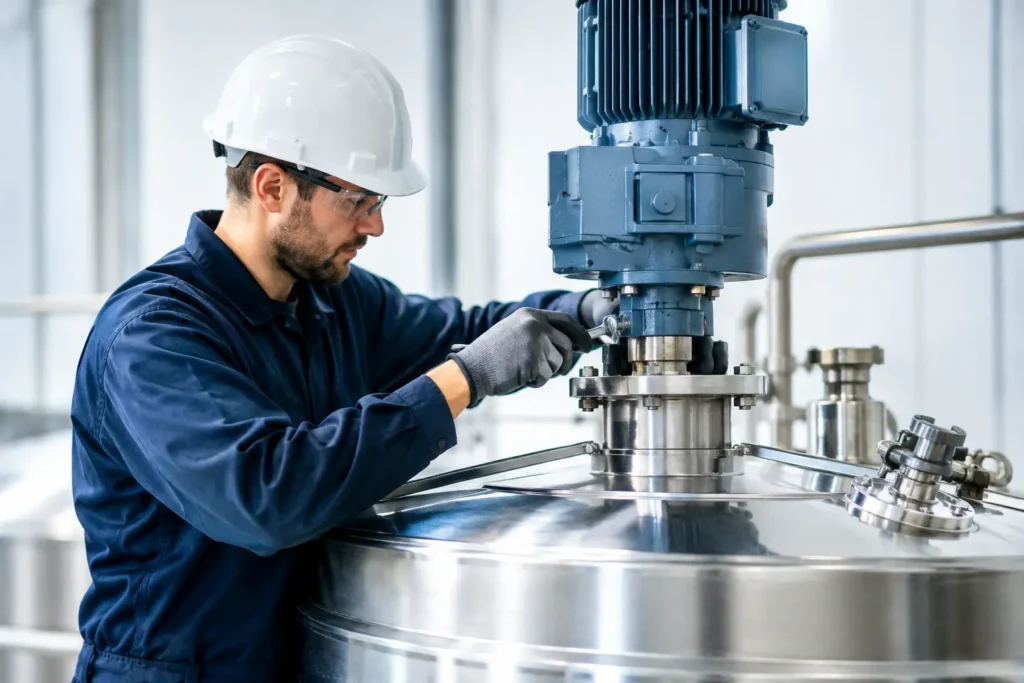
A tank mixer rarely fails without leaving evidence first. Increased vibration, a changing motor load, seal leakage, unusual gearbox noise, or longer batch times are operating signals that deserve attention before they become lost production. This tank mixer maintenance guide focuses on the mechanical and process checks that protect agitation performance in chemical processing, water treatment, food production, coatings, polymers, and other demanding plant services.
Maintenance intervals should never be copied blindly from another vessel or mixer model. A slow-speed top-entry mixer handling a clean, low-viscosity liquid has different wear mechanisms than a side-entry unit blending abrasive slurry, or a high-shear mixer producing a tight emulsion. The right program combines OEM requirements with actual duty cycle, fluid properties, vessel geometry, temperature, and operating history.
Start With Safe Isolation and Process Conditions
Before inspecting a tank mixer, isolate electrical energy, lock out and tag out the drive, and verify that stored energy has been released. Shut off associated chemical feeds, confirm the vessel is depressurized where applicable, and follow confined-space procedures if vessel entry is required. A rotating shaft, suspended assembly, or chemical residue can create serious hazards even after the motor is stopped.
Record the process condition before taking equipment apart. Maintenance personnel should know what was being mixed, the normal batch level, operating temperature, density, viscosity, agitator speed, and whether solids or gas are present. This context helps distinguish a mechanical fault from a process upset. For example, a motor drawing higher amperage may point to bearing damage, but it can also result from a viscosity increase, settled solids, impeller fouling, or an unexpected change in liquid level.
Tank Mixer Maintenance Guide: Build a Practical Inspection Schedule
A useful maintenance schedule has three levels: operator observations during operation, planned external inspections, and periodic shutdown work. The interval depends on service severity. Corrosive chemicals, abrasive solids, thermal cycling, frequent starts and stops, washdown exposure, and 24-hour operation all justify more frequent checks.
Every shift or weekly: Watch the operating signals
Operators are often first to detect a changing mixer. Check for abnormal sound from the motor, gearbox, coupling, or shaft. Listen for rumbling bearings, intermittent knocking, gear whine, and cavitation-like noise caused by vortexing or air entrainment.
Compare running amperage with the established baseline. A gradual change matters more than one isolated reading. Also inspect for seal drips, lubricant leaks, loose guards, unusual vibration, hot surfaces, and movement at the mounting structure. Document observations in a log that connects each reading to batch type and operating conditions.
Monthly or quarterly: Inspect accessible mechanical components
With the mixer safely isolated, inspect the motor, reducer, mounting plate, support structure, coupling, and exposed shaft. Check fasteners for loosening, corrosion, or evidence of fretting. Verify that guards remain secure and that the shaft turns smoothly by hand when the design and process condition allow it.
Inspect flexible coupling elements for cracking, compression set, worn teeth, or elastomer deterioration. Misalignment shortens coupling and bearing life, particularly on long-shaft top-entry mixers. If the mixer uses belts, inspect belt tension, pulley alignment, and belt condition. An over-tightened belt can overload motor and reducer bearings; a loose belt can slip, overheat, and produce inconsistent agitator speed.
Review gearbox lubricant level, color, and contamination. Milky oil suggests water intrusion. Metallic particles, burnt odor, or excessive darkening may indicate internal wear or overheating. Use the lubricant grade specified for the reducer and service temperature. More grease or oil is not automatically better – over-lubrication can raise bearing temperature and damage seals.
During planned shutdowns: Inspect wetted components
Planned shutdowns are the time to inspect the impeller, shaft, lower bearing or steady bearing assembly, and internal mounting hardware. Remove buildup that changes blade profile, increases drag, or creates an imbalance. In crystallizing, polymerizing, or solids-handling service, even a modest deposit can affect hydraulic loading and mixing circulation.
Inspect impeller blades for erosion, pitting, cracks, bent edges, and worn welds. Corrosion at blade-to-hub connections deserves close attention. Confirm that retaining hardware is intact and that the impeller has not migrated on the shaft. A loose impeller is both a performance issue and a major vessel-damage risk.
Check the shaft for straightness, corrosion, scoring, and wear at bearing contact points. Long shafts require careful attention because shaft runout can accelerate seal, bearing, and coupling failures. If a lower support bearing is used, inspect the bearing material and support bracket for chemical attack, abrasive wear, or product buildup.
Protect the Seal System From Early Failure
Mechanical seals are frequently blamed when leakage appears, but the seal is often reacting to another problem. Shaft runout, vibration, dry running, excessive vessel pressure, improper flush conditions, misalignment, and incompatible elastomers can all shorten seal life.
Inspect the seal area for leakage paths, crystallized deposits, discoloration, and heat damage. Verify that seal flush, barrier fluid, or quench systems are functioning as designed. A flush line that is plugged, incorrectly valved, or supplied at inadequate pressure can turn a minor maintenance issue into an unplanned shutdown.
Material compatibility is equally important. Seal faces, elastomers, and hardware must match the chemical, temperature, and cleaning regime. A seal that performs well in neutral water service may fail rapidly in solvent, caustic, oxidizing, or high-temperature operation. If seals repeatedly fail, review the entire operating envelope rather than replacing the same parts on the same schedule.
Use Vibration, Temperature, and Power Trends
Condition monitoring provides an early warning system for critical mixers. For high-value batches, continuous-process vessels, or difficult-access installations, baseline vibration and temperature data can be more valuable than a calendar-only maintenance plan.
Measure vibration at the motor and gearbox bearing locations using consistent points and operating conditions. Rising vibration can indicate imbalance, misalignment, loose mounting hardware, bent shafts, gear damage, or bearing degradation. A sudden increase after cleaning or product change may point to impeller buildup or a process condition that has altered hydraulic load.
Thermography can identify hot motor connections, overloaded drives, and abnormal bearing temperatures. Motor current trends add another useful signal. When vibration, temperature, and amperage all change together, maintenance teams have stronger evidence that intervention is needed. When only amperage changes, investigate the process side as well as the machine.
Keep Mixer Performance Connected to the Process
A mechanically sound mixer can still fail its production purpose. Verify actual agitator speed against the design requirement, especially after variable-frequency drive adjustments, motor replacements, or gearbox work. Confirm liquid level, baffle condition, impeller clearance, and direction of rotation. Reversed rotation can dramatically reduce pumping and blending performance on pitched-blade or hydrofoil impellers.
Watch for vortex formation, air entrainment, dead zones, solids settling, foam changes, and extended blend times. These conditions may require operational adjustments, but they can also reveal worn impellers, altered shaft position, damaged baffles, or an original mixer selection that no longer matches the process.
This is where application-specific engineering matters. Changes in batch size, viscosity, specific gravity, chemical formulation, or temperature can move a mixer outside its intended operating window. A review of impeller geometry, shaft design, mounting arrangement, and wetted materials may prevent recurring maintenance costs more effectively than repeated component replacement.
Stock the Parts That Actually Control Downtime
A maintenance storeroom should prioritize parts with predictable wear and long replacement lead times. For most tank mixers, that means the correct seal kit, coupling insert or element, critical bearings, gearbox lubricant, belts where applicable, and mounting hardware. Plants operating corrosive or abrasive service may also need spare impellers, shafts, or lower-bearing components.
Do not substitute components solely on physical fit. A near-match seal elastomer, coupling insert, or bearing arrangement can change chemical resistance, torque capacity, temperature capability, or alignment tolerance. Maintain accurate mixer records with model information, serial numbers, shaft dimensions, impeller configuration, seal materials, motor data, and installed spare-part numbers.
For custom-built systems, ProMixUSA can support maintenance planning with application-specific material selection, mixing configuration knowledge, and replacement components matched to the actual duty. That support is especially valuable when a plant has modified a vessel, changed chemistry, or inherited equipment with incomplete documentation.
Treat Repeat Failures as Engineering Evidence
If the same seal, bearing, coupling, or impeller problem returns, stop treating it as a routine replacement. Review failure timing, operating data, batch records, inspection findings, and any process changes that occurred before the event. Repeated failures usually indicate an unresolved load, alignment, chemical compatibility, or hydraulic issue.
The most effective maintenance program makes the mixer easier to trust: operators know what normal sounds like, technicians have meaningful trend data, and spare parts match the equipment and chemistry. That discipline protects more than the drive assembly – it protects the consistency of every batch the vessel produces.