
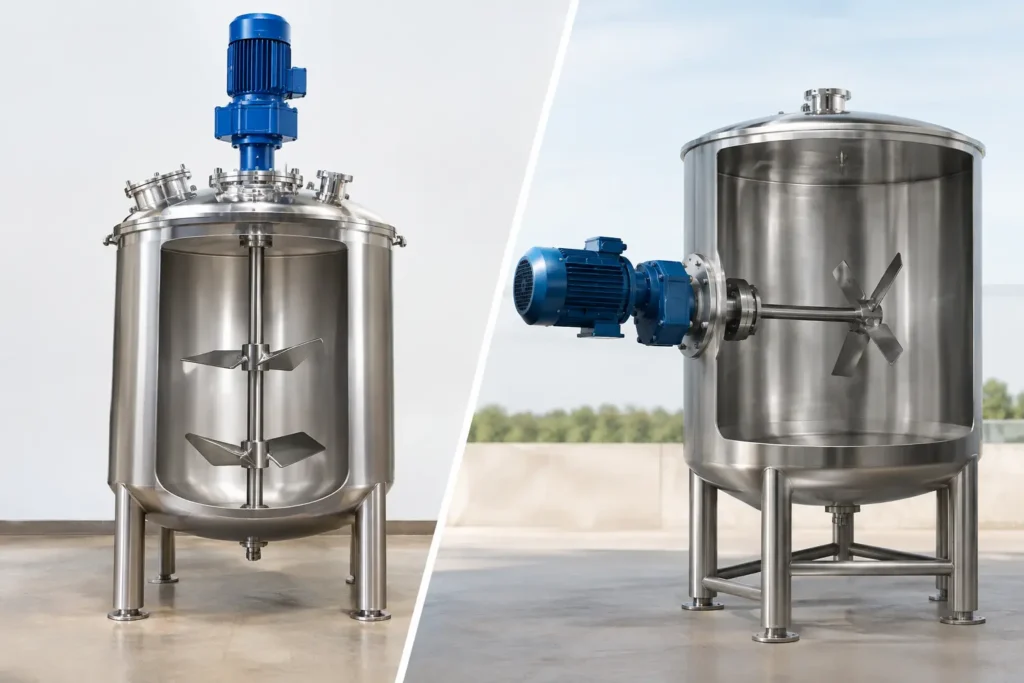
A top entry vs side entry decision is not a matter of mounting preference. It determines how momentum enters the tank, how reliably the batch turns over, where maintenance occurs, and whether the mixer can hold process performance as liquid level, viscosity, and formulation change. For industrial tanks, the wrong selection can leave dead zones, increase blend times, overload a drive, or turn a straightforward maintenance task into a shutdown event.
Both configurations can deliver dependable agitation when they are matched to the actual duty. The key is to start with the process objective, then work backward through vessel geometry, fluid properties, impeller hydraulics, and site constraints.
Top Entry vs Side Entry: The Process Difference
A top-entry mixer mounts through the tank roof, typically near the vessel centerline. A vertical shaft carries one or more impellers into the liquid, creating axial, radial, or mixed flow based on impeller selection and placement. This arrangement gives engineers substantial control over the flow pattern throughout tank depth.
A side-entry mixer mounts through the tank shell, usually at an angle that drives liquid around the vessel perimeter. Its horizontal shaft is normally shorter than a top-entry shaft, and it is commonly fitted with a high-efficiency axial-flow impeller. The resulting circulation pattern is particularly effective for large-volume, low-viscosity storage tanks.
The distinction matters because mixing is driven by fluid movement, not motor horsepower alone. A 10-horsepower mixer in the right location can outperform a larger unit that produces circulation in the wrong part of the vessel.
When a Top-Entry Mixer Is the Better Fit
Top-entry tank mixers are the more versatile choice for demanding batch processes. They can be engineered with multiple impellers at different elevations, allowing the system to overcome density gradients, suspend solids, distribute additives, and keep higher-viscosity fluids moving from top to bottom.
This flexibility makes top-entry designs well suited for chemical blending, polymer preparation, coatings, wastewater treatment, food and sanitary processing, slurry handling, and applications requiring controlled shear. A disperser blade, pitched-blade turbine, hydrofoil, or combination of impeller types can be selected around the process result rather than the mounting style.
Vertical control for difficult tank duties
A deep vessel with a large liquid-height-to-diameter ratio often benefits from vertical agitation. With multiple impellers, a top-entry mixer can create circulation zones along the shaft and limit stratification between upper and lower tank regions. This is especially valuable when a liquid must stay homogeneous through a long batch hold.
Top entry is also a strong option for solids suspension. Impeller clearance from the tank bottom, baffle arrangement, particle size, and settling velocity must all be considered, but vertical designs give engineers more ways to direct energy toward the tank floor. For powders, crystals, pigments, or mineral slurries, that control is often decisive.
Design considerations for top entry
The top-entry advantage comes with mechanical requirements. Long shafts must be designed around critical speed, deflection, bearing span, and impeller loading. Large mixers may require a substantial roof nozzle, support structure, bridge, or reinforced tank cover. Where vapor containment or pressure control is required, the seal system must match the service conditions.
Access above the tank is another practical issue. The plant needs sufficient headroom to remove the drive, shaft, and impeller assembly. On a mezzanine, inside a confined process building, or below existing pipe racks, installation and maintenance space can become a major part of the project scope.
Where Side-Entry Mixers Perform Best
Side-entry mixers are widely used on large storage tanks containing low-viscosity liquids such as fuels, oils, solvents, and similar products. Rather than pushing fluid downward through a long shaft, the mixer introduces a high-volume stream across the tank. That stream follows the tank wall and establishes bulk circulation over a large diameter.
For large tanks, one side-entry mixer may provide adequate turnover. Larger diameters or more demanding blending duties may require two or more units positioned at calculated elevations and orientations. Multiple mixers allow the system to maintain circulation while avoiding excessive power concentration at one point on the tank wall.
Efficient circulation in broad, shallow tanks
Side-entry mixers are often effective where tank diameter is large relative to liquid depth. The shorter shaft reduces some of the mechanical challenges associated with long vertical shafts, while axial-flow impellers can move high fluid volumes at relatively low shear. That combination can make side entry an efficient option for tank turnover, temperature uniformity, and prevention of stratification in bulk storage.
This does not mean side entry is automatically the low-cost answer. The mixer may be less expensive than a large top-entry unit in certain storage applications, but the tank shell nozzle, reinforcement, isolation equipment, and number of required mixers can change the installed cost. Comparing motor size alone misses the real project economics.
Shell penetration and maintenance planning
A side-entry mixer creates a penetration through the tank wall, so seal reliability and isolation strategy deserve close attention. Depending on the tank and mixer design, maintenance may require tank isolation, draining to a safe level, or a specialized service arrangement. Some systems are designed for in-service maintenance with isolation hardware, but that capability must be specified early rather than assumed.
The mounting elevation also matters. A side-entry impeller must remain adequately submerged at the lowest operating level. If the tank frequently runs near empty, the mixer can pull air, lose hydraulic efficiency, or create unwanted surface agitation. A top-entry configuration may offer more flexibility for variable liquid levels, depending on impeller location and duty.
Viscosity, Shear, and Product Sensitivity
Fluid viscosity is one of the fastest ways to narrow the choice. Side-entry mixers generally excel in low-viscosity services where bulk circulation is the primary objective. As viscosity rises, the flow field becomes more localized and the tank may require more torque, specialized impellers, closer wall clearance, or multiple mixing zones.
Top-entry configurations are usually easier to adapt for moderate and high-viscosity products because impellers can be staged along the shaft. For very viscous service, however, neither a conventional top-entry nor side-entry turbine should be selected by habit. Anchor, helical ribbon, close-clearance, or high-torque designs may be required.
Shear is equally important. A storage tank may only need gentle turnover, while an emulsion, dispersion, or powder-wetting operation may need concentrated high shear. A side-entry hydrofoil is generally selected for circulation rather than intense particle size reduction. A top-entry mixer can support more impeller options, but high shear may still require a dedicated rotor-stator or ultra-high-shear system.
Tank Geometry and Internals Can Decide the Outcome
No mixer should be selected without a clear view of the vessel. Diameter, straight-side height, bottom shape, roof geometry, liquid range, manways, heating coils, dip pipes, level instruments, and internal supports all influence the final design.
Top-entry mixers need room for the shaft and impeller path. Side-entry mixers need a clear discharge path and enough shell area for a properly located nozzle. In either case, poorly placed coils or internal piping can interrupt circulation and create stagnant pockets.
Baffles deserve special attention. In a top-entry tank, baffles often prevent vortexing and convert rotation into productive bulk mixing. Side-entry storage applications may use the tank wall and impeller angle to establish circulation, but internal features can still alter the flow pattern. When batch quality, solids suspension, or blend time is critical, mixer simulation can verify whether the proposed arrangement reaches every part of the vessel.
A Practical Selection Path
Start by defining the result the mixer must achieve: blend two liquids, prevent settling, maintain temperature, suspend solids, disperse gas, dissolve powder, or keep stored product uniform. Then document the minimum and maximum operating volume, viscosity range, density, solids loading, temperature, pressure, and chemical compatibility requirements.
Next, evaluate vessel constraints. A tall, narrow tank with changing viscosity and solids typically points toward top entry. A very large storage tank with low-viscosity liquid and a need for broad circulation may point toward side entry. But the geometry is only the beginning. Maintenance access, roof loading, shell reinforcement, electrical classification, seal requirements, and available crane access all belong in the selection review.
Finally, specify the equipment as a system. Motor, gearbox, shaft, impeller, seal, mounting flange, materials of construction, controls, and tank internals must work together. Stainless steel may be appropriate for sanitary or corrosive service, while specialty alloys, lined construction, or engineered polymers may be necessary for aggressive chemicals. A mixer that is hydraulically correct but materially incompatible is not a finished solution.
Choose the Mixer Around the Duty, Not the Catalog Category
Top entry is usually the stronger platform for complex batch mixing, solids suspension, viscosity variation, and multi-level flow control. Side entry is often the efficient choice for large, low-viscosity storage tanks where broad circulation and tank turnover are the primary goals. There is overlap, and that is where process data and engineering judgment matter most.
ProMixUSA helps industrial teams evaluate mixer geometry, materials, impeller technology, mounting requirements, and custom process constraints before equipment is released for fabrication. Bring the tank drawing, fluid data, and operating targets to the discussion. Those details turn a mounting decision into a mixing system that performs reliably on the plant floor.