
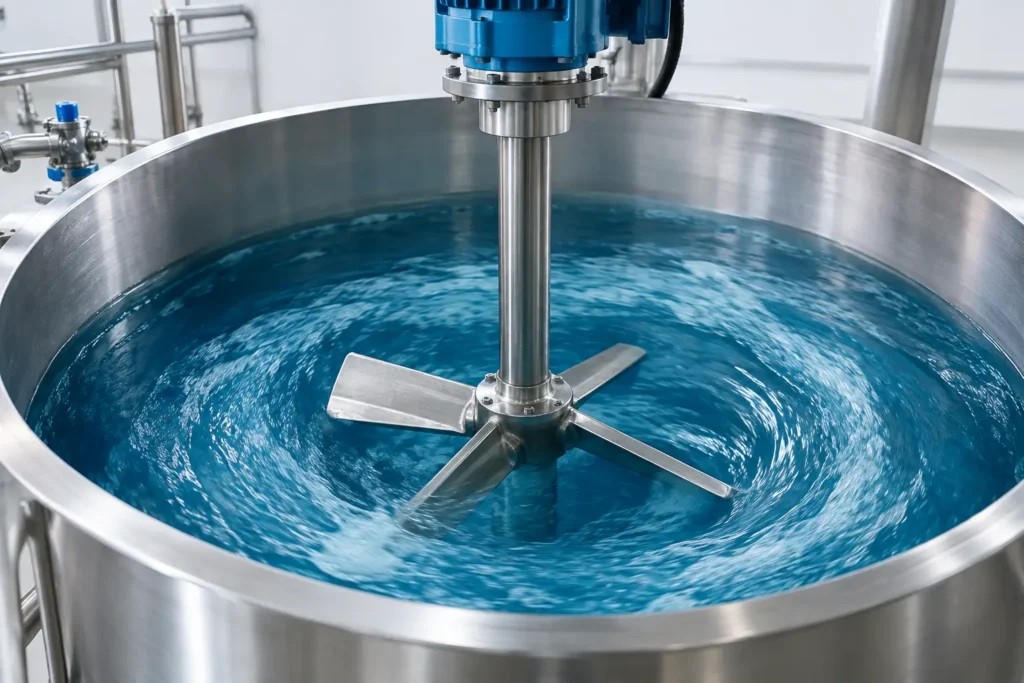
A tank can look fully mixed while the process is failing at the bottom, along the wall, or beneath the liquid surface. This tank agitation guide focuses on the variables that determine whether a mixer produces repeatable results: fluid behavior, vessel geometry, impeller selection, power input, mounting position, and materials of construction. The right equipment does more than turn a shaft. It creates the circulation, shear, suspension, or dispersion required by the process.
Start With the Mixing Duty
Tank agitation begins with a clear definition of what must happen inside the vessel. “Mixing” can mean blending two miscible liquids, dissolving powders, keeping solids suspended, dispersing gas, maintaining temperature uniformity, emulsifying immiscible liquids, or preventing settling during storage. These duties can require very different hydraulic conditions.
For example, a low-viscosity chemical blend may need broad top-to-bottom turnover at relatively modest shear. A polymer solution may demand slow-moving, high-torque agitation that reaches the vessel wall. An emulsion may require a combination of bulk circulation and a high-shear mixer or inline rotor-stator device. Selecting a mixer by horsepower alone is a common specification error because the same motor size can deliver dramatically different results with a different impeller, speed, or gearbox.
Define the process target in measurable terms. That may be blend time, concentration uniformity, particle suspension, droplet size, temperature variance, or batch-to-batch consistency. It also helps to identify the consequences of under-mixing and over-mixing. Some products tolerate long blend times. Others degrade, entrain air, foam, shear-sensitive solids, or lose product quality when exposed to excess agitation.
Fluid Properties Drive Mixer Selection
Viscosity is the first property most teams review, but it is not the only one that matters. Density, solids loading, particle size, settling rate, vapor pressure, temperature range, corrosiveness, and whether the fluid changes during the batch all affect the final design.
Low-viscosity fluids often respond well to axial-flow impellers that pump product downward or upward through the tank. These impellers create strong bulk circulation with efficient power use. In water-like fluids, the process may be turbulent, which supports rapid blending and solids suspension.
As viscosity rises, the flow regime can shift toward laminar behavior. In this range, a small high-speed impeller may simply churn product near the shaft while leaving stagnant material near the wall and tank bottom. Large-diameter, close-clearance impellers such as anchors, gates, or helical designs are often more appropriate for viscous batches. They move fluid near the vessel wall, where heat transfer and product turnover can otherwise become poor.
A single batch can also change character over time. Powder wet-out, reaction progress, cooling, evaporation, or solids addition can substantially increase viscosity. Specify the mixer for the hardest operating point, not only the initial liquid condition. If the product transitions from a thin liquid to a heavy slurry, the drive train must have sufficient torque reserve throughout the cycle.
Solids Suspension Is Not the Same as Blending
Suspending solids requires enough upward and radial fluid movement to prevent particles from remaining on the tank bottom. A tank may appear uniform from the surface while dense particles continue to settle below the impeller zone.
The required agitation depends on particle density, size distribution, concentration, and the acceptable amount of settled material. For some applications, complete off-bottom suspension is necessary. For others, preventing hard packing and maintaining pumpable slurry is sufficient. That distinction can change the required impeller type, mixer horsepower, and mounting arrangement.
Match the Impeller to the Required Flow Pattern
Impeller geometry determines how energy enters the fluid. The correct geometry should be selected around the mixing duty rather than selected from a standard equipment list.
Axial-flow impellers are commonly used for blending, heat transfer, solids suspension, and bulk circulation in lower-viscosity liquids. Their flow direction can be especially effective in baffled vessels because the discharge stream travels through the tank and returns to the impeller in a controlled circulation loop.
Radial-flow turbines produce more localized shear. They are often used where dispersion is important, including some gas-liquid and liquid-liquid mixing applications. They can be effective, but a radial turbine alone may not deliver the bulk turnover needed in a tall or large-diameter tank.
For demanding emulsification, dispersion, or particle deagglomeration, a high-shear mixer may be required. High shear is not automatically better. It consumes more energy and can increase heat generation, foam, air entrainment, and wear. In many systems, the most effective arrangement is a bulk tank mixer for turnover paired with an inline high-shear device for controlled processing of a recirculated stream.
Multiple impellers may be needed when liquid height is substantial relative to tank diameter. One impeller can leave weakly mixed zones above or below its pumping range. Staged impellers improve vertical circulation, particularly in tall vessels, viscous products, and solids-handling applications.
Tank Geometry and Mounting Can Make or Break Performance
A properly sized mixer can still perform poorly in the wrong vessel configuration. Tank diameter, straight-side height, bottom shape, liquid level range, internal coils, dip pipes, and nozzles all influence flow behavior.
Baffles are a major consideration in many low-viscosity applications. Without baffles, a centered top-entry mixer can create vortexing, where the liquid rotates with the impeller instead of circulating through the vessel. Vortexing can entrain air, create surface foam, and reduce mixing efficiency. Vertical baffles interrupt rotational flow and convert more of the mixer’s energy into useful circulation.
Not every tank can accept baffles. Sanitary vessels, mobile tanks, and certain corrosive services may require an alternative approach. Off-center mounting, angled mounting, or an appropriate impeller configuration can reduce vortex formation when fixed baffles are impractical.
Top-entry mixers are widely used because they can accommodate long shafts, multiple impellers, and a broad range of vessel sizes. Side-entry mixers can be a strong choice for large storage tanks where the objective is circulation, blending, or preventing stratification. Portable mixers are useful for smaller batches, pilot work, intermittent production, and facilities that need flexibility across multiple tanks.
Mounting also affects maintenance access. A specification should account for available overhead clearance, lifting requirements, shaft removal, seal service, and whether the vessel must remain in operation during planned maintenance.
Size the Drive for Torque, Not Just Motor Horsepower
Mixer sizing involves more than assigning a motor rating. The drive must supply the required torque at the required impeller speed, including startup conditions and changes in product viscosity. Gear reduction is frequently necessary to produce low-speed, high-torque operation for larger impellers or viscous materials.
An oversized motor does not correct a poor impeller selection. Conversely, a well-selected impeller can often reduce operating power while improving blend time and circulation. The goal is not maximum energy input. It is controlled energy input at the right location in the tank.
Variable frequency drives can add valuable process control. They allow operators to start gently, adjust speed as viscosity changes, reduce splashing at low liquid levels, and tune performance during product development. A VFD should be selected with the motor and hazardous-area requirements in mind, especially when the process handles flammable solvents or combustible materials.
Specify Materials, Seals, and Connections for the Actual Service
The wetted components must withstand the chemistry, temperature, cleaning method, and contamination requirements of the process. Stainless steel is common in sanitary and general industrial service, but it is not the universal answer. Chlorides, strong acids, caustics, solvents, and abrasive slurries may require specialty alloys, coated components, engineered polymers, or lined construction.
Seal selection deserves the same attention as the impeller. A standard single mechanical seal may be suitable for many closed-tank applications, while hazardous, volatile, toxic, or high-value product service can require a double mechanical seal, barrier system, or magnetic-drive configuration. The correct seal arrangement protects personnel, reduces product loss, and supports compliance requirements.
For sanitary processes, surface finish, cleanability, elastomer compatibility, and connection style matter as much as mixer capacity. For industrial chemical service, flange ratings, vapor containment, corrosion allowance, and equipment grounding may be more critical. The equipment should be engineered around the full operating envelope rather than a single nominal condition.
Use Testing and Modeling Before a Difficult Installation
When the process involves unusual rheology, multiphase behavior, tall vessels, large batch volumes, or strict quality requirements, engineering analysis can prevent expensive field changes. Mixer simulation can evaluate circulation patterns, dead zones, shear exposure, and expected blend behavior before equipment is fabricated.
This is particularly valuable when modifying an existing tank. Internal obstructions, legacy nozzles, limited mounting locations, and changing product formulations can make standard sizing rules unreliable. A modeled solution may show that a second impeller, a different mounting angle, or a revised baffle arrangement delivers better results than simply increasing motor size.
ProMixUSA engineers tank mixing systems around the actual process duty, including impeller technology, mounting style, shaft design, materials, seals, and custom vessel constraints. That approach helps facilities move from trial-and-error mixing to repeatable production performance.
The best next step is to collect accurate process data before requesting a mixer quote: tank drawings, working volume, fluid properties, temperature range, solids details, required blend time, cleaning needs, and area classification. Those details turn a mixer purchase into an agitation system designed to perform where it matters – inside the tank.